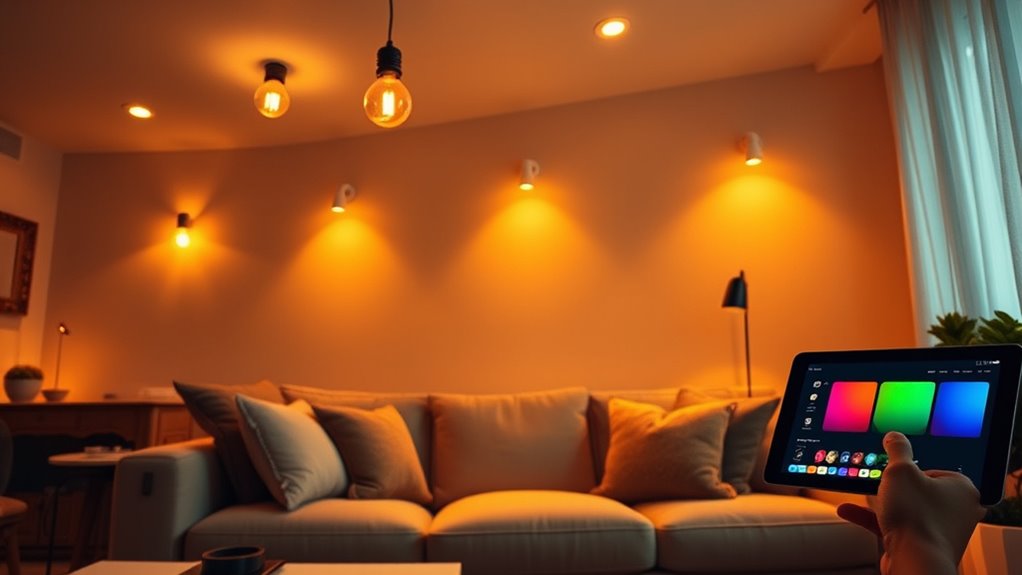

To set the mood with smart lighting, start by choosing color-changing bulbs compatible with your voice assistant or app. Use your voice or control app to select preset scenes or customize colors, brightness, and scheduling for different atmospheres. Sync your lights with music or timers to enhance the ambiance further. With simple adjustments and automation, you can easily create immersive environments that suit any occasion—discover more ways to elevate your space as you explore smarter lighting options.
Key Takeaways
- Use voice commands to easily change lighting colors, dim brightness, or activate pre-set scenes for different moods.
- Schedule lighting times and set adaptive brightness to create the perfect ambiance automatically.
- Customize lighting schemes with various colors and scenes to match your desired atmosphere or activity.
- Integrate smart bulbs with music or security systems for synchronized, immersive environments.
- Control and adjust lighting remotely via smartphone or virtual assistants for convenience and mood setting anytime.
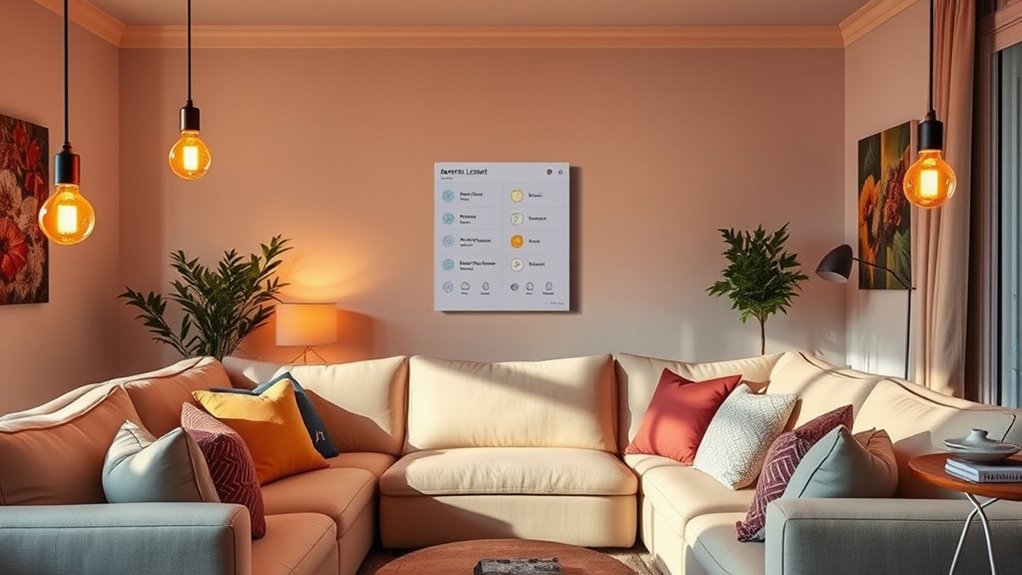
Have you ever wished your lighting could adapt seamlessly to your daily routines? With smart lighting, that wish becomes a reality. By integrating smart bulbs and controls into your home, you can effortlessly change the ambiance to suit any mood or activity. One of the most convenient features is voice control, which allows you to turn lights on or off, dim them, or even change colors just by speaking. Imagine arriving home after a long day and simply saying, “Set the living room to cozy,” and your lights respond instantly, creating the perfect environment without lifting a finger. Voice control makes managing your lighting intuitive, especially when your hands are full or you’re already settled into your evening routine. Plus, it’s compatible with popular virtual assistants like Alexa, Google Assistant, or Siri, so you can integrate it seamlessly into your existing smart home ecosystem.
Effortlessly control your home lighting with voice commands for a smarter, more comfortable living experience.
Beyond convenience, smart lighting markedly boosts your energy efficiency. Traditional bulbs tend to waste energy through unnecessary power consumption or when left on unintentionally. Smart bulbs, on the other hand, allow you to schedule lighting times, set brightness levels, and even turn lights off remotely. You don’t need to worry about forgetting to switch off the lights when you leave the room; you can do it from your phone or through voice commands. Many smart lighting systems also feature adaptive brightness, adjusting automatically based on the time of day or ambient light levels. This ensures you’re not wasting electricity while still maintaining a comfortable environment. Over time, these efficiencies can lead to noticeable savings on your energy bills and contribute positively to your household’s carbon footprint.
Setting the mood with smart lighting is straightforward and customizable. You can choose from a variety of colors and lighting schemes that match your preferences or specific activities. Whether you’re hosting a dinner party, relaxing with a book, or enjoying movie night, adjusting your lighting is as simple as selecting a pre-set scene or creating your own. You can even synchronize your lighting with music or home security systems for a truly immersive experience. The flexibility of smart controls means you’re never limited to static lighting; instead, you can craft the perfect atmosphere for every moment.
In essence, smart lighting transforms how you interact with your home’s environment. Voice control offers effortless operation, while energy efficiency helps you save money and reduce waste. Additionally, smart home integration enhances overall convenience and security, making your living space more responsive and adaptive to your needs. Combined, they give you the power to create dynamic, beautiful, and sustainable lighting that adapts perfectly to your lifestyle.
Frequently Asked Questions
Can Smart Bulbs Work During Power Outages?
During a power outage, smart bulbs typically won’t work unless you have backup power. Many smart bulbs rely on your home’s main electrical supply and won’t operate without power. To keep your smart lighting functional during outages, consider installing backup power solutions like uninterruptible power supplies (UPS) or battery backups. This way, you can control your smart bulbs even when the main power is out.
Are Smart Lighting Systems Compatible With All Home Automation Platforms?
Imagine your home as a symphony, each device playing in harmony. Your smart lighting system’s platform compatibility determines whether all instruments work together smoothly. While many smart bulbs support popular platforms like Alexa, Google, or Apple, not all devices integrate seamlessly. You’ll want to verify each product’s compatibility to guarantee effortless device integration, creating a cohesive and responsive environment that adapts effortlessly to your mood.
How Secure Are Smart Lighting Controls From Hacking?
You might wonder how secure smart lighting controls really are from hacking. While they use wireless security protocols to protect your system, vulnerabilities can exist if you don’t update firmware or use weak passwords. Hackers may exploit hacking vulnerabilities in poorly secured networks. To stay safe, make sure your Wi-Fi has strong encryption, change default passwords, and keep firmware current. This minimizes risks and keeps your smart lighting secure from potential threats.
Do Smart Bulbs Emit Blue Light That Could Affect Sleep?
They say, “Prevention is better than cure,” and it’s true for sleep health. Modern smart bulbs often emit blue light, which can impact your sleep by disrupting melatonin production. To minimize blue light impact, use dimmable or warm-colored settings in the evening. This helps reduce sleep disruption, ensuring your smart lighting enhances your space without interfering with your rest. Adjusting your lighting habits makes a big difference.
What Is the Average Lifespan of Smart Bulbs Compared to Traditional Bulbs?
You might wonder about bulb longevity and how smart bulbs compare to traditional ones. On average, smart bulbs last about 15,000 to 25,000 hours, which is longer than the 1,000 to 2,000 hours typical for incandescent bulbs. LED smart bulbs generally have a superior lifespan, making them a durable choice. So, when considering a lifespan comparison, smart bulbs offer markedly greater longevity, reducing replacement needs over time.
Conclusion
With smart lighting, you hold the key to transforming any space into an enchanting haven. By seamlessly integrating smart bulbs and controls, you can effortlessly craft the perfect ambiance for every moment—day or night. Don’t just settle for ordinary lighting; open a universe of infinite possibilities that make your home feel like a luxurious retreat. Embrace these innovative tools, and watch your environment become a masterpiece of mood and atmosphere, more breathtaking than you ever imagined.