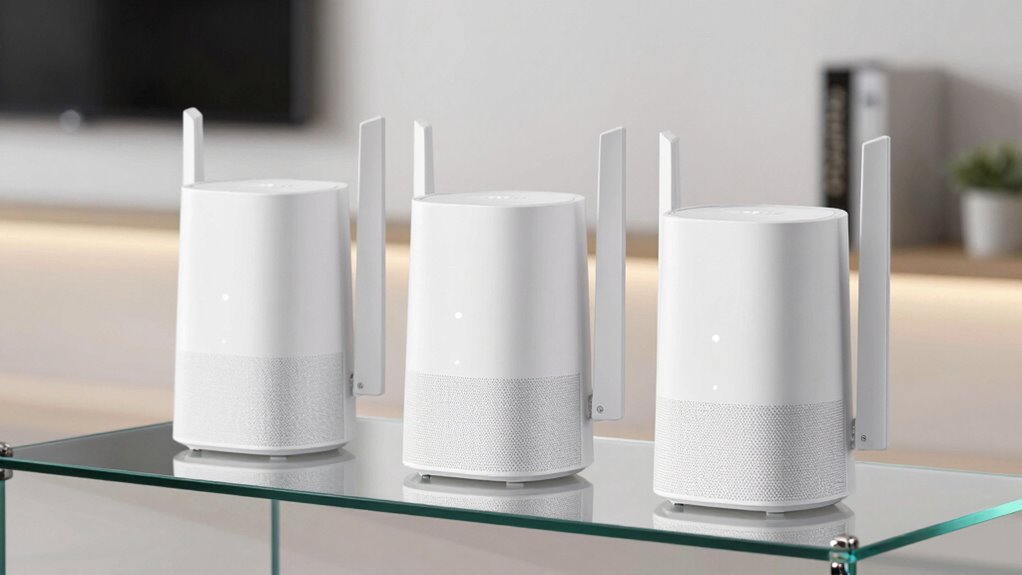

A tri-band mesh WiFi system 3-pack can extend wireless coverage across a larger home while giving mesh traffic another band to use. My best overall pick is the NETGEAR Orbi RBE773, which pairs WiFi 7 with a 2.5 Gig port and a stated coverage area of up to 8,000 square feet. The TP-Link Deco XE70 Pro is a standout for buyers seeking WiFi 6E, while the Deco 7 Pro WiFi 7 models suit households looking toward newer wireless standards. The main tradeoffs are WiFi generation, wired port capacity, system size, and whether a third unit will help your layout. Read on for the full comparison and guidance on choosing a system that fits your home and internet service.

Get furniture and decor delivered free with Prime
- Fast, free delivery on millions of items
- Prime Video, Amazon Music and more included
- Member-only deals all year
Complete the kit


Key Takeaways
- WiFi 7 choices lead on newer standards: The Orbi RBE773 and several Deco 7 Pro systems bring WiFi 7 to the lineup, but their stated speeds and port details differ, so check the exact model before choosing.
- WiFi 6E remains a distinct middle ground: The Deco XE70 Pro, Deco XE75, and ASUS ZenWiFi ET9 offer 6 GHz support without requiring a WiFi 7 system.
- A three-pack is not always the right configuration: The Orbi RBK663 is listed with a router and two satellites, while the Deco XE75 also appears as both a three-pack and a two-pack.
- Coverage figures are not direct performance guarantees: Models list different claimed coverage areas and device counts, but walls, floor plans, and node placement affect real results.
- Port and backhaul needs separate the contenders: The RBE773 lists a 2.5 Gig port, while some other listings emphasize high wireless speed without the same port detail; wired equipment and internet plans can make that distinction matter.
| NETGEAR Orbi Whole Home Tri-Band WiFi 6 Mesh Network System (RBK754P) – Router with 3 Satellite Extenders, Security Features, Coverage up to 10,000 sq ft, 75 Devices, AX5200 (Up to 5.2 Gbps) |  | Best for Maximum Coverage | Wi-Fi standard: 802.11ax Wi-Fi 6, tri-band | Combined speed: AX5200, up to 5.2 Gbps | Coverage: Up to 10,000 sq. ft.; expandable by 2,500 sq. ft. per satellite | VIEW ON AMAZON | See Our Full Breakdown |
| TP-Link Deco XE70 Pro AXE4900 Tri-Band WiFi 6E Mesh WiFi System, 3-Pack |  | Best for Wi-Fi 6E Value | Wi-Fi standard: Wi-Fi 6E, tri-band | Coverage: Up to 7,200 sq. ft. | Number of units: 3 | VIEW ON AMAZON | See Our Full Breakdown |
| Deco 7 Pro Tri-Band Wi-Fi 7 Mesh System, 10Gbps Internet, 3 Pack |  | Best for Wi-Fi 7 Coverage | Wi-Fi technology: Wi-Fi 7, tri-band | Total bandwidth: 14 Gbps | Coverage: Up to 8,100 sq. ft. | VIEW ON AMAZON | See Our Full Breakdown |
| Deco 7 Pro Tri-Band WiFi 7 BE10000 Whole Home Mesh System 6-Stream 10 Gbps |  | Best for Multi-Gig Wired Setups | Wi-Fi standard: Wi-Fi 7, tri-band | Coverage: Up to 7,600 sq. ft. | Streams: 6 | VIEW ON AMAZON | See Our Full Breakdown |
| NETGEAR Orbi Whole Home Tri-Band WiFi 6 Mesh Network System (RBK663) – Router with 2 Satellite Extenders, AX3800, Coverage up to 6,600 sq. ft., Supports 75 Devices |  | Best for Mid-Size Homes | Wi-Fi standard: Wi-Fi 6 (802.11ax), tri-band | Coverage: Up to 6,600 sq. ft. | Number of satellites: 2 | VIEW ON AMAZON | See Our Full Breakdown |
| TP-Link Deco XE75 AXE5400 Tri-Band WiFi 6E System, 3-Pack |  | Best Overall WiFi 6E Three-Pack | WiFi standard: WiFi 6E (802.11ax) | Bands: Tri-band: 2.4 GHz, 5 GHz, 6 GHz | Maximum speed: Up to 5,400 Mbps | VIEW ON AMAZON | See Our Full Breakdown |
| TP-Link Deco XE75 AXE5400 Tri-Band WiFi 6E Mesh System, 2-Pack |  | Best for Smaller Homes | WiFi standard: WiFi 6E (802.11ax) | Bands: Tri-band | Maximum speed: Up to 5,400 Mbps | VIEW ON AMAZON | See Our Full Breakdown |
| ASUS ZenWiFi Whole-Home Tri-band Mesh WiFi 6E System (ET9 3PK) |  | Best for High-Speed WiFi 6E | WiFi generation: WiFi 6E | Bands: Tri-band | Maximum speed: Up to 7,800 Mbps | VIEW ON AMAZON | See Our Full Breakdown |
| NETGEAR Orbi 770 Series WiFi 7 Mesh System, 3 Pack |  | Best WiFi 7 Upgrade | WiFi generation: WiFi 7 | Bands: Tri-band | Maximum speed: Up to 11 Gbps | VIEW ON AMAZON | See Our Full Breakdown |
| NETGEAR Orbi Tri-Band Whole Home Mesh WiFi System (RBK50) |  | Best for Basic Whole-Home Coverage | Listed WiFi technology: Tri-band WiFi 6; compatibility lists 802.11ac and 802.11ax | Listed speed: Up to 3 Gbps | Listed coverage: Up to 5,000 sq. ft. | VIEW ON AMAZON | See Our Full Breakdown |
| Deco 7 Pro BE14000 Tri-Band Wi-Fi 7 Whole Home Mesh System |  | Best for High-Capacity Homes | Wi-Fi technology: Wi-Fi 7 | Bands: Tri-band | Total bandwidth: Up to 14 Gbps | VIEW ON AMAZON | See Our Full Breakdown |
| NETGEAR Orbi Tri-Band WiFi 7 Mesh Network System (RBE773) – Router + 2 Satellite Extenders | | Best for Maximum Listed Coverage | Wi-Fi standard: Wi-Fi 7 (802.11ax, as listed) | Bands: Tri-band: 2.4 GHz, 5 GHz, and 6 GHz | Maximum speed: Up to 11 Gbps | VIEW ON AMAZON | See Our Full Breakdown |
| NETGEAR Orbi 370 Series WiFi 7 Mesh System, 3 Pack |  | Best for Wi-Fi 7 on a More Modest Speed Tier | Wi-Fi technology: Wi-Fi 7 | Number of units: 3-pack | Maximum speed: Up to 5 Gbps | VIEW ON AMAZON | See Our Full Breakdown |
| mesh wifi system tri band 3 pack | Coverage | Ports | Bands |
|---|---|---|---|
| NETGEAR Orbi Whole Home Tri-Ba | Up to 10,000 sq. ft.; expandable by 2,500 sq. ft. per satellite | — | — |
| TP-Link Deco XE70 Pro AXE4900 | Up to 7,200 sq. ft. | 9 total, including a 2.5 Gbps port | — |
| Deco 7 Pro Tri-Band Wi-Fi 7 Me | Up to 8,100 sq. ft. | 1 x 10 Gbps WAN, 1 x 2.5 Gbps WAN/LAN, 1 x USB 3.0 | — |
| Deco 7 Pro Tri-Band WiFi 7 BE1 | Up to 7,600 sq. ft. | — | — |
| NETGEAR Orbi Whole Home Tri-Ba | Up to 6,600 sq. ft. | — | — |
| TP-Link Deco XE75 AXE5400 Tri- | — | — | Tri-band: 2.4 GHz, 5 GHz, 6 GHz |
| TP-Link Deco XE75 AXE5400 Tri- | — | 6 total | Tri-band |
| ASUS ZenWiFi Whole-Home Tri-ba | — | 4 | Tri-band |
| NETGEAR Orbi 770 Series WiFi 7 | — | 7 | Tri-band |
| NETGEAR Orbi Tri-Band Whole Ho | — | 7 | Tri-band |
| Deco 7 Pro BE14000 Tri-Band Wi | 3,100 sq. ft. | 1 × 10 Gbps WAN, 1 × 2.5 Gbps WAN/LAN, 1 × USB 3.0 | Tri-band |
| NETGEAR Orbi Tri-Band WiFi 7 M | Up to 8,000 sq. ft. | 7 total, including a 2.5 Gig Ethernet port | Tri-band: 2.4 GHz, 5 GHz, and 6 GHz |
| NETGEAR Orbi 370 Series WiFi 7 | Up to 6,000 sq. ft. | — | — |
More Details on Our Top Picks
NETGEAR Orbi Whole Home Tri-Band WiFi 6 Mesh Network System (RBK754P) – Router with 3 Satellite Extenders, Security Features, Coverage up to 10,000 sq ft, 75 Devices, AX5200 (Up to 5.2 Gbps)
For a three-unit mesh setup where coverage is the main priority, the Orbi RBK754P leads this group with a stated reach of up to 10,000 sq. ft. and support for 75 devices. Its Wi-Fi 6 tri-band connection and AX5200 rated combined speed suit busy homes with simultaneous streaming, calls, and gaming, while Ethernet ports on the router and satellites give some devices a wired option. Compared with the TP-Link Deco XE70 Pro, it claims more coverage but supports fewer devices and lacks Wi-Fi 6E. The broad coverage figure comes with a practical caveat: obstacles and layout affect real reach, and the supplied description’s satellite count conflicts with the listed port total, so confirm the package contents before buying. App setup may also be less comfortable for hands-off buyers.
Pros:- Stated coverage of up to 10,000 sq. ft. is the largest in this five-product group.
- Tri-band Wi-Fi 6 with AX5200 combined speeds suits homes with concurrent streaming and gaming.
- Ethernet ports on the router and satellites support wired connections for compatible devices.
- Includes WPA2/WPA3, an advanced firewall, and a 30-day NETGEAR Armor trial.
Cons:- Supports up to 75 devices, fewer than the TP-Link Deco XE70 Pro and the Wi-Fi 7 Deco 7 Pro models listed here.
- The product title and description mention three satellites, while the supplied port total does not clearly match that configuration; verify what is included.
- Setup runs through the Orbi app and may be confusing for less technical buyers.
Best for: Owners of large, multi-room homes who want Wi-Fi 6 tri-band coverage, wired connections at satellite locations, and built-in network security.
Not ideal for: Households seeking Wi-Fi 6E or Wi-Fi 7, or buyers who need a clearly documented unit count before choosing a mesh kit.
- Wi-Fi standard:802.11ax Wi-Fi 6, tri-band
- Combined speed:AX5200, up to 5.2 Gbps
- Coverage:Up to 10,000 sq. ft.; expandable by 2,500 sq. ft. per satellite
- Maximum devices:75
- Router Ethernet:3 x 1 Gbps LAN ports
- Satellite Ethernet:2 x 1 Gbps LAN ports per satellite
- Security:NETGEAR Armor 30-day trial, WPA2/WPA3, advanced firewall
- Maximum upstream data transfer rate:2,400 Mbps
Our verdict“Choose the RBK754P if broad stated coverage and tri-band Wi-Fi 6 matter more than Wi-Fi 6E or a higher device limit.”
TP-Link Deco XE70 Pro AXE4900 Tri-Band WiFi 6E Mesh WiFi System, 3-Pack
The Deco XE70 Pro makes the most sense for buyers who want Wi-Fi 6E in a three-unit mesh kit without stepping up to Wi-Fi 7. Its 4.9 Gbps rated speed, coverage up to 7,200 sq. ft., and support for as many as 200 devices make it a more device-ready choice than the NETGEAR Orbi RBK663, which is rated for 75 devices and a smaller coverage area. The 6 GHz band can help compatible devices use less congested wireless capacity, but older phones and laptops cannot take full advantage of it. A 2.5 Gbps port and wired-backhaul support add flexibility, though the supplied port count does not specify how those ports are distributed. HomeShield Basic is included, while advanced configuration may take more effort than app-based setup suggests.
Pros:- Wi-Fi 6E tri-band adds access to the 6 GHz band for compatible devices.
- Supports up to 200 devices, substantially more than the NETGEAR Orbi RBK663.
- Stated coverage reaches 7,200 sq. ft. across the three-unit system.
- Includes a 2.5 Gbps port and wired-backhaul support for flexible network connections.
Cons:- Wi-Fi 6E benefits depend on having compatible client devices.
- The listed 4.9 Gbps is a combined rating, not the speed a single device should expect.
- Advanced network settings may feel involved for buyers who want minimal configuration.
Best for: Households with Wi-Fi 6E-capable phones or laptops, many smart-home devices, and a large home that needs three mesh nodes.
Not ideal for: Buyers with mostly older Wi-Fi devices who will not benefit from 6 GHz, or those who want extensive control without working through advanced settings.
- Wi-Fi standard:Wi-Fi 6E, tri-band
- Coverage:Up to 7,200 sq. ft.
- Number of units:3
- Maximum devices:Up to 200
- Ports:9 total, including a 2.5 Gbps port
- Security:WPA3, HomeShield Basic
- Processor:1 GHz dual-core
Our verdict“Pick the Deco XE70 Pro if you want a three-node Wi-Fi 6E system and a high device limit without moving to Wi-Fi 7.”
Deco 7 Pro Tri-Band Wi-Fi 7 Mesh System, 10Gbps Internet, 3 Pack
This Deco 7 Pro is the pick for buyers who want Wi-Fi 7 across a three-node system and a stated coverage area larger than the BE10000 Deco 7 Pro in this lineup. Its claimed 8,100 sq. ft. reach and support for more than 200 devices fit sprawling homes with many connected clients. The listed 14 Gbps total bandwidth is a system rating, not a guarantee of that speed on one device, but Wi-Fi 7 and multi-gig connectivity leave more room for newer equipment than the Wi-Fi 6E Deco XE70 Pro. Port selection is unusual: the data lists a 10 Gbps WAN port and a 2.5 Gbps WAN/LAN port, plus USB 3.0, rather than the four 2.5G ports listed for the BE10000. Buyers should match that layout to their wired needs, and plan for a separate modem.
Pros:- Wi-Fi 7 and 14 Gbps total bandwidth rating offer newer wireless technology than the Wi-Fi 6E Deco XE70 Pro.
- Stated coverage reaches 8,100 sq. ft., the broadest among the two Deco 7 Pro models here.
- Supports more than 200 devices for homes with dense connected-device counts.
- Includes a 10 Gbps WAN port, a 2.5 Gbps WAN/LAN port, and USB 3.0.
Cons:- The 14 Gbps figure is total rated bandwidth, not a per-device speed guarantee.
- The supplied port list offers fewer clearly specified multi-gig wired options than the BE10000 Deco 7 Pro.
- A separate modem is required, and the listed unit dimensions may make placement harder in compact rooms.
Best for: Owners of large homes investing in Wi-Fi 7 devices who want broad stated coverage and at least one 10 Gbps WAN connection.
Not ideal for: Buyers with no Wi-Fi 7 clients, limited space for larger units, or a need for several multi-gig wired LAN connections.
- Wi-Fi technology:Wi-Fi 7, tri-band
- Total bandwidth:14 Gbps
- Coverage:Up to 8,100 sq. ft.
- Number of units:3
- Device support:Over 200 devices
- Ports:1 x 10 Gbps WAN, 1 x 2.5 Gbps WAN/LAN, 1 x USB 3.0
- Security:TP-Link HomeShield
- Dimensions:4.23 x 4.23 x 6.93 inches
Our verdict“Choose this Deco 7 Pro if Wi-Fi 7, more than 200 device capacity, and the lineup’s largest stated Deco coverage area are your priorities.”
Deco 7 Pro Tri-Band WiFi 7 BE10000 Whole Home Mesh System 6-Stream 10 Gbps
Where the other Wi-Fi 7 Deco 7 Pro emphasizes a 10 Gbps WAN port and a larger coverage claim, the BE10000 stands out for four 2.5G WAN/LAN ports. That layout is useful for homes with multi-gig internet, wired access points, or several high-bandwidth devices that benefit from direct connections. It lists coverage up to 7,600 sq. ft. and support for more than 200 devices, making it a strong alternative to the NETGEAR Orbi RBK754P for buyers who need newer Wi-Fi 7 rather than Wi-Fi 6 and broad Ethernet options. Its 10 Gbps wireless speed is a rated maximum, not a promise for every client. Coverage is also lower on paper than the other Deco 7 Pro, and its advanced settings may ask more of less experienced users.
Pros:- Four 2.5G WAN/LAN ports offer more multi-gig wired flexibility than the other Deco 7 Pro listed here.
- Wi-Fi 7 tri-band system with a rated speed of up to 10 Gbps.
- Supports over 200 devices and coverage up to 7,600 sq. ft.
- Includes USB 3.0, AI roaming, HomeShield security, and VPN support.
Cons:- Its stated coverage is 500 sq. ft. less than the other Deco 7 Pro model in this batch.
- The 10 Gbps speed is a maximum rating and depends on compatible equipment and conditions.
- Advanced features may require technical know-how, and a separate modem is needed for internet service.
Best for: Wi-Fi 7 households with multi-gig internet or several wired devices that need multiple 2.5G network ports.
Not ideal for: Buyers whose main goal is the largest stated coverage area, or households that do not have Wi-Fi 7 or multi-gig equipment.
- Wi-Fi standard:Wi-Fi 7, tri-band
- Coverage:Up to 7,600 sq. ft.
- Streams:6
- Device support:Over 200 devices
- Ethernet ports:Four 2.5G WAN/LAN ports
- Other port:USB 3.0
- Features:AI roaming, HomeShield security, VPN support
Our verdict“Choose the BE10000 if multiple multi-gig wired connections matter more than having the largest coverage claim in the lineup.”
NETGEAR Orbi Whole Home Tri-Band WiFi 6 Mesh Network System (RBK663) – Router with 2 Satellite Extenders, AX3800, Coverage up to 6,600 sq. ft., Supports 75 Devices
The Orbi RBK663 suits buyers who want a three-unit Wi-Fi 6 tri-band system but do not need the expansive coverage claimed by the RBK754P. Its router-and-two-satellite layout is specified directly, with coverage up to 6,600 sq. ft. and support for 75 devices—a more modest footprint than the RBK754P’s 10,000 sq. ft. claim, while still offering more reach than many basic kits. WPA3 and NETGEAR Armor add a security layer, and the Orbi app handles setup and management. Compared with the TP-Link Deco XE70 Pro, the RBK663 has a lower device limit and no listed Wi-Fi 6E support, so it is less suited to a crowded household with newer devices. It also needs a separate modem or ISP gateway, and walls can cut into coverage.
Pros:- Router plus two satellites form a clearly described three-unit mesh system.
- Stated coverage of up to 6,600 sq. ft. suits many mid-size homes.
- Tri-band Wi-Fi 6 is rated for speeds up to 3.8 Gbps.
- Includes WPA3, NETGEAR Armor, and app-based setup.
Cons:- Its 75-device limit is well below the Deco XE70 Pro’s stated capacity of up to 200.
- Does not list Wi-Fi 6E or Wi-Fi 7 support.
- Requires a separate modem or ISP gateway, and walls or layout can reduce coverage.
Best for: Households in a mid-size home that want a clearly specified router plus two satellites, Wi-Fi 6 tri-band, and capacity for up to 75 devices.
Not ideal for: Owners of very large homes, households with more than 75 connected devices, or buyers who want Wi-Fi 6E or Wi-Fi 7.
- Wi-Fi standard:Wi-Fi 6 (802.11ax), tri-band
- Coverage:Up to 6,600 sq. ft.
- Number of satellites:2
- Maximum devices:75
- Ethernet ports:7
- Compatible internet providers:Cable, fiber, DSL, satellite
- Security and setup:WPA3, NETGEAR Armor; setup through the Orbi app
Our verdict“Pick the RBK663 for a mid-size home that needs a three-node Wi-Fi 6 mesh, but choose the Deco XE70 Pro for Wi-Fi 6E or a higher device limit.”
TP-Link Deco XE75 AXE5400 Tri-Band WiFi 6E System, 3-Pack
The Deco XE75 three-pack is my balanced pick for a large home that needs more than a basic router-and-extender setup. Its 6 GHz band can carry mesh traffic between units or serve compatible devices, helping reduce competition on the older bands. Coverage is listed at 7,200 sq. ft., and three LAN ports per unit give wired devices more connection options than the Orbi 770’s seven ports across its three units. The Deco app and AI-driven optimization also make this a more approachable fit than the higher-speed ASUS ZenWiFi ET9, whose setup may feel less straightforward. The tradeoff is that WiFi 6E is not the newest generation, and the coverage claim may be excessive for apartments or smaller homes. You will also need a separate modem for most internet services.
Pros:- Three units are rated to cover up to 7,200 sq. ft.
- Dedicated 6 GHz band can reduce interference and support mesh backhaul.
- Three LAN ports on each unit provide useful wired connections around the home.
- Deco app, AI-driven mesh optimization, and HomeShield security simplify network management.
Cons:- Requires a separate modem for most internet service.
- WiFi 6E lacks the newer capabilities of the WiFi 7 NETGEAR Orbi 770.
- Three units may be unnecessary for smaller homes or apartments.
Best for: Households with a large or multi-level home, several connected devices, and a mix of wired and WiFi 6E equipment.
Not ideal for: Apartment dwellers and buyers seeking the newest WiFi 7 generation; the three-unit coverage may be more than needed, and WiFi 6E is an older standard than WiFi 7.
- WiFi standard:WiFi 6E (802.11ax)
- Bands:Tri-band: 2.4 GHz, 5 GHz, 6 GHz
- Maximum speed:Up to 5,400 Mbps
- Listed coverage:Up to 7,200 sq. ft.
- Units:3
- LAN ports:3 per unit; 9 total
- Memory:512 MB RAM
- Security protocols:WPA2/WPA3-Personal
Our verdict“Choose the Deco XE75 three-pack for large homes that want approachable WiFi 6E coverage, but skip it if you need WiFi 7 or only have a small space to cover.”
TP-Link Deco XE75 AXE5400 Tri-Band WiFi 6E Mesh System, 2-Pack
This two-pack Deco XE75 makes the most sense when you want WiFi 6E mesh without placing three units around the house. It shares the same listed 5,400 Mbps tri-band capability and 6 GHz band as the XE75 three-pack, but its coverage is rated at 5,500 sq. ft., so the smaller set is a better match for a moderately sized home. The 6 GHz band can help compatible devices or mesh links avoid congestion on older bands, while the Deco app keeps setup simpler than the ASUS ZenWiFi ET9’s more involved setup may be. The main compromise is physical reach: compared with the three-pack XE75’s 7,200 sq. ft. claim, this package has less room for dead-zone control across spread-out or multi-level layouts. Older devices may not benefit from WiFi 6E, and you still need a modem for most internet providers.
Pros:- WiFi 6E tri-band design includes a 6 GHz band.
- Listed coverage of up to 5,500 sq. ft. suits many mid-sized homes.
- Deco app provides setup and network management.
- HomeShield security features are included.
Cons:- Two units offer less coverage headroom than the XE75 three-pack.
- Older client devices cannot make full use of the 6 GHz band.
- Requires a separate modem for most internet service.
Best for: Owners of moderately sized homes who want WiFi 6E mesh and app-based management without installing a third unit.
Not ideal for: People with large, long, or multi-level homes who need the extra placement flexibility and listed coverage of the Deco XE75 three-pack.
- WiFi standard:WiFi 6E (802.11ax)
- Bands:Tri-band
- Maximum speed:Up to 5,400 Mbps
- Listed coverage:Up to 5,500 sq. ft.
- Units:2
- Ports:6 total
- Control method:Deco app
- Warranty:2 years
Our verdict“Pick this two-pack for a mid-sized home that needs WiFi 6E without a third node; choose the three-pack XE75 when your layout needs broader coverage.”
ASUS ZenWiFi Whole-Home Tri-band Mesh WiFi 6E System (ET9 3PK)
The ASUS ZenWiFi ET9 three-pack is the speed-focused WiFi 6E option here, with a listed combined rate of up to 7,800 Mbps and coverage up to 7,800 sq. ft. That makes it a stronger fit on paper for homes with compatible devices and demanding local network use than the TP-Link Deco XE75, which is rated up to 5,400 Mbps. AiMesh compatibility also gives ASUS owners a path to incorporate compatible networking gear, while included security and parental controls add useful management tools. Those advantages come with a more involved setup experience, and WiFi 6E speeds depend on devices that can use the 6 GHz band. Compared with the NETGEAR Orbi 770, the ET9 remains on WiFi 6E rather than WiFi 7. The supplied product data also identifies this unit as renewed, making warranty and condition details important to verify.
Pros:- Listed combined WiFi speed reaches up to 7,800 Mbps.
- Three units are rated to cover up to 7,800 sq. ft.
- AiMesh compatibility can support expansion with compatible ASUS gear.
- Includes internet security and parental controls.
Cons:- Renewed condition may mean limited or uncertain warranty coverage.
- Setup may be more complex than the Deco XE75 app-led experience.
- Compatible WiFi 6E clients are needed to benefit from the 6 GHz band.
Best for: Tech-forward households with WiFi 6E devices that want high listed throughput, parental controls, and flexibility to use compatible AiMesh equipment.
Not ideal for: Buyers who want a straightforward setup, a confirmed full warranty, or WiFi 7; the renewed status and more complex setup may be a poor fit.
- WiFi generation:WiFi 6E
- Bands:Tri-band
- Maximum speed:Up to 7,800 Mbps
- Listed coverage:Up to 7,800 sq. ft.
- Units:3
- Ports:4
- Security protocol:WPA3
- Additional features:AiMesh compatibility, parental controls, lifetime free internet security
Our verdict“Choose the ASUS ET9 if you want the highest listed WiFi 6E speed in this group and can accept renewed-condition uncertainty and a potentially less simple setup.”
NETGEAR Orbi 770 Series WiFi 7 Mesh System, 3 Pack
For buyers who want a WiFi 7 three-pack rather than another WiFi 6E system, the Orbi 770 is the clearest step forward in this group. Its listed speed reaches 11 Gbps, with coverage up to 8,000 sq. ft. and support for up to 100 devices. That gives it more stated speed and coverage than the TP-Link Deco XE75 three-pack, although the Deco XE75 lists more total LAN ports: nine versus seven here. The Orbi app is designed to simplify setup, and 2.5 Gbps LAN bandwidth can suit a fast wired connection. The tradeoffs are a 100-device limit, a shorter stated return period, and an Armor security trial that becomes subscription-based afterward. WiFi 7 gains also depend on compatible client devices; older WiFi 5 and WiFi 6 gear remains supported.
Pros:- WiFi 7 with listed speeds up to 11 Gbps.
- Three-unit system is rated to cover up to 8,000 sq. ft.
- Supports up to 100 devices and is compatible with WiFi 5 and WiFi 6.
- Includes 2.5 Gbps LAN port bandwidth and Orbi app management.
Cons:- Seven ports provide fewer wired connection points than the Deco XE75 three-pack’s nine.
- NETGEAR Armor security is subscription-based after its trial.
- WiFi 7 benefits depend on compatible client devices.
Best for: Households planning a WiFi 7 upgrade, with a large home, newer compatible devices, and a need for high-speed wired networking.
Not ideal for: Buyers with mostly older devices, a need for many wired ports, or a preference for security features that do not shift to a subscription after a trial.
- WiFi generation:WiFi 7
- Bands:Tri-band
- Maximum speed:Up to 11 Gbps
- Listed coverage:Up to 8,000 sq. ft.
- Units:3
- Supported devices:Up to 100
- Ports:7
- LAN port bandwidth:2,500 Mbps
Our verdict“Choose the Orbi 770 for a large home ready for WiFi 7, but favor the Deco XE75 if you want more listed LAN ports or do not need the newer wireless generation.”
NETGEAR Orbi Tri-Band Whole Home Mesh WiFi System (RBK50)
The Orbi RBK50 is the simpler, older-generation choice for buyers who mainly want mesh coverage rather than 6 GHz or WiFi 7 features. Its listed reach is up to 5,000 sq. ft. and its stated speed is 3 Gbps, making it a more modest option than the Deco XE75 and its WiFi 6E band. Tri-band operation is intended to help distribute network traffic, while seven ports and guest-network support offer practical basics for a connected home. The tradeoff is age: this listing specifies WPA2-PSK security and describes WiFi 6 technology while also listing 802.11ac and 802.11ax compatibility, so buyers should confirm the exact model capabilities before choosing it. It also lacks the newer 6 GHz and WiFi 7 options offered by the ASUS ET9 and Orbi 770.
Pros:- Listed coverage reaches up to 5,000 sq. ft.
- Tri-band design supports traffic distribution across the network.
- Seven ports provide wired connection options.
- Guest-network support helps separate visitors from the main network.
Cons:- Listed speed of 3 Gbps is lower than the WiFi 6E Deco XE75 and WiFi 7 Orbi 770.
- WPA2-PSK is listed rather than WPA3.
- Product data gives mixed generation details, so exact wireless capabilities should be verified.
Best for: Households seeking straightforward tri-band coverage for everyday WiFi use and willing to choose an older system without 6 GHz or WiFi 7.
Not ideal for: Buyers prioritizing current-generation WiFi, WPA3 security, or high throughput for newer devices; the Deco XE75 and Orbi 770 offer newer wireless standards.
- Listed WiFi technology:Tri-band WiFi 6; compatibility lists 802.11ac and 802.11ax
- Listed speed:Up to 3 Gbps
- Listed coverage:Up to 5,000 sq. ft.
- Bands:Tri-band
- Ports:7
- Security protocol:WPA2-PSK
- Antenna type:Internal
- Control method:Voice
Our verdict“Pick the RBK50 for basic tri-band coverage and wired connections, but choose the Deco XE75 or Orbi 770 if newer WiFi features and security matter more.”
Deco 7 Pro BE14000 Tri-Band Wi-Fi 7 Whole Home Mesh System
The Deco 7 Pro BE14000 is the strongest fit here for a large, busy home that can make use of Wi-Fi 7: its listed 14 Gbps total bandwidth and support for over 200 devices give it more headroom than the Orbi 370 Series, which tops out at 5 Gbps and lists support for multiple devices without a comparable capacity figure. Coverage is listed at 3,100 sq. ft., so don’t mistake its high throughput for the broadest reach in this group; the Orbi 770 RBE773 claims up to 8,000 sq. ft. The Deco’s 10 Gbps WAN and 2.5 Gbps WAN/LAN ports suit fast wired internet and local connections, while app-based setup keeps management approachable. The tradeoff is its premium, Wi-Fi 7 performance can go unused with older client devices, and its stated coverage is less suited to very large properties.
Pros:- Tri-band Wi-Fi 7 with up to 14 Gbps total bandwidth.
- Supports over 200 devices, giving connected homes room to grow.
- 10 Gbps WAN and 2.5 Gbps WAN/LAN ports support fast wired connections.
- Deco app provides setup and network management.
Cons:- Listed coverage of 3,100 sq. ft. is lower than the Orbi 770 RBE773’s stated 8,000 sq. ft.
- Wi-Fi 7 advantages depend on compatible client devices.
- High-end capacity may be unnecessary for smaller or lightly connected homes.
Best for: Households with a fast internet plan, many connected devices, and Wi-Fi 7 phones or computers across a moderately large home.
Not ideal for: Buyers whose main need is maximum whole-home reach, or small households with older devices that will not benefit much from Wi-Fi 7 throughput.
- Wi-Fi technology:Wi-Fi 7
- Bands:Tri-band
- Total bandwidth:Up to 14 Gbps
- Coverage:3,100 sq. ft.
- Device capacity:Over 200 devices
- Ports:1 × 10 Gbps WAN, 1 × 2.5 Gbps WAN/LAN, 1 × USB 3.0
- Dimensions:4.23 × 4.23 × 6.93 inches
Our verdict“Choose the Deco 7 Pro BE14000 if device capacity and Wi-Fi 7 throughput matter more than the widest stated coverage.”
NETGEAR Orbi Tri-Band WiFi 7 Mesh Network System (RBE773) – Router + 2 Satellite Extenders
For a home where reach matters more than the highest device count, the NETGEAR Orbi RBE773 makes the clearest case: its listed 8,000 sq. ft. coverage is well above the Deco 7 Pro BE14000’s 3,100 sq. ft. claim. Tri-band enhanced backhaul is designed to keep communication between the router and satellites moving alongside household traffic, which can help maintain coverage across distant rooms. Its Wi-Fi 7 speeds up to 11 Gbps are substantial, though below the Deco’s stated 14 Gbps, and its 100-device limit is also lower than the Deco’s 200-plus capacity. The seven ports, including a 2.5 Gig Ethernet port, add useful wired flexibility. Buyers should check the unit’s market and warranty details: it is described as U.S.-market focused, and the listing notes that a renewed unit may have limited warranty coverage.
Pros:- Listed coverage reaches up to 8,000 sq. ft.
- Tri-band enhanced backhaul supports links between the router and satellites.
- Wi-Fi 7 speeds are listed up to 11 Gbps.
- Seven total ports include a 2.5 Gig Ethernet port.
Cons:- Supports up to 100 devices, below the Deco 7 Pro BE14000’s stated 200-plus.
- Its stated maximum speed is lower than the Deco 7 Pro BE14000’s 14 Gbps.
- The listing flags U.S.-market design and potentially limited warranty for renewed units.
Best for: Owners of large, spread-out homes who want a three-unit Wi-Fi 7 mesh system and expect to connect up to 100 devices.
Not ideal for: Buyers outside the U.S. market, those needing a stated capacity above 100 devices, or anyone unwilling to verify renewed-unit warranty terms.
- Wi-Fi standard:Wi-Fi 7 (802.11ax, as listed)
- Bands:Tri-band: 2.4 GHz, 5 GHz, and 6 GHz
- Maximum speed:Up to 11 Gbps
- Coverage:Up to 8,000 sq. ft.
- Device capacity:Up to 100 devices
- Ports:7 total, including a 2.5 Gig Ethernet port
- Backhaul:Enhanced tri-band backhaul
- Security:WPA3, WPA2, and Advanced Router Protection
Our verdict“Pick the Orbi RBE773 when broad stated coverage is the priority and its market and warranty conditions fit your purchase.”
NETGEAR Orbi 370 Series WiFi 7 Mesh System, 3 Pack
The NETGEAR Orbi 370 Series suits buyers who want a three-unit Wi-Fi 7 setup for broad home coverage without choosing the lineup’s highest listed speed tier. It claims up to 6,000 sq. ft. of coverage and speeds up to 5 Gbps, while the Orbi RBE773 raises those figures to 8,000 sq. ft. and 11 Gbps. That makes the 370 a more restrained option for homes where coverage across several rooms or floors matters, but extreme throughput is not the main goal. It is listed as compatible with any internet provider and with Wi-Fi 5 and Wi-Fi 6 devices, so older clients can remain on the network even if they cannot use Wi-Fi 7 features. The tradeoffs: actual reach depends on construction and layout, and NETGEAR Armor protection beyond the 30-day trial requires a subscription.
Pros:- Three-unit system lists coverage up to 6,000 sq. ft.
- Wi-Fi 7 speeds are listed up to 5 Gbps.
- Compatible with any internet provider and Wi-Fi 5 and Wi-Fi 6 devices.
- Can be expanded, with each satellite listed for up to 2,000 sq. ft. of coverage.
Cons:- Its 5 Gbps ceiling is below the Orbi RBE773’s listed 11 Gbps and the Deco 7 Pro BE14000’s 14 Gbps.
- Actual coverage varies with home layout and building materials.
- NETGEAR Armor protection requires a subscription after the 30-day free trial.
Best for: Households seeking a three-unit Wi-Fi 7 system for a multi-room or multi-storey home, with a mix of newer and older Wi-Fi devices.
Not ideal for: People who need the Orbi RBE773’s higher stated speed and coverage, or buyers who want ongoing Armor protection without a subscription.
- Wi-Fi technology:Wi-Fi 7
- Number of units:3-pack
- Maximum speed:Up to 5 Gbps
- Coverage:Up to 6,000 sq. ft.
- Expandable coverage:Up to 2,000 sq. ft. per satellite
- Compatibility:Any internet provider; Wi-Fi 5 and Wi-Fi 6 devices
- Security:Built-in security features; NETGEAR Armor 30-day free trial
Our verdict“Choose the Orbi 370 Series if you want three-unit Wi-Fi 7 coverage for a larger home but do not need the higher speed tier of the RBE773.”

How We Picked
I compared these systems by the factors that affect a tri-band mesh purchase: wireless generation, stated speed and coverage, number of included nodes, device capacity, and available wired connectivity. I also looked at whether a model’s listing gives enough detail for a buyer to distinguish it from similarly named versions, especially among the Deco 7 Pro and Orbi options. A claimed coverage figure is useful for shortlisting, but it does not promise the same result in every home.
The ranking favors systems that balance current wireless features with clearly described hardware and a practical three-node setup. WiFi 7 models rank well when their specifications or ports offer a clear advantage, while WiFi 6E picks remain strong for buyers who want 6 GHz without choosing WiFi 7. Two-packs and older WiFi 6 systems rank lower for this specific roundup unless their fit, coverage, or simpler configuration better matches a buyer’s needs.
| mesh wifi system tri band 3 pack | Bands |
|---|---|
| NETGEAR Orbi Whole Home Tri-Ba | — |
| TP-Link Deco XE70 Pro AXE4900 | — |
| Deco 7 Pro Tri-Band Wi-Fi 7 Me | — |
| Deco 7 Pro Tri-Band WiFi 7 BE1 | — |
| NETGEAR Orbi Whole Home Tri-Ba | — |
| TP-Link Deco XE75 AXE5400 Tri- | Tri-band: 2.4 GHz, 5 GHz, 6 GHz |
| TP-Link Deco XE75 AXE5400 Tri- | Tri-band |
| ASUS ZenWiFi Whole-Home Tri-ba | Tri-band |
| NETGEAR Orbi 770 Series WiFi 7 | Tri-band |
| NETGEAR Orbi Tri-Band Whole Ho | Tri-band |
| Deco 7 Pro BE14000 Tri-Band Wi | Tri-band |
| NETGEAR Orbi Tri-Band WiFi 7 M | Tri-band: 2.4 GHz, 5 GHz, and 6 GHz |
| NETGEAR Orbi 370 Series WiFi 7 | — |
Factors to Consider When Choosing Mesh Wifi System Tri Band 3 Pack
Before choosing by generation or advertised speed, I would match the system to the home, internet plan, and devices it needs to serve. These broader checks can prevent paying for capacity you cannot use—or buying three nodes when placement or wiring is the actual problem.
Choose a node count for your floor plan, not just its square footage
A three-pack gives you more placement options, but an extra node only helps when it can receive a stable connection from the rest of the mesh. Long, narrow homes and multi-floor layouts may benefit from nodes placed along the route between rooms, while a compact open plan may not need all three. Thick masonry, metal features, and dense walls can weaken signals more than the home’s listed area suggests. Avoid putting every node at the far edge of a weak signal; mesh units need a usable link to relay data. If you already own compatible units, check whether the new system can join them before treating a three-pack as the only route to better coverage.
Pick WiFi 6, 6E, or 7 based on your devices and upgrade timeline
WiFi 7 is the newest generation represented here, but a newer label alone does not make every device faster. Your phones, computers, and home equipment need compatible wireless hardware to use newer capabilities. WiFi 6E adds access to the 6 GHz band, which can be useful where supported devices need a less crowded connection, but that band has shorter reach through obstacles than lower-frequency bands. Older devices can still connect to newer systems, though they will not gain features they do not support. If most of your devices are older, consider whether better node placement or wired connections would make a more noticeable difference than a generational upgrade.
Treat mesh backhaul and client traffic as separate needs
Tri-band systems have an additional band that can help manage communication among mesh nodes and connected devices, but how a system uses its bands varies. A dedicated wireless backhaul can preserve more capacity for client devices, while shared-band designs may divide airtime between both jobs. Wired Ethernet backhaul can reduce the wireless relay burden when you can connect nodes by cable. Check the manufacturer’s details for supported backhaul behavior instead of assuming that every tri-band system dedicates a band in the same way. In a home with several busy floors, node-to-node link quality may matter more than the highest advertised combined speed.
Match Ethernet ports to your internet service and wired equipment
Wireless speed claims do not tell the whole story if your modem, plan, or wired devices have specific port requirements. A multi-gig internet plan needs a compatible WAN connection to deliver its full speed to the router, and a fast local network may call for suitable LAN ports as well. The RBE773 listing identifies a 2.5 Gig port, making that detail relevant to buyers with multi-gig service or wired equipment. Other product listings may leave port counts or speeds unclear, so verify the exact hardware revision before buying. If your household relies on a desktop, network storage, or wired access point, port layout can be more useful than a headline wireless number.
Read coverage and device claims as planning estimates
Manufacturers’ coverage and device figures provide a starting point, not a promise of uniform speeds in every room. A home with many connected devices may still perform well if most use little bandwidth, while a smaller household streaming, gaming, and transferring large files at once can place heavier demands on the network. Walls, interference, node spacing, and the location of the main router all affect results. For a difficult layout, prioritize a system with enough nodes and a clear placement plan rather than choosing solely by the largest listed area. Leave room for a wired connection to high-demand equipment when possible, since that can reduce wireless congestion.
Check app, security, and support requirements before committing
Mesh systems differ in setup tools, management options, parental controls, and security features, and those details can affect daily ownership more than a small speed difference. Check which features are included, which require an account or subscription, and whether the app supports the controls your household needs. If you prefer adjusting network settings from a browser or managing separate network names, confirm that the system allows it. Security support matters over the life of the hardware, so review update policies and the manufacturer’s support information. A system with fewer advanced controls may be a better fit for a household that values simple setup, while a more configurable option suits someone who wants closer control of the network.
Frequently Asked Questions
Should I choose a three-pack if the listing says it covers my whole home?
Not automatically. Coverage figures are estimates and can change with wall materials, floors, interference, and where the router can be placed. A three-pack is most useful when the nodes can form a strong chain or connect reliably to the main router. In a smaller open home, a two-pack may be enough, while a challenging layout may need careful placement more than an extra unit. Check return terms and plan node positions before relying on a published area figure.
Will a WiFi 7 mesh system improve speed for my WiFi 6 devices?
WiFi 6 devices can connect to a WiFi 7 system, but they continue to use the features their own hardware supports. They will not gain WiFi 7-specific capabilities just because the router has them. A newer system may still improve coverage or network capacity, depending on its hardware and your home layout, but that is different from upgrading each device’s wireless standard. If few of your devices are WiFi 7 compatible, compare the system’s coverage, ports, and price against a WiFi 6E option before deciding.
Is WiFi 6E a better fit than WiFi 7 for a home with older devices?
It can be, especially when you want access to 6 GHz for compatible newer devices without paying for features that your current equipment cannot use. Older devices still connect through the bands and standards they support, so they do not receive a direct benefit from 6 GHz. WiFi 7 may make more sense if you expect to replace devices soon or want the newer system generation for a longer ownership period. Compare the specific models’ node count, port options, and management features rather than treating generation as the only deciding factor. The best fit depends on the devices you use now and how soon you plan to upgrade them.
Can I mix a two-pack and a three-pack from the same product family?
Do not assume that the same family name guarantees compatibility across every generation or hardware revision. Confirm that the units use compatible mesh technology and that the manufacturer supports mixing those exact models. A two-pack can be a sensible starting point if you can add a matching node later, but a mismatched satellite may not join the network or may limit available features. Check the product’s compatibility information before buying an extra unit separately. This matters in this lineup because some families appear in both two-node and three-node configurations.
What should I verify before pairing a tri-band mesh system with multi-gig internet?
Check the router’s WAN port speed first, then review its LAN ports if you have wired devices or a multi-gig switch. A high wireless speed claim does not guarantee that the internet connection can enter the router at the same rate. The modem, service plan, Ethernet cabling, and client devices also need to support the speeds you want. If your plan is below gigabit and you have few wired devices, a multi-gig port may offer limited immediate value. For a faster plan or network storage, verify the exact port specifications for the model and hardware version you intend to buy.
Conclusion
For most buyers seeking a capable three-node system with current-generation features, I would start with the NETGEAR Orbi RBE773 as the best overall pick, particularly if its stated 2.5 Gig port and coverage fit your needs. For best value among WiFi 6E choices, compare the TP-Link Deco XE70 Pro and XE75 three-pack based on the exact features and port details you need. The best premium direction is a WiFi 7 system such as a Deco 7 Pro or Orbi 770, with the right choice depending on verified specifications and connectivity needs. For beginners, a clearly supported three-node kit with straightforward app setup is a safer priority than chasing the largest speed figure. For homes already using compatible WiFi 6E devices, the ASUS ZenWiFi ET9 or a Deco XE model may suit that specific need; if your layout only calls for two nodes, consider the Deco XE75 two-pack rather than buying a third unit without a clear placement role.