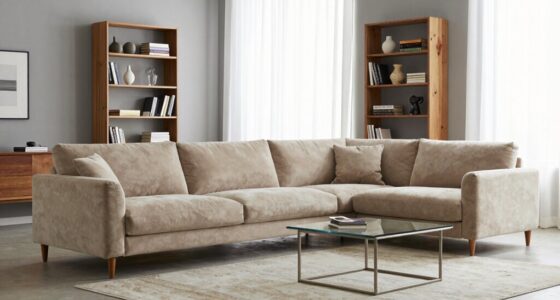
To achieve a balanced living room, follow the sofa size rule: leave at least 18 inches of clearance around your sofa for easy movement and to avoid overcrowding. Measure your space carefully and choose a sofa that complements the room’s proportions—smaller for tight areas, larger for spacious rooms. Balancing size with other furniture creates harmony and flow. Want to learn more about selecting the perfect sofa size for your space? Keep exploring for helpful tips.

Get furniture and decor delivered free with Prime
- Fast, free delivery on millions of items
- Prime Video, Amazon Music and more included
- Member-only deals all year
Key Takeaways
- Measure your room carefully to select a sofa that fits comfortably without overwhelming or leaving the space feeling empty.
- Leave at least 18 inches of clearance around the sofa for easy movement and proper flow.
- Balance the sofa size with other furniture to maintain harmony and proportion within the space.
- Choose a color that complements existing décor to create visual balance and enhance room aesthetics.
- Select textures and fabrics that add interest without clashing, ensuring overall design cohesion.

Choosing the right sofa size can make or break your living space. It’s not just about finding a piece that fits; it’s about creating a balanced, inviting environment. When selecting your sofa, consider how it will interact with your room’s layout, lighting, and existing furniture. A sofa that’s too large can overwhelm the space, while one that’s too small might leave your room feeling empty or unwelcoming. To guarantee harmony, think about the flow of your living room and how much space you want around your furniture. You want the sofa to serve as a comfortable centerpiece without crowding other elements or limiting movement. Paying attention to room proportions ensures your furniture choices enhance rather than hinder the overall design. Color coordination plays a pivotal role in making your sofa blend seamlessly into your living room. Pick a hue that complements your walls, rugs, and accent pieces. If your walls are neutral, a bold-colored sofa can add a striking focal point, but if your room already features vibrant tones, a more subdued color might be best for balance. Keep in mind that darker fabrics tend to hide stains better and can add a cozy feel, while lighter shades bring freshness and openness. Your choice of fabric textures also impacts the overall vibe. Smooth, sleek materials like leather or microfiber create a modern look, whereas plush fabrics like velvet or chenille add warmth and a touch of luxury. Mixing textures can add visual interest, but be mindful of scale and color to avoid clashing. When it comes to size, measure your space carefully. For example, if your living room is small, opt for a loveseat or a compact sectional that doesn’t overpower the room. In larger spaces, you can afford a spacious sofa, perhaps with additional chairs or ottomans for versatility. Remember to leave enough clearance for walkways—at least 18 inches between the sofa and other furniture pieces is a good rule. This guarantees easy movement and prevents the space from feeling cramped. Also, consider the scale of your other furniture: a large sofa in a tiny room can look out of place, while a petite sofa in a grand room might seem lost. Ultimately, the sofa size rule is about balance and harmony. Measure your space, consider your color palette, and select fabric textures that support the mood you want to create. When these elements come together thoughtfully, your living room becomes a comfortable, stylish retreat that feels just right.
Products Worth Considering

Blueair Blue Pure 211i Max Air Purifier for Large Rooms

Sonos Era 100 SL Compact Microphone-Free Speaker, Black

Hisense 75U6SF Pro 75-Inch U6 Pro Mini-LED 4K UHD Smart Fire TV
As an affiliate, we earn on qualifying purchases.
Frequently Asked Questions
How Do I Measure My Living Room Accurately?
To measure your living room accurately, start by using a tape measure to record the length and width of each wall. Note down the measurements, including doorways and windows, to guarantee your furniture fits comfortably. Consider how color schemes and lighting choices will impact the space perception. Proper measurements help you select the right sofa size, making your room feel balanced and inviting without overcrowding or underusing the space.
What Sofa Styles Suit Small Spaces Best?
Think of your small space as a cozy nest, perfect for a well-chosen sofa. Corner configurations and sectional designs are your best allies, maximizing seating without overwhelming. Opt for compact styles with slim arms and light colors, which make the room feel airy. Sectionals that fit snugly into corners create a seamless look. These choices help you enjoy comfort and style without sacrificing precious space.
Can I Mix Different Sofa Sizes in One Room?
Yes, you can mix different sofa sizes in one room. To make it work, focus on mixing styles thoughtfully and maintaining color coordination. Choose sofas with complementary colors or patterns to create harmony. Varying sizes can add visual interest, but make certain they don’t clutter the space. Keep the layout balanced and cohesive by considering the room’s flow, so your mix enhances your living room rather than overwhelming it.
How Does Furniture Placement Affect Room Size Perception?
You can make your room feel larger or cozier by how you place your furniture. Use light color schemes and strategic lighting effects to enhance space perception. Position furniture to create open pathways, avoiding clutter that shrinks the room visually. Bright lighting and lighter hues reflect more light, making the space seem bigger. Conversely, darker colors and dim lighting can make a room feel smaller and more intimate.
Are There Sofa Height Considerations for Comfort?
You might think sofa height is just about style, but it’s essential for comfort optimization. The right sofa height keeps your feet flat on the floor, supports your back, and reduces strain. Too high or low can cause discomfort over time. Pay attention to seat height, ideally around 17-19 inches, to make certain your sofa truly supports your relaxation. Choosing the perfect height transforms your living room into a haven of comfort.
Conclusion
Remember, following the sofa size rule helps your living room feel balanced and inviting, just like a well-tuned orchestra. Don’t forget to measure your space and choose a sofa that fits perfectly — no need to summon a genie. With this simple rule, you’ll avoid the chaos of a cluttered or cramped room, making your space feel like it’s straight out of a modern-day fairy tale. Now, go ahead and make your living room the envy of every time traveler!