A 4K short throw projector can create a large image from close to the wall, but the right pick depends on your room, lighting, and whether you value gaming speed or a cinema-style setup. I rank the Hisense PL2 as the best overall for its ultra-short-throw design, Google TV, and Dolby Vision and Atmos support. The BenQ TK710STi is a strong alternative for buyers who want a short-throw gaming and home-entertainment model, while the AWOL Aetherion Max targets premium ultra-short-throw viewing. The main tradeoffs are placement flexibility, built-in streaming and audio, and how much light control your room needs. Read on for the full breakdown and help matching a projector to your space.

Get furniture and decor delivered free with Prime
- Fast, free delivery on millions of items
- Prime Video, Amazon Music and more included
- Member-only deals all year
Complete the kit


Key Takeaways
- The Hisense PL2 is the most balanced pick: its ultra-short-throw design and Google TV suit buyers seeking a living-room setup without a separate streaming device.
- The BenQ TK710STi is the gaming-focused short-throw choice: it offers a different fit from the more cinema-oriented ultra-short-throw models.
- AWOL’s lineup spans distinct premium needs: the Aetherion Pro emphasizes clarity and contrast claims, the Aetherion Max is positioned as a premium ultra-short-throw model, and the LTV-3000 Pro adds triple-laser 3D support.
- Smart platforms and audio vary meaningfully: built-in Google TV, VIDAA OS, Dolby Atmos, and Dynaudio features can reduce extra equipment, but they should not outweigh room fit.
- “4K short throw” does not mean one placement style: the BenQ and Optoma short-throw models differ from the ultra-short-throw Hisense, AWOL, and JMGO options, so check the required wall distance before choosing.
| Optoma GT3900UHD 4K UHD Short Throw Laser Projector |  | Best for Bright, Compact-Room Setups | Native resolution: 3840 × 2160 | Brightness: 4,000 lumens | Light source: Laser | VIEW ON AMAZON | See Our Full Breakdown |
| BenQ TK710STi 3200 Lumens 4K HDR Short Throw Home Entertainment Projector | 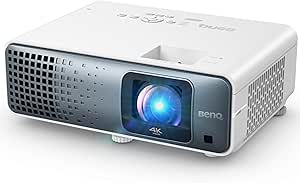 | Best for Streaming and Responsive Gaming | Native resolution: 3840 × 2160 | Brightness: 3,200 lumens | Light source: Laser | VIEW ON AMAZON | See Our Full Breakdown |
| BenQ TK700 4K HDR Home Entertainment Gaming and Movie Projector |  | Best for Buyers Who Can Trade Short Throw for a Lamp-Based Option | Native resolution: 3840 × 2160 | Brightness: 3,200 ANSI lumens | Contrast ratio: 10,000:1 | VIEW ON AMAZON | See Our Full Breakdown |
| Optoma UHD35STX 4K UHD Short Throw Gaming and Home Entertainment Projector |  | Best for High-Refresh Gaming in a Tight Room | Native resolution: 3840 × 2160 | Brightness: 3,600 lumens | Display type: DLP | VIEW ON AMAZON | See Our Full Breakdown |
| GO2 Upgrade 4K Short Throw Projector with VIDAA OS, 5000 ANSI Lumens, 65W Dolby Audio, Voice Control, and WiFi/Bluetooth |  | Best for Built-In Audio and Flexible Streaming | Resolution: 4K | Brightness: 5,000 ANSI lumens | Throw ratio: 1:1 | VIEW ON AMAZON | See Our Full Breakdown |
| Hisense PL2 Ultra Short Throw 4K UHD Laser Projector with Dolby Vision & Atmos, Google TV, WIFI 6E |  | Best for Smart-TV Convenience | Resolution: 3840 × 2160 (4K UHD) | Brightness: 2700 lumens | Contrast ratio: 3000:1 | VIEW ON AMAZON | See Our Full Breakdown |
| AWOL Aetherion Pro 4K Projector, 2600 ISO Lumens, Short Throw, Google TV, PixelLock Clarity, 6000:1 Contrast, Dolby Vision, 200″ Display |  | Best for a Giant-Screen Cinema | Native resolution: 3840 × 2160 | Brightness: 3000 lumens listed; description also cites 2600 ISO lumens | Contrast ratio: 3,000,000:1 listed; title also cites 6000:1 | VIEW ON AMAZON | See Our Full Breakdown |
| AWOL VISION LTV-3000 Pro 4K 3D Ultra Short Throw Triple Laser Projector with Dolby Vision & Atmos |  | Best for 3D and Integrated Audio | Native resolution: 3840 × 2160 | Brightness: 2000 lumens; maximum white brightness listed as 3000 ANSI lumens | Contrast ratio: 2500:1 | VIEW ON AMAZON | See Our Full Breakdown |
| AWOL VISION Aetherion Max 4K Ultra-Short Throw Laser Projector |  | Best for Competitive Gaming | Resolution: 3840 × 2160 (4K) | Brightness: 3000 ANSI lumens listed | Contrast ratio: 3,000,000:1 listed; description also cites 6,000:1 native | VIEW ON AMAZON | See Our Full Breakdown |
| JMGO O2S Ultra 4K Ultra Short Throw Triple Laser Projector with Dolby Vision and Dynaudio Speakers |  | Best for Built-In Sound and Streaming | Native resolution: 3840 × 2160 | Brightness: 3600 lumens | Contrast ratio: 4000:1 | VIEW ON AMAZON | See Our Full Breakdown |
| 4k short throw projector | Brightness | Native resolution | Connectivity | Contrast ratio |
|---|---|---|---|---|
| Optoma GT3900UHD 4K UHD Short | 4,000 lumens | 3840 × 2160 | HDMI | — |
| BenQ TK710STi 3200 Lumens 4K H | 3,200 lumens | 3840 × 2160 | — | 600,000:1 |
| BenQ TK700 4K HDR Home Enterta | 3,200 ANSI lumens | 3840 × 2160 | HDMI, USB 2.0 Type-A | 10,000:1 |
| Optoma UHD35STX 4K UHD Short T | 3,600 lumens | 3840 × 2160 | HDMI, USB | — |
| GO2 Upgrade 4K Short Throw Pro | 5,000 ANSI lumens | — | Wi-Fi, Bluetooth, 2 × HDMI 2.1, 2 × USB, AV, 3.5 mm headphone jack | — |
| Hisense PL2 Ultra Short Throw | 2700 lumens | — | Bluetooth, Ethernet, HDMI, USB, Wi-Fi 6E | 3000:1 |
| AWOL Aetherion Pro 4K Projecto | 3000 lumens listed; description also cites 2600 ISO lumens | 3840 × 2160 | HDMI, USB 2.0 | 3,000,000:1 listed; title also cites 6000:1 |
| AWOL VISION LTV-3000 Pro 4K 3D | 2000 lumens; maximum white brightness listed as 3000 ANSI lumens | 3840 × 2160 | — | 2500:1 |
| AWOL VISION Aetherion Max 4K U | 3000 ANSI lumens listed | — | 3 × HDMI 2.1a, DisplayPort 1.4a | 3,000,000:1 listed; description also cites 6,000:1 native |
| JMGO O2S Ultra 4K Ultra Short | 3600 lumens | 3840 × 2160 | — | 4000:1 |
More Details on Our Top Picks
Optoma GT3900UHD 4K UHD Short Throw Laser Projector
The Optoma GT3900UHD is the strongest fit here when short placement distance and sustained brightness matter more than built-in streaming. Its 0.496:1 throw ratio and 4,000-lumen laser output suit compact entertainment rooms and golf simulators, where a projector closer to the screen can reduce player shadows. Compared with the BenQ TK710STi, it offers more listed brightness and a longer stated light-source life, while the BenQ adds Android TV and a 4 ms gaming mode at 1080p/240Hz. The Optoma’s 30,000-hour laser life also avoids the shorter lamp-life tradeoff of the BenQ TK700. Its limits are a 10.8-foot maximum throw distance and a 6.4-pound body that is less convenient to move between rooms. Buyers should plan their installation around the short throw rather than expect a flexible long-distance setup.
Pros:- 4,000-lumen laser output is the highest stated brightness among these five products.
- 0.496:1 throw ratio suits small rooms and helps keep players from blocking the image.
- Stated 30,000-hour DuraCore laser life reduces routine light-source replacement.
- Native 3840 × 2160 resolution with HDR compatibility.
Cons:- Maximum throw distance is limited to 10.8 feet, restricting placement options in larger rooms.
- At 6.4 pounds, it is less convenient to carry or reposition than a small portable projector.
- The listed connectivity is HDMI, with no built-in streaming platform specified.
Best for: Golf-simulator owners and home-entertainment buyers who need a bright 4K image from a short distance and can use an external streaming device.
Not ideal for: People who want an all-in-one streaming projector or need to project from more than 10.8 feet away.
- Native resolution:3840 × 2160
- Brightness:4,000 lumens
- Light source:Laser
- Light-source life:Up to 30,000 hours
- Throw ratio:0.496:1
- Throw distance:1.08–10.8 feet
- Weight:6.4 pounds
- Connectivity:HDMI
Our verdict“Choose the GT3900UHD for a bright, long-life 4K setup in a compact room, but skip it if you need onboard streaming or long-distance placement.”
BenQ TK710STi 3200 Lumens 4K HDR Short Throw Home Entertainment Projector
The BenQ TK710STi makes the most sense for buyers who want 4K short-throw projection with streaming built in, rather than a projector that depends on extra hardware for apps. Its Android TV, auto focus, and 3,200-lumen laser source give it a more ready-to-watch setup than the Optoma GT3900UHD, which lists HDMI connectivity but no built-in streaming platform. The BenQ also has a stated 4 ms response at 1080p/240Hz, a useful fit for players who favor fast refresh rates; the Optoma UHD35STX lists the same 240Hz ceiling but does not offer the same built-in Android TV feature in the supplied data. The tradeoff is less brightness than the GT3900UHD and a stated 20,000-hour light-source life. Its listed 8.4-foot minimum throw distance also makes it less suited to very tight placements than the Optoma’s 1.08-foot minimum.
Pros:- Built-in Android TV supports streaming without a separate device.
- 4 ms response is specified for 1080p at 240Hz.
- Laser light source avoids the lamp replacement cycle of the BenQ TK700.
- Auto focus and digital keystone correction can simplify setup.
Cons:- Its 3,200-lumen brightness is below the Optoma GT3900UHD’s 4,000 lumens.
- The stated light-source life is 20,000 hours, shorter than the GT3900UHD’s 30,000 hours.
- The listed minimum throw distance of 8.4 feet is not a fit for very close placement.
Best for: Console gamers and movie watchers who want built-in Android TV, laser illumination, and a short-throw 4K projector in one setup.
Not ideal for: Buyers who need the shortest possible placement distance, the highest listed brightness, or a long-life source closer to 30,000 hours.
- Native resolution:3840 × 2160
- Brightness:3,200 lumens
- Light source:Laser
- Light-source life:20,000 hours
- Contrast ratio:600,000:1
- Gaming response:4 ms at 1080p/240Hz
- Throw distance:8.4–16.3 feet
- Built-in features:Android TV, auto focus, built-in speaker, digital keystone correction
Our verdict“Pick the TK710STi if built-in streaming and high-refresh gaming matter more than maximum brightness or the closest possible throw.”
BenQ TK700 4K HDR Home Entertainment Gaming and Movie Projector
The BenQ TK700 is the outlier in this group: it offers 4K gaming and HDR, but the supplied product data does not support calling it a short-throw projector. Its listed throw distance is 2.5 to 5 feet, yet the product description explicitly says it has no short-throw capability, so buyers should verify room geometry before choosing it for a near-screen setup. Compared with the Optoma UHD35STX, which is explicitly described as short throw and lists a 0.4-meter minimum distance, the TK700 is the less dependable choice for a tight room. Its 16 ms input lag and 3,200-lumen output suit console entertainment, while the 4,000-hour lamp life is a clear disadvantage beside the laser-based Optoma GT3900UHD and BenQ TK710STi. I’d treat its built-in Dolby Atmos speaker as a convenience, not a substitute for a dedicated audio system.
Pros:- Native 3840 × 2160 resolution with HDR and enhanced black-detail technology.
- Stated 16 ms input lag supports responsive console gaming.
- 3,200-lumen brightness is suited to more than a fully dark viewing space.
- Built-in speaker and HDMI 2.0 provide a straightforward entertainment setup.
Cons:- The product description says it lacks short-throw capability, making it a risky fit for this roundup’s core use.
- Listed lamp life is 4,000 hours, far below the stated laser lives of the Optoma GT3900UHD and BenQ TK710STi.
- Listed power consumption is 380 watts.
Best for: Console gamers who want 4K HDR, a stated 16 ms input lag, and a projector for a room where placement distance has been checked in advance.
Not ideal for: Buyers who specifically need a verified short-throw lens, a long-life laser source, or a large image beyond the listed 320-inch maximum.
- Native resolution:3840 × 2160
- Brightness:3,200 ANSI lumens
- Contrast ratio:10,000:1
- Lamp life:4,000 hours
- Maximum image size:320 inches
- Listed throw distance:2.5–5 feet
- Weight:6.8 pounds
- Connectivity:HDMI, USB 2.0 Type-A
Our verdict“Consider the TK700 only if its placement works in your room and you value 4K gaming more than a clearly specified short-throw lens or long-life laser.”
Optoma UHD35STX 4K UHD Short Throw Gaming and Home Entertainment Projector
The Optoma UHD35STX is the most clearly gaming-focused pick for buyers who need a short throw and fast refresh without moving up to a laser model. It lists a 4.2 ms input lag and 240Hz refresh rate, while its 3,600-lumen output sits between the BenQ TK710STi’s 3,200 lumens and the GT3900UHD’s 4,000. The stated minimum throw distance of 0.4 meters gives it a more credible close-placement case than the BenQ TK700, whose product description says it lacks short-throw capability. Its lamp-based design is the main compromise: the listed 10,000-hour life is shorter than either laser Optoma or the laser BenQ TK710STi, and the supplied warranty includes only 90 days for the lamp. At over 10 pounds, it is also a poor choice for frequent room-to-room moves.
Pros:- Low stated input lag of 4.2 ms and refresh rate up to 240Hz target fast-paced gaming.
- 0.4-meter minimum throw distance supports close placement.
- 3,600-lumen brightness is higher than the BenQ TK710STi’s stated 3,200 lumens.
- Native 3840 × 2160 resolution and HDMI/USB connectivity.
Cons:- Lamp life is listed at 10,000 hours, below the laser-based options in this group.
- At over 10 pounds, it is cumbersome to reposition.
- The supplied warranty gives the lamp only 90 days of coverage.
Best for: Competitive console and PC gamers who want a short-throw 4K image with a 240Hz mode and can accept a lamp-based light source.
Not ideal for: Buyers seeking a lightweight projector, a long-life laser source, or the convenience of built-in streaming apps.
- Native resolution:3840 × 2160
- Brightness:3,600 lumens
- Display type:DLP
- Minimum throw distance:0.4 meters
- Maximum throw distance:3.3 meters
- Maximum image size:300 inches
- Light-source life:10,000 hours
- Connectivity:HDMI, USB
Our verdict“Choose the UHD35STX for close-placement gaming and fast refresh, but favor a laser model if long light-source life matters more.”
GO2 Upgrade 4K Short Throw Projector with VIDAA OS, 5000 ANSI Lumens, 65W Dolby Audio, Voice Control, and WiFi/Bluetooth
The GO2 Upgrade stands apart from the Optoma and BenQ models by prioritizing built-in entertainment features: VIDAA OS, voice control, Apple AirPlay, and a stated 65W Dolby Audio system. That makes it appealing to households that want fewer separate devices and a projector that can serve casual movie nights or outdoor viewing. Its claimed 5,000 ANSI lumens are the highest figure in this group, but the product description still cautions that it is not suitable for bright rooms, so I would not treat the number alone as proof of daylight performance. Unlike the GT3900UHD, it gives a stated 1:1 throw ratio and a 50-to-500-inch image range, though the supplied data does not specify a minimum throw distance. The tradeoff is a proprietary VIDAA platform rather than Android TV, plus limited detail on the 4K implementation and light source.
Pros:- VIDAA OS, voice control, and Apple AirPlay reduce reliance on separate streaming hardware.
- Stated 65W Dolby Audio is more substantial than the basic built-in speaker convenience listed for the BenQ TK710STi.
- Two HDMI 2.1 ports and two USB ports provide several connection options.
- 360-degree rotatable stand and auto focus offer flexible placement and setup.
Cons:- The proprietary VIDAA platform may not suit buyers who prefer Android TV, such as the BenQ TK710STi offers.
- The description warns against bright-room use despite the stated 5,000 ANSI lumens.
- The supplied data does not specify light-source type or operating life.
Best for: Families and casual movie watchers who value built-in apps, voice and phone controls, and strong onboard audio for a flexible home or outdoor setup.
Not ideal for: Buyers who need verified laser longevity, a well-documented short-throw distance for a specific room, or reliable viewing in a bright room.
- Resolution:4K
- Brightness:5,000 ANSI lumens
- Throw ratio:1:1
- Image size range:50–500 inches
- Operating system:VIDAA
- Audio:65W Dolby Audio
- Connectivity:Wi-Fi, Bluetooth, 2 × HDMI 2.1, 2 × USB, AV, 3.5 mm headphone jack
- Additional features:Auto focus, voice control, parental control, 360° rotatable stand, Apple AirPlay
Our verdict“Pick the GO2 Upgrade for an app-and-audio-rich casual setup, but choose a better-documented laser model for a carefully planned short-throw theater.”
Hisense PL2 Ultra Short Throw 4K UHD Laser Projector with Dolby Vision & Atmos, Google TV, WIFI 6E
The Hisense PL2 is the most straightforward fit here for buyers who want an ultra-short-throw 4K setup with streaming built in. Its Google TV interface and Wi-Fi 6E reduce the need to add a separate streaming box, while Dolby Vision and HDR support give compatible films more visual range. The 0.22-to-1.5-foot throw distance helps it sit close to the wall, though the listed range is broad and placement still needs careful setup. Compared with the AWOL VISION LTV-3000 Pro, the PL2 offers a longer stated light-source life and a higher listed brightness, but it lacks that model’s advertised 3D support and built-in center-channel speaker. Its 150-inch ceiling also rules it out for buyers chasing the largest image in this group.
Pros:- Google TV and Wi-Fi 6E provide built-in streaming and modern wireless connectivity.
- 4K UHD resolution with Dolby Vision and HDR support.
- Ultra-short-throw placement can reduce the space needed between projector and wall.
- Listed 25,000-hour laser light-source life.
Cons:- Maximum image size is limited to 150 inches.
- Weight and dimensions are not specified, making installation planning harder.
- A suitable wall or screen is still needed for a clean image.
Best for: Movie and streaming viewers who want Google TV built in and a projector that can sit close to the wall.
Not ideal for: Buyers who need an image larger than 150 inches, a specified compact chassis, or a built-in center-channel speaker.
- Resolution:3840 × 2160 (4K UHD)
- Brightness:2700 lumens
- Contrast ratio:3000:1
- Projection size:80–150 inches
- Throw distance:0.22–1.5 feet
- Light-source life:25,000 hours
- Connectivity:Bluetooth, Ethernet, HDMI, USB, Wi-Fi 6E
- Supported standards:Dolby Vision, HDR
Our verdict“Choose the PL2 if built-in Google TV and close wall placement matter more than a screen larger than 150 inches or extra audio and 3D features.”
AWOL Aetherion Pro 4K Projector, 2600 ISO Lumens, Short Throw, Google TV, PixelLock Clarity, 6000:1 Contrast, Dolby Vision, 200″ Display
The Aetherion Pro earns its place for buyers whose priority is a screen that can reach 200 inches, larger than the 150-inch limits listed for the Hisense PL2 and AWOL VISION LTV-3000 Pro. Its 4K resolution, Dolby Vision support, and advertised PixelLock clarity target a detailed, cinematic image, while low-latency gaming features broaden its use beyond films. The appeal comes with a room-planning tradeoff: the listing gives a 0.5-foot minimum throw but also a maximum distance of 20.19 feet, so it is not as easy to place inches from the wall as the PL2. The supplied details also conflict on brightness and contrast figures, so I would verify those specifications before buying. Large-screen ambitions make this a less natural choice for compact rooms.
Pros:- Listed maximum image size of 200 inches exceeds the 150-inch limits of several alternatives here.
- 4K resolution and Dolby Vision support suit detailed movie viewing.
- Low-latency gaming features support responsive play.
- Anti-rainbow technology is intended to reduce visual discomfort during extended viewing.
Cons:- Large-screen setup and the listed throw-distance range may be difficult to accommodate in smaller rooms.
- The product information gives conflicting brightness and contrast figures.
- The listed connectivity details are limited to HDMI and USB 2.0.
Best for: Dedicated home-cinema and gaming buyers with room for a screen up to 200 inches and time to plan placement.
Not ideal for: Small-room shoppers or buyers who need unambiguous brightness and contrast specifications before choosing.
- Native resolution:3840 × 2160
- Brightness:3000 lumens listed; description also cites 2600 ISO lumens
- Contrast ratio:3,000,000:1 listed; title also cites 6000:1
- Maximum image size:200 inches
- Throw distance:0.5-foot minimum; 20.19-foot maximum listed
- Light-source life:25,000 hours
- Connectivity:HDMI, USB 2.0
- Control:App, remote, voice
Our verdict“Pick the Aetherion Pro if a 200-inch image is your main goal and your room can handle its larger, more involved setup.”
AWOL VISION LTV-3000 Pro 4K 3D Ultra Short Throw Triple Laser Projector with Dolby Vision & Atmos
The LTV-3000 Pro stands apart from the Hisense PL2 by pairing 3D support with a built-in center-channel speaker, a useful combination for a cinema room where extra components are unwelcome. Dolby Vision, HDR10+, and Dolby Atmos support also give it a broad home-theater feature set, and its ultra-short-throw design targets images from 80 to 150 inches without a long projector run. Brightness is the main compromise: the supplied data lists 2000 lumens, with a separate maximum white-brightness figure of 3000 ANSI lumens. That uncertainty, plus the recommendation for a dark room and compatible ALR screen, makes it less forgiving than the brighter-listed Hisense PL2. This pick makes more sense for controlled-light movie rooms than for daytime viewing or buyers seeking simple, clearly specified setup details.
Pros:- Supports 4K, Dolby Vision, HDR10+, and 3D content.
- Built-in center-channel speaker can clarify dialogue without a separate speaker.
- Ultra-short-throw design supports an 80–150-inch image.
- Dolby Atmos support adds compatibility with immersive audio formats.
Cons:- The listed brightness figures differ, complicating comparisons with alternatives.
- Best image performance is described as requiring a dark room and compatible ALR screen.
- Listed power draw is 300 watts.
Best for: Home-theater owners who watch 3D content and want a center-channel speaker built into an ultra-short-throw projector.
Not ideal for: Daytime viewers without light control, or buyers who want straightforward brightness specifications and minimal screen requirements.
- Native resolution:3840 × 2160
- Brightness:2000 lumens; maximum white brightness listed as 3000 ANSI lumens
- Contrast ratio:2500:1
- Image size:80–150 inches
- Throw distance:0.5-foot minimum; 1.68-foot maximum listed
- Light-source life:25,000 hours
- Video formats:Dolby Vision, HDR10+, 3D
- Power:300 watts
Our verdict“Choose the LTV-3000 Pro for its 3D and built-in dialogue-focused audio features, provided you can control room light and plan around its screen needs.”
AWOL VISION Aetherion Max 4K Ultra-Short Throw Laser Projector
The Aetherion Max is the gaming-focused choice in this set, with a stated 1 ms-class latency at 240 Hz, HDMI 2.1a inputs, DisplayPort 1.4a, and VRR/ALLM support in the product description. Those connections and response claims give it a clearer gaming case than the Hisense PL2, whose listing emphasizes smart streaming instead. Its 4K laser image and 80-to-150-inch size range also leave room for movie nights and sports. The tradeoff is that the supplied specifications list both 3000 ANSI lumens and 3000,000:1 contrast, while the description cites a 6,000:1 native contrast ratio; buyers should confirm which figures apply. It is also described as floor-mount only, and the stated need for an ALR screen can add constraints to a fixed room setup.
Pros:- Advertised 1 ms-class latency at 240 Hz is aimed at responsive gaming.
- HDMI 2.1a and DisplayPort 1.4a provide modern wired connection options.
- VRR and ALLM support are listed for gaming use.
- Ultra-short-throw ratio and 80–150-inch image range suit large-screen rooms.
Cons:- Product details give conflicting contrast-ratio figures.
- The listing specifies floor mounting only and does not include a ceiling-mount option.
- An ALR screen is recommended for best performance.
Best for: Console and PC gamers who want a large 4K image, high-refresh-rate support, and HDMI 2.1a or DisplayPort connections.
Not ideal for: Buyers who need ceiling mounting, want a plug-and-play wall setup without an ALR screen, or require consistent published contrast figures.
- Resolution:3840 × 2160 (4K)
- Brightness:3000 ANSI lumens listed
- Contrast ratio:3,000,000:1 listed; description also cites 6,000:1 native
- Throw ratio:0.2:1
- Image size:80–150 inches
- Gaming latency:1 ms class at 240 Hz
- Connectivity:3 × HDMI 2.1a, DisplayPort 1.4a
- Warranty:2 years
Our verdict“Choose the Aetherion Max if gaming connections and low-latency claims outweigh mounting flexibility and the need to verify conflicting specifications.”
JMGO O2S Ultra 4K Ultra Short Throw Triple Laser Projector with Dolby Vision and Dynaudio Speakers
The JMGO O2S Ultra is the most self-contained entertainment pick here: it combines Google TV and native Netflix with a built-in 20W Dynaudio system and Dolby Atmos and DTS:X support. That makes it a stronger fit for buyers who want to reduce extra boxes and speakers than the Hisense PL2, whose supplied description highlights Google TV but does not specify built-in audio hardware. The JMGO also lists 3600 lumens and a 4000:1 contrast ratio, alongside RGB triple-laser imaging and Dolby Vision. Its image range tops out at 150 inches, so it cannot match the Aetherion Pro’s stated 200-inch ceiling. The product data calls it portable and tabletop-mounted, but its minimum throw distance is listed as one meter, so confirm the actual room layout before treating it as an inches-from-the-wall installation.
Pros:- Google TV and native Netflix reduce reliance on a separate streaming device.
- Built-in 20W Dynaudio speakers support Dolby Atmos and DTS:X formats.
- RGB triple-laser light source, Dolby Vision, and listed 3600-lumen brightness.
- Supports images from 80 to 150 inches.
Cons:- Maximum image size is smaller than the AWOL Aetherion Pro’s listed 200 inches.
- Minimum throw distance is listed as one meter, limiting placement flexibility.
- Software update support details are not provided.
Best for: Streaming households that want Google TV, native Netflix, and substantial built-in audio in one tabletop projector.
Not ideal for: Buyers seeking a 200-inch image, a very close wall placement, or detailed information about software update support.
- Native resolution:3840 × 2160
- Brightness:3600 lumens
- Contrast ratio:4000:1
- Image size:80–150 inches
- Throw distance:1-meter minimum; 4-meter maximum listed
- Light source:RGB triple laser
- Audio and formats:20W Dynaudio speakers; Dolby Vision, Dolby Atmos, DTS:X
- Smart features:Google TV, native Netflix
Our verdict“Pick the O2S Ultra if built-in streaming and stronger onboard audio matter more than a 200-inch image or the shortest possible throw.”

How We Picked
I compared each projector through the needs implied by 4K short-throw viewing: how it is meant to sit in a room, what kind of entertainment it supports, and which conveniences are built in. I gave weight to stated features such as laser light sources, HDR formats, gaming positioning, smart TV platforms, audio support, and claimed brightness or contrast, while treating those claims as specifications rather than independent test results. I also looked at whether each model’s feature set made sense for a distinct buyer rather than assuming that more features automatically make a better choice.
The ranking favors useful balance and clear placement fit over a single headline specification. The Hisense PL2 leads for its combination of ultra-short-throw design and smart entertainment features; the BenQ TK710STi ranks highly for buyers prioritizing short-throw gaming. Premium AWOL models follow for buyers with more specific image and format priorities, while options with less clearly differentiated roles rank lower. Since the lineup spans short-throw and ultra-short-throw designs, I treat those as different installation choices, not interchangeable labels.
Factors to Consider When Choosing 4k Short Throw Projector
Choosing a projector starts with the room, not the feature list. I would settle the installation distance and viewing habits first, then compare image features, gaming needs, and built-in conveniences. These decisions can prevent a mismatch that a higher specification alone cannot fix.
Short Throw and Ultra-Short Throw Solve Different Room Problems
A short-throw projector sits closer to the screen than a conventional projector, while an ultra-short-throw model is designed to sit very near the wall or screen. That difference affects furniture placement, cable routes, and how easily people can walk through the beam. Measure the available depth from the intended position to the screen area, and check the model’s throw specifications before buying. Do not assume that every product marketed as short throw can sit on the same cabinet. Ultra-short-throw setups can be especially sensitive to screen flatness and projector alignment. If you need to move the projector between rooms, a farther-throw option may be easier to reposition than a fixed UST arrangement.
Match Brightness to Room Light and Screen Size
Brightness claims are useful for comparing stated specifications, but they do not tell the whole story of how an image will look in your room. Ambient light, wall or screen material, image size, and viewing habits all affect perceived contrast and vividness. A large image generally places more demands on the projector than a smaller one, while daylight can wash out dark scenes even on a bright model. Think about whether you can dim the room during movies or need daytime viewing. Avoid choosing on a high lumen figure alone, especially when brands may use different measurement terms. A dedicated screen and controllable lighting can improve the result more than an upgrade that does not address the room.
Check Gaming Needs Beyond the 4K Label
For gaming, 4K resolution is only one part of the decision. Buyers should check the exact supported refresh rates, input lag, and resolution combinations for the console or PC they plan to use; product names alone do not answer those questions. A model positioned for gaming, such as the BenQ TK710STi or Optoma UHD35STX, may suit that use better than a projector whose main appeal is built-in streaming or cinema formats. Confirm the ports and supported modes in the manufacturer specifications before purchase. If competitive play matters, prioritize response behavior and a comfortable screen size over smart-TV extras. Movie-first buyers can give more weight to HDR support and room control instead.
Treat HDR and Color Formats as Part of the Whole Chain
Features such as Dolby Vision and HDR support matter only when the projector, source device, connection, and content work together. A format logo does not guarantee the same image result across products, and room brightness can limit the impact of HDR. Check which services and devices you use and whether they output the formats the projector supports. If you already have a streaming box or receiver, built-in smart features may be less valuable than image or placement advantages. Buyers building a simple living-room setup may prefer an integrated platform, while home theater owners may value compatibility with their existing equipment. Keep the source chain in mind before paying extra for a format you rarely use.
Decide How Much Built-In Audio and Streaming You Need
Built-in platforms such as Google TV or VIDAA can simplify setup by putting apps and voice control in one place. Integrated speakers, including models marketed with Dolby Audio, Dolby Atmos, or Dynaudio, can also reduce the number of devices needed for casual viewing. Those features are conveniences, not a guarantee that the sound will meet every room’s needs. If you already own a soundbar or receiver, check the audio connections and decide whether projector speakers matter to you. A simpler setup can be appealing for a bedroom or shared living space, while a dedicated theater may benefit more from separate audio equipment. Compare the full system you intend to use rather than treating built-in features as free improvements.
Spend More for a Specific Benefit, Not a Bigger Feature List
Premium models make the most sense when a named feature solves a real need: a particular ultra-short-throw installation, triple-laser design, 3D support, or an image characteristic you value. Extra format support and smart features may have little practical value if your room cannot accommodate the projector or you already own equivalent devices. Before paying more, write down the two or three benefits you will use often and verify them in the specifications. Also check warranty terms, ventilation needs, cleaning guidance, and the availability of suitable replacement accessories. Buyers with flexible placement and straightforward viewing needs may get better value from a less elaborate model. The most expensive option is not automatically the best match for your setup.
Frequently Asked Questions
Should I choose a short-throw projector or an ultra-short-throw projector for my living room?
I would choose based on where the projector can sit, not on the label alone. A standard short-throw model needs more distance from the screen than an ultra-short-throw model, which is designed to sit very close to the wall. Measure the furniture depth and screen area, then compare those measurements with the manufacturer’s throw guidance. UST models can make a tidy living-room installation, but alignment and screen flatness matter. If you may move the projector often, a less fixed placement may be more convenient.
Can a 4K short-throw projector replace a television in a bright room?
It can serve as a large-screen display, but bright rooms are a harder environment for projected images than dim rooms. Daylight and room lighting can reduce contrast, particularly in darker scenes, so stated brightness should not be the only deciding factor. Consider whether you can use curtains, dimmable lighting, or a screen suited to your environment. If you watch mostly during the day and cannot control ambient light, a television may be the more dependable everyday choice. A projector makes more sense when large image size is a priority and the room can be managed.
Does a projector with Dolby Vision or Dolby Atmos guarantee better movies?
No single format label guarantees a better result. The source, streaming service, connection, room, and projector all affect what you see and hear, and the benefit depends on whether your content uses the format. Dolby Atmos support on a projector also does not necessarily replace a separate sound system for an immersive theater setup. Compare the supported formats with the devices and services you already use. If you mainly watch standard streaming content or use external audio, other factors such as placement and brightness may matter more.
What should I verify before buying a short-throw projector for gaming?
Check the supported resolution and refresh-rate combinations, input lag information, and available connections for your console or PC. A product described as a gaming projector may still have mode limits that matter for a particular source, so confirm details in the manufacturer specifications. Also check whether your intended screen size and placement work with the room. For competitive games, responsiveness can matter more than built-in streaming features or movie formats. For mixed gaming and films, look for a balance that suits both rather than relying on the 4K label.
Do I need a special screen for an ultra-short-throw projector?
A suitable screen can help, but the right choice depends on the room and projector. UST placement makes surface flatness and alignment especially noticeable, so a wavy or uneven surface may affect the image. A wall can work for some setups, though its texture and color may limit image quality. In rooms with ambient light, buyers may also want to research screens designed for UST use and their compatibility with the specific model. Check installation requirements before purchasing a screen, since an incompatible surface can undermine the projector’s placement benefits.
Conclusion
For most buyers seeking a balance of ultra-short-throw placement and smart entertainment, I recommend the Hisense PL2 as the best overall pick. The BenQ TK710STi is my choice for buyers who put short-throw gaming first, while the GO2 Upgrade is the lineup’s value-oriented option for those drawn to its stated brightness, VIDAA OS, and built-in audio features. For a premium setup, compare the AWOL Aetherion Max with the Aetherion Pro and LTV-3000 Pro by the specific image, format, and 3D features you need; I would not pick one solely for its premium positioning. Beginners who want integrated apps may find the Hisense PL2 easier to build around, while buyers with limited placement depth should focus on the UST models from Hisense, AWOL, and JMGO. If your main need is gaming from a closer position, start with the BenQ TK710STi and verify its supported modes for your system before deciding.