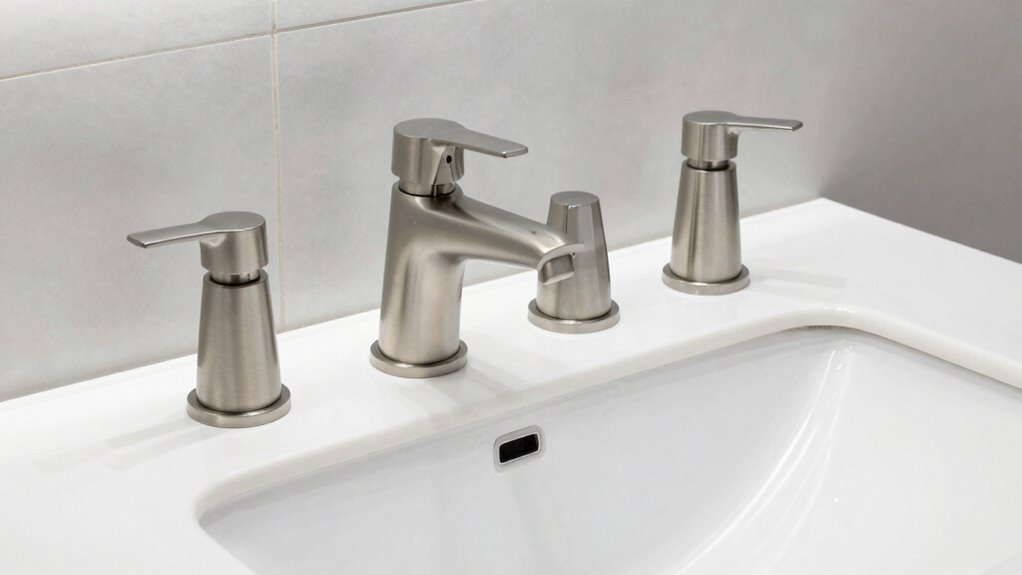

Choosing an ADA-compliant bathroom faucet is about more than finding an accessibility label: the controls must suit the user, and the faucet must fit the sink and installation setting. I put the Gerber Tribune first for a straightforward single-handle setup, while the American Standard Innsbrook Selectronic is the strongest touch-free choice for busy commercial restrooms. The Pfister Jaida adds a two-handle accessible option with WaterSense credentials, though it needs a widespread sink.

Get furniture and decor delivered free with Prime
- Fast, free delivery on millions of items
- Prime Video, Amazon Music and more included
- Member-only deals all year
These picks involve different compromises. A manual lever is direct and avoids battery upkeep, but handle layout and reach still matter. Sensor operation can reduce touching and water use, yet depends on power and sensor placement. Two-handle models offer separate temperature controls, but ask users to operate more than one control. I compare each faucet by its stated accessibility features, installation requirements, flow information, and practical fit—not by appearance alone.
Complete the kit


Key Takeaways
- The Gerber Tribune is my most flexible everyday pick here: it has one ADA-compliant lever and a single-hole installation, but it will not fit every sink.
- The American Standard Innsbrook Selectronic avoids handle operation and is aimed at commercial use; its 0.5 GPM flow and battery-powered sensor are meaningful tradeoffs.
- The Pfister Jaida is the other explicitly identified ADA-compliant manual model, but its two handles and widespread three-hole layout require a suitable sink and user.
- The Moen Weylon offers dual lever handles, a high-arc spout, and WaterSense certification, but the supplied details do not identify it as ADA compliant.
- Before choosing, check the exact sink configuration and the user’s ability to reach and operate controls; a product label alone cannot confirm an accessible installation.
| Gerber Tribune Single Handle Bathroom Faucet – ADA Compliant, Chrome |  | Best Overall | Mounting: Deck mount | Installation: Single hole | Controls: One top-positioned lever handle | VIEW ON AMAZON | See Our Full Breakdown |
| American Standard Innsbrook Selectronic Hands-Free Battery Powered Faucet, 0.5 GPM, Polished Chrome |  | Best for Touch-Free Commercial Use | Model: 6055205.002 | Mounting: 4-inch centerset | Operation: Infrared sensor, hands-free | VIEW ON AMAZON | See Our Full Breakdown |
| Pfister Jaida Waterfall Bathroom Sink Faucet 8-Inch Widespread 2-Handle Chrome |  | Best WaterSense-Certified Two-Handle Pick | Model: LF049JDCC | Installation: Widespread, three-hole | Controls: Two handles | VIEW ON AMAZON | See Our Full Breakdown |
| Moen Weylon 84790SRN Spot-Resist Brushed Nickel Two-Handle High-Arc Bathroom Faucet |  | Best for High-Arc Clearance, With an Accessibility Caveat | Model: 84790SRN | Installation: Four-inch centerset | Controls: Two lever handles | VIEW ON AMAZON | See Our Full Breakdown |
| ada compliant bathroom faucet | Finish | Installation | Controls | Flow rate |
|---|---|---|---|---|
| Gerber Tribune Single Handle B | Chrome | Single hole | One top-positioned lever handle | 1.2 GPM |
| American Standard Innsbrook Se | Polished chrome | — | — | 0.5 GPM |
| Pfister Jaida Waterfall Bathro | Chrome | Widespread, three-hole | Two handles | 1.2 GPM |
| Moen Weylon 84790SRN Spot-Resi | Spot-Resist brushed nickel | Four-inch centerset | Two lever handles | — |
More Details on Our Top Picks
Gerber Tribune Single Handle Bathroom Faucet – ADA Compliant, Chrome
The Tribune takes my top spot because it pairs an expressly ADA-compliant lever with a simple one-handle layout. A single control can make ordinary on-and-off use less involved than managing separate hot and cold handles, and the deck-mounted, single-hole format keeps the installation straightforward when the sink is designed for it. Its all-brass construction and included pop-up drain also make this a more complete residential-style package than the commercial sensor faucet, which serves a different kind of bathroom.
The fixed vertical spout uses a 1.2 GPM flow rate and laminar stream, described as helping limit splashing. That may suit a user who values a controlled stream, though anyone used to a stronger flow should account for the lower rate. The optional cover plate may help with some compatible layouts, but it does not change the faucet’s stated single-hole installation. Unlike the Pfister Jaida, this model keeps operation to one handle; unlike the Innsbrook, it does not rely on a battery or sensor.
My main reservation is fit: buyers need a compatible sink, and a single-handle faucet does not by itself guarantee that the installed controls will be reachable or comfortable for a particular user. The supplied details also do not name a water-saving certification. I would choose it as the most balanced manual option in this lineup, not as a substitute for checking the bathroom’s full accessibility needs.
Pros:- Explicitly identified ADA-compliant lever
- Single handle keeps routine control to one lever
- Brass construction and included pop-up drain
- Laminar stream is described as splash reducing
Cons:- Limited to single-hole installation
- 1.2 GPM may feel slower than a higher-flow faucet
- No water-saving certification is listed in the supplied details
Best for: Buyers seeking a manual faucet with an explicitly ADA-compliant lever, a single control, and a compatible single-hole vanity.
Not ideal for: People with a centerset or widespread sink that cannot accept a single-hole faucet, or buyers who require a stated water-efficiency certification.
- Mounting:Deck mount
- Installation:Single hole
- Controls:One top-positioned lever handle
- Flow rate:1.2 GPM
- Finish:Chrome
- Material:Brass
- Spout:Fixed vertical; laminar flow
- Included items:50/50 pop-up drain; optional cover plate
Our verdict“I rank the Tribune first for its clearly stated accessible lever and practical one-handle design, provided the sink accepts a single-hole faucet.”
American Standard Innsbrook Selectronic Hands-Free Battery Powered Faucet, 0.5 GPM, Polished Chrome
For a restroom where users should not have to grasp or turn a handle, the Innsbrook Selectronic is the lineup’s clearest alternative to the Tribune. Its infrared sensor operation is explicitly listed as ADA compliant, and the faucet is designed for commercial bathrooms with vandal-resistant construction. That combination gives it a distinct role: instead of refining a manual control, it removes handle operation altogether. The stated 0.5 GPM flow rate and claim of saving up to 77% compared with standard 2.2 GPM faucets also make water use a central part of its appeal.
That same setup creates operating dependencies the Gerber avoids. The faucet uses a CR-P2 lithium battery, with a listed life of up to four years, so facilities need a plan for replacement. A fail-safe shutoff before battery depletion is cited, but it does not eliminate maintenance. Sensor response can also be affected by obstructions or low light according to the supplied information; placement and the actual restroom environment deserve attention before choosing it. At 0.5 GPM, it may not deliver the basin experience users expect from the 1.2 GPM Gerber or Pfister.
The listed 4-inch centerset mounting is another point to verify against the sink, and the product’s commercial orientation may be more than a household needs. I would place this model ahead of a manual faucet when hands-free use, heavy traffic, and lower water consumption are priorities. For a quiet home bathroom or anyone unwilling to manage batteries and sensor conditions, the Gerber is the simpler fit.
Pros:- Touch-free sensor operation avoids handle grasping
- Explicitly listed as ADA compliant
- 0.5 GPM flow and stated water-saving claim
- Vandal-resistant design for high-use settings
Cons:- Battery requires eventual replacement
- Sensor operation may be affected by obstructions or low light
- Very low flow may not suit every user’s preference
Best for: Commercial facilities and shared restrooms seeking explicitly ADA-compliant touch-free operation, vandal resistance, and low stated flow.
Not ideal for: Households wanting a simple manual faucet, buyers who do not want battery maintenance, or users who prefer a stronger stream.
- Model:6055205.002
- Mounting:4-inch centerset
- Operation:Infrared sensor, hands-free
- Flow rate:0.5 GPM
- Power:CR-P2 lithium battery
- Listed battery life:Up to 4 years
- Finish:Polished chrome
- Pressure range:20–125 psi
- Other stated features:ADA compliant; vandal resistant
Our verdict“I recommend the Innsbrook for busy commercial bathrooms that benefit from touch-free use and can support sensor and battery upkeep.”
Pfister Jaida Waterfall Bathroom Sink Faucet 8-Inch Widespread 2-Handle Chrome
The Jaida stands out as the manual two-handle faucet in this group with an explicit ADA-compliant claim and named water-efficiency credentials. Its WaterSense and CAL Green listings give buyers a documented efficiency point that the Gerber’s supplied details do not provide. The waterfall spout also gives the faucet a more distinctive look than the Tribune’s conventional fixed vertical spout, while the 1.2 GPM flow rate matches the Gerber rather than the much lower-flow Innsbrook.
Accessibility is not identical across these models, though. The Jaida has two handles, which means users operate separate controls instead of one lever as on the Gerber. Some buyers may prefer independent temperature adjustment, but others may find a two-control routine less convenient. Its widespread three-hole setup is an even firmer constraint: it needs a sink with the right hole arrangement and enough room for separated handles. The single-hole Tribune is more suitable for a compatible compact vanity, while the Jaida is better for a bathroom already designed for widespread fixtures.
Installation features such as TiteSeal and the Push & Seal drain are intended to simplify fitting, but they cannot make an incompatible sink compatible. I would choose this when the layout fits and the combination of two handles, waterfall styling, and stated efficiency matters. Buyers should still assess the actual handle operation and reach for the intended user rather than assuming that an ADA label settles every accessibility question.
Pros:- Explicitly identified as ADA compliant
- EPA WaterSense and CAL Green credentials are listed
- Push & Seal drain and TiteSeal installation features
- 1.2 GPM flow rate
Cons:- Requires a widespread three-hole sink and installation space
- Two handles mean more control steps than the Gerber’s single lever
- Waterfall styling may not suit buyers seeking a conventional spout
Best for: Buyers with an eight-inch widespread, three-hole sink who want a two-handle faucet with stated ADA compliance and water-efficiency credentials.
Not ideal for: Anyone with a single-hole or centerset sink, or users who would find two separate handles harder to operate than one lever or a sensor.
- Model:LF049JDCC
- Installation:Widespread, three-hole
- Controls:Two handles
- Flow rate:1.2 GPM
- Finish:Chrome
- Spout:Waterfall
- Efficiency:EPA WaterSense and CAL Green listed
- Drain:Push & Seal
- Installation feature:TiteSeal technology
Our verdict“The Jaida is my choice for an ADA-labeled, efficiency-minded two-handle faucet when a widespread sink is already in place.”
Moen Weylon 84790SRN Spot-Resist Brushed Nickel Two-Handle High-Arc Bathroom Faucet
The Weylon earns a place in this comparison for buyers who need sink clearance and prefer separate lever controls, but I rank it fourth because the supplied details do not state that it is ADA compliant. Its dual levers and high-arc spout may be useful features, yet neither is a replacement for an explicit accessibility claim or a check of the user’s reach and operating ability. This distinction matters: the Gerber and Jaida are both explicitly labeled ADA compliant, and the Innsbrook is also listed that way.
For a compatible four-inch centerset sink, the high-arc spout gives more room beneath the outlet than a lower profile design may provide. The Spot-Resist brushed nickel finish is described as resisting fingerprints and water spots, and the faucet includes a lift-rod drain assembly and escutcheon plate. WaterSense certification is listed, which sets it apart from the Gerber’s supplied specification sheet. However, the dual-handle arrangement asks the user to operate separate controls, unlike the Tribune’s one-lever layout or the Innsbrook’s sensor activation.
I would treat the Weylon as a candidate for an accessible bathroom only after confirming its compliance status with the manufacturer and checking the specific installation against the user’s needs. It makes more sense when spout clearance, finish, and water efficiency are priorities and the buyer is prepared to verify the accessibility question. If the purchase depends on a stated ADA-compliant faucet, the other three products offer clearer evidence.
Pros:- High-arc spout offers added sink clearance
- WaterSense certification is listed
- Spot-Resist finish is described as resisting fingerprints and water spots
- Includes escutcheon plate and lift-rod drain assembly
Cons:- Supplied product details do not identify it as ADA compliant
- Requires a four-inch centerset sink
- Two handles may be less convenient than one lever or sensor operation
Best for: Buyers prioritizing high-arc sink clearance, a brushed nickel finish, and WaterSense certification who will verify accessibility suitability before purchase.
Not ideal for: Anyone who needs an explicitly ADA-compliant product based on the supplied specifications or whose sink is not a four-inch centerset.
- Model:84790SRN
- Installation:Four-inch centerset
- Controls:Two lever handles
- Spout:High arc
- Finish:Spot-Resist brushed nickel
- Efficiency:WaterSense certified
- Included items:Escutcheon plate and lift-rod drain assembly
- Warranty:Limited lifetime
Our verdict“I would consider the Weylon for clearance and efficiency, but not rely on it as an ADA-compliant pick without direct confirmation.”

How We Picked
I ranked these faucets around the question a buyer actually has: which option is most likely to suit an accessible bathroom, given the product information supplied? I gave the most weight to an explicit ADA-compliance claim and to control style, because a faucet should be operable by the intended user rather than selected on finish alone. That puts the Gerber and American Standard ahead of options whose details are less definitive or whose layouts narrow installation fit.
I also compared installation type, handle count, flow rate where provided, and intended setting. A single-hole faucet can be a practical match for a compatible vanity; a four-inch centerset or widespread faucet depends on existing sink holes. Low flow may conserve water but can feel different at the basin. Sensor control brings touch-free use and commercial durability claims, but adds battery dependence. I treated specifications as supplied rather than filling gaps with assumptions.
ADA claims for a faucet do not certify the whole bathroom or prove that the faucet will work for every person. Reach, approach, sink clearance, water temperature management, and installation height also affect usability. I flag those limitations and do not treat Moen’s lever handles or WaterSense certification as proof of ADA compliance, since its supplied product details make no such claim. The order reflects the strength of the stated accessibility information balanced against fit and operating tradeoffs.
| ada compliant bathroom faucet | Installation | Controls | Finish | Spout |
|---|---|---|---|---|
| Gerber Tribune Single Handle B | Single hole | One top-positioned lever handle | Chrome | Fixed vertical; laminar flow |
| American Standard Innsbrook Se | — | — | Polished chrome | — |
| Pfister Jaida Waterfall Bathro | Widespread, three-hole | Two handles | Chrome | Waterfall |
| Moen Weylon 84790SRN Spot-Resi | Four-inch centerset | Two lever handles | Spot-Resist brushed nickel | High arc |
Factors to Consider When Choosing Ada Compliant Bathroom Faucet
I would narrow the choice by starting with the person who will use the faucet and the sink that must accept it. A faucet can carry an accessibility claim and still be a poor match for a particular user’s reach, grip, or preferred control method. The details below help separate a suitable product from a suitable installation.
Match the control to the user
A single lever, such as the Gerber Tribune’s, keeps routine operation to one control. That may be preferable to separate hot and cold handles, though the lever still needs to be reachable and usable for the individual. The Pfister Jaida and Moen Weylon use two handles; the Jaida is explicitly listed as ADA compliant, while the Weylon’s supplied information does not make that claim. The Innsbrook eliminates manual handle operation through a sensor, but buyers must account for sensor response and battery upkeep. When accessibility is a requirement, verify the manufacturer’s compliance details and consider the user’s actual abilities.
Check the sink-hole layout before choosing
The mounting pattern can rule out an otherwise appealing faucet. The Tribune is single-hole; the Jaida is widespread with three holes and needs space for separated controls; the Moen is designed for a four-inch centerset sink. The Innsbrook also lists 4-inch centerset mounting. Compare those requirements with the sink or countertop, including existing holes, before ordering. An optional cover plate may help with certain layouts, but it does not change the stated installation type. If replacing an existing faucet, measure rather than choosing by finish or style alone.
Balance flow, water use, and daily function
The listed flow rates are 0.5 GPM for the Innsbrook and 1.2 GPM for the Gerber and Jaida. The sensor faucet’s lower flow and stated water-saving comparison may appeal to high-use facilities, while some users may prefer a fuller-feeling stream. The Jaida and Moen list water-efficiency credentials; the supplied Gerber details do not name a certification. Consider the job of the sink and the user’s preferences, and do not assume a certification or lower flow automatically makes a faucet more accessible.
Account for maintenance and operating conditions
Manual faucets avoid electronic power requirements. The Innsbrook’s battery is listed for up to four years, but replacement remains part of ownership, and sensor performance may be affected by obstructions or low light. For commercial settings, its vandal-resistant construction and touch-free operation may justify that added upkeep. At home, a single-lever manual faucet such as the Tribune may be easier to maintain. I would also check service access and the manufacturer’s installation instructions, especially where the faucet will see frequent use.
Treat ADA compliance as one part of bathroom access
A faucet label cannot confirm that the whole sink area is accessible. The finished installation also involves reach, approach, clearance, and temperature control, as well as the user’s ability to operate the chosen control. Confirm current requirements with a qualified professional when compliance affects a project, and ask the manufacturer for documentation if the product listing is unclear. This is especially relevant to the Moen Weylon: its supplied details list dual levers and WaterSense certification but do not identify it as ADA compliant.
Frequently Asked Questions
Which faucet in this roundup is the best starting point for an accessible home bathroom?
I would start with the Gerber Tribune if the sink accepts a single-hole faucet and a manual lever suits the user. It is explicitly identified as ADA compliant and keeps operation to one control. The Pfister Jaida is another stated ADA-compliant option, but its two handles and widespread three-hole layout make it a more specific fit. Confirm the installation and the user’s needs rather than relying on the label alone.
Is a touch-free faucet automatically easier for every user?
No. The American Standard Innsbrook Selectronic avoids handle operation, which can help in some settings, but sensor placement and response matter. Its details also warn that obstructions or low light may affect performance, and its battery will eventually need replacement. A user may prefer the predictability of a manual lever, so I would compare control needs and operating conditions before choosing touch-free operation.
What is the difference between the Gerber Tribune and Pfister Jaida?
The Tribune has one ADA-compliant lever and a single-hole installation, while the Jaida has two handles and requires a widespread three-hole sink. Both list a 1.2 GPM flow rate, but the Jaida also lists WaterSense and CAL Green credentials. I would favor the Tribune for a compatible single-hole vanity and one-control operation, and the Jaida when the sink is widespread and its two-handle layout and efficiency credentials fit the buyer’s priorities.
Can I assume the Moen Weylon is ADA compliant because it has lever handles?
No. The supplied Weylon details describe dual lever handles, a four-inch centerset installation, and WaterSense certification, but they do not state ADA compliance. Lever handles may be easier for some people to operate than knobs, but that feature alone does not establish compliance or suitability for a specific user. If a stated ADA-compliant faucet is required, verify directly with the manufacturer or choose one of the models in this roundup that is explicitly identified as compliant.
What should I measure before buying an ADA-compliant bathroom faucet?
Check the number and spacing of the sink holes, the available room for the faucet and handles, and the spout’s position over the basin. Then consider whether the intended user can reach and operate the controls from the installed position. The Tribune is single-hole, the Innsbrook and Weylon specify four-inch centerset mounting, and the Jaida requires a widespread three-hole setup. For a regulated project, confirm the complete installation against applicable requirements with a qualified professional.
Conclusion
For most buyers who want a clearly identified accessible manual faucet, I would choose the Gerber Tribune when the sink is single-hole and one lever suits the user. For a busy shared or commercial restroom where touch-free use and low flow matter, the American Standard Innsbrook Selectronic is the more purpose-built pick, with battery and sensor maintenance as the tradeoff. Choose the Pfister Jaida if you have a widespread sink and want a two-handle option with stated water-efficiency credentials. I would select the Moen Weylon for its high-arc clearance and finish only after confirming its accessibility status, since the supplied details do not identify it as ADA compliant.
Whichever model you choose, match its mounting pattern to the sink and assess the finished layout for the person who will use it. The strongest product choice is the one whose controls, reach, and installation work together—not simply the faucet with the most appealing feature list.
Evergreen bestsellers Picks

KitchenAid Artisan 5-Qt Tilt-Head Stand Mixer – Dried Rose (KSM150PS)

Hisense 55-Inch E6SR Series Hi-QLED 4K UHD Smart Roku TV (2026 Model)

Ninja Crispi 5-in-1 Glass Air Fryer System, Emerald, FN103BF
As an affiliate, we earn on qualifying purchases.