
Searching for an AV receiver for a 7.2-channel system? My best overall pick is the Onkyo TX-NR7100, which stands out for its THX certification and broader setup flexibility, while the Denon AVR-X1800H is a sensible fit for many first-time home theater builds and the Marantz Cinema 70s suits rooms where a slim chassis matters. The main tradeoffs are channel capacity, room calibration, HDMI and gaming support, and how much space the receiver takes up. Some models offer more features for adding speakers or sources, while simpler receivers can be easier to set up and match to a modest system. I’ll compare all 13 picks by their strengths, limitations, and likely fit so you can choose a receiver that matches your room and plans.

Get furniture and decor delivered free with Prime
- Fast, free delivery on millions of items
- Prime Video, Amazon Music and more included
- Member-only deals all year
Complete the kit


Key Takeaways
- The Onkyo TX-NR7100 is the feature-led pick: its 9.2-channel layout and THX certification give it more room for expanded speaker arrangements than the many 7.2-channel models here.
- Denon’s AVR-X1800H and AVR-X1700H suit practical 7.2 builds: both list 80 watts per channel and built-in HEOS, so buyers should compare their desired connectivity and system needs rather than assume more channels are necessary.
- HDMI claims need context: several receivers advertise 4K120 or 8K support, but buyers should verify the number and type of compatible inputs against their consoles, TV, and source devices.
- The Marantz Cinema 70s fills a distinct space: its slimline design and six HDMI inputs can appeal where cabinet height and device connections matter more than a full-size chassis.
- Not every 7.1 or 9.1 listing signals equal home theater capability: the Pyle models vary in stated channel layout and feature details, so confirm speaker outputs, processing formats, and HDMI capabilities before building a system around one.


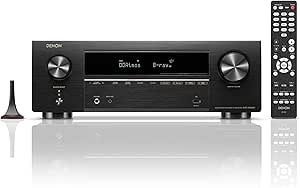


| av receiver 72 channel | Channels | HDMI ports |
|---|---|---|
| Pyle 9.1 Channel AV Receiver w | 9.1 | — |
| Onkyo TX-NR7100 9.2-Channel TH | 9.2 | 8 |
| Yamaha RX300A 5.2-Channel Home | 5.2 | 5 |
| Denon AVR-X1800H 7.2 Channel A | 7.2-channel listing; 7-channel output specification | 4 |
| Pyle 7.1-Channel Hi-Fi Bluetoo | 7.1 | 4 |
| Yamaha RX500A 7.2-Channel Home | 7.2 | 5 |
| Pioneer VSX935 7.2 Channel Net | 7.2 | 8 |
| Onkyo TX-NR6100 7.2 Channel TH | 7.2 | 8 |
| JBL MA710 7.2 Channel 8K AV Re | 7.2 | — |
| Onkyo TX-NR5100 7.2-Channel 8K | 7.2 | 4 |
| Marantz Cinema 70s Slimline 7. | 7.2 | — |
| Pyle 5.2 Channel Hi-Fi Home Th | 5.2 | 4 |
| Denon AVR-X1700H 7.2 Channel A | 7.2 | — |
More Details on Our Top Picks
Pyle 9.1 Channel AV Receiver with Bluetooth Streaming and 8K HDMI Support
For shoppers focused on the “72 channel” query but willing to choose more channels for a larger layout, this Pyle offers 9.1-channel processing, Bluetooth, and 8K/4K HDMI pass-through in one receiver. Its extra channel capacity gives it an advantage over the Denon AVR-X1800H, which is a 7-channel option better suited to a conventional living-room setup. Multiple input types also help connect older sources alongside HDMI devices. The supplied information lists 600 watts, but does not clarify how that figure is allocated across channels, so I would not use it alone to judge speaker-driving power. The stated features are broad, yet the description provides less detail about streaming services and connectivity than the Onkyo TX-NR7100. Choose it for channel count and flexible connections; skip it if detailed network features are your priority.
Pros:- 9.1-channel configuration offers more layout capacity than the 7-channel Denon AVR-X1800H.
- 8K/4K HDMI pass-through supports current high-resolution video sources.
- Bluetooth enables wireless music playback from compatible devices.
- HDMI, USB, optical, coaxial, and auxiliary inputs accommodate varied sources.
Cons:- The 600-watt figure is not broken down by channel in the supplied specifications.
- Streaming-service and network features are not detailed.
- The feature information is less specific about audio calibration than the Onkyo TX-NR7100.
Best for: Home theater owners who want a 9.1-channel layout, Bluetooth music playback, and several types of wired input.
Not ideal for: Buyers who need clearly specified per-channel power or detailed built-in streaming-service support.
- Channels:9.1
- Power:600 watts
- Video support:8K/4K HDMI pass-through
- Video feature:8K upscaling
- Connectivity:Bluetooth, HDMI, USB, optical, coaxial, auxiliary
- Audio setup:Auto calibration and built-in DSP
- Color:Black
Our verdict“Choose this Pyle if you want a 9.1-channel receiver with broad wired inputs and Bluetooth, but not if detailed network and power specifications matter most.”
Onkyo TX-NR7100 9.2-Channel THX Certified AV Receiver
The Onkyo TX-NR7100 is the most feature-detailed choice here for buyers building an ambitious 9.2-channel theater. Its Dirac Live room correction gives it a meaningful distinction from the Pyle 9.1-channel receiver: the Onkyo specifies a room-calibration system, THX certification, and IMAX Enhanced mode, rather than leaning mainly on channel count and connection variety. Eight HDMI ports and 8K/4K transfer at up to 40 Gbps also suit a setup with several modern sources. Its listed 100 watts per channel and 220-watt total power figures should be read as separate supplied specifications, not added together. The tradeoff is a more involved installation, plus a full-size chassis that needs room in a cabinet. For a simpler 7-channel system, the Denon AVR-X1800H is a less elaborate fit.
Pros:- 9.2-channel design supports a more expansive speaker layout than the 7-channel Denon AVR-X1800H.
- Dirac Live room correction provides a specified calibration feature.
- Eight HDMI ports offer ample connections for multiple video sources.
- THX certification, IMAX Enhanced, and listed streaming services broaden its feature set.
Cons:- Setup complexity may be challenging for beginners.
- Full-size dimensions require ample shelf or cabinet space.
- Its extensive feature set may be unnecessary for buyers building a basic 5.1- or 7-channel system.
Best for: Home theater enthusiasts planning a 9.2-channel system who want room correction, multiple HDMI connections, and specified streaming options.
Not ideal for: First-time receiver buyers seeking a straightforward setup, or owners with limited cabinet space and no need for advanced calibration.
- Channels:9.2
- Power per channel:100 watts
- Total power:220 watts
- HDMI ports:8
- HDMI bandwidth:8K/4K at 40 Gbps
- Room correction:Dirac Live
- Audio certifications and modes:THX Certified; IMAX Enhanced
- Wireless and streaming:Bluetooth; Spotify, Amazon Music HD, Pandora, TIDAL, Deezer, and TuneIn
- Dimensions:14.9 in D x 17.13 in W x 6 in H
Our verdict“Pick the TX-NR7100 for a feature-rich 9.2-channel theater with Dirac Live and plentiful HDMI inputs, provided you have room and patience for setup.”
Yamaha RX300A 5.2-Channel Home Theater AV Receiver with Dolby Atmos, 4K120/8K HDMI, Bluetooth Multipoint
The Yamaha RX300A is the clearest choice in this group for a buyer who values simple 5.2-channel placement over expansion. It has fewer channels than the Denon AVR-X1800H and far fewer than the Onkyo TX-NR7100, so it is not aimed at a large immersive speaker array. Instead, its listed 4K120/8K60 support, Dolby Vision, HDR10+, and automatic room correction cover key needs for a smaller system that still connects to a modern TV and game console. Bluetooth Multipoint can make switching between compatible devices easier for casual listening. The compromise is capacity: five HDMI ports and 5.2 channels leave less room for additional sources and speakers than the Denon’s 7-channel design. Its listed 70-watt output also makes it a less convincing fit for large rooms or high-volume playback.
Pros:- 5.2-channel layout keeps the system simpler than the 7-channel Denon AVR-X1800H or 9.2-channel Onkyo TX-NR7100.
- 4K120/8K60 HDMI support suits modern gaming and high-resolution video sources.
- Dolby Vision and HDR10+ support add compatibility with listed HDR formats.
- Bluetooth Multipoint and automatic room correction add useful convenience for a modest setup.
Cons:- Five channels do not match the expansion potential of the Denon AVR-X1800H or Onkyo TX-NR7100.
- Five HDMI ports may constrain systems with many connected devices.
- Listed 70-watt output may be a limiting factor in large rooms or at high listening levels.
Best for: Apartment dwellers and first-time home theater owners building a 5.2-channel setup for a TV, game console, and a few sources.
Not ideal for: Buyers planning 7.1 or larger speaker layouts, connecting many HDMI devices, or filling a large room at high volume.
- Channels:5.2
- Power:70 watts
- HDMI ports:5
- Video support:4K120/8K60 HDMI
- HDR formats:Dolby Vision and HDR10+
- Audio formats:Dolby Atmos and DTS Virtual:X
- Bluetooth:Multipoint
- Room correction:Automatic room correction
Our verdict“Choose the RX300A for a straightforward 5.2-channel system with modern video support, not for a theater you expect to expand to seven or more channels.”
Denon AVR-X1800H 7.2 Channel AV Stereo Receiver (80W x 7), WiFi, Bluetooth
For shoppers whose intended system is specifically 7-channel surround, the Denon AVR-X1800H is a more direct fit than the 5.2-channel Yamaha RX300A without stepping up to the Onkyo TX-NR7100’s 9.2-channel capacity. Its listed 80 watts per channel, Dolby Atmos and DTS:X support, and 8K/60Hz or 4K/120Hz pass-through target a small or medium room with current video sources. HEOS adds multi-room streaming, giving it a networked listening option beyond the Pyle models described mainly around Bluetooth and physical inputs. The tradeoff is that the supplied data lists four HDMI ports, fewer than the Onkyo’s eight, and setup may take more effort than a basic receiver installation. Buyers who need extra channels or specified Dirac Live calibration should compare the Onkyo; those who want a conventional 7-channel room are better served here.
Pros:- Seven-channel design is a better fit for a standard surround setup than the Yamaha RX300A’s 5.2-channel layout.
- Listed 80 watts per channel supports a practical small- or medium-room use case.
- 8K/60Hz and 4K/120Hz pass-through accommodate modern video sources.
- HEOS supports multi-room streaming, unlike the Bluetooth-focused Pyle descriptions.
Cons:- Four HDMI ports offer fewer connections than the Onkyo TX-NR7100’s eight.
- Seven channels cannot match the Onkyo’s 9.2-channel expansion capacity.
- Setup may require more technical effort than a basic receiver installation.
Best for: Small- to medium-room theater owners who want seven-channel audio, modern video pass-through, and multi-room streaming.
Not ideal for: Buyers planning a 9-channel speaker layout, needing more than four HDMI connections, or seeking the Onkyo TX-NR7100’s specified Dirac Live correction.
- Channels:7.2-channel listing; 7-channel output specification
- Output power:80 watts x 7
- HDMI ports:4
- Video pass-through:8K/60Hz and 4K/120Hz
- Surround formats:Dolby Atmos and DTS:X
- Connectivity:Bluetooth
- Streaming:HEOS; Amazon Music, Spotify, and TIDAL
- Color:Black
Our verdict“Choose the AVR-X1800H for a modern 7-channel room with HEOS multi-room audio, but look to the Onkyo TX-NR7100 if you need more channels or HDMI inputs.”
Pyle 7.1-Channel Hi-Fi Bluetooth Stereo Amplifier – 2000 Watt AV Home Theater Receiver with Radio, USB, RCA, HDMI, Microphone Inputs, Supports 4K HD TV & 3D
This Pyle takes a different route from the Denon AVR-X1800H: its appeal is not a richer network feature set, but a 7.1-channel layout paired with HDMI, RCA, USB, optical, coaxial, and microphone inputs. That mix may suit a multipurpose room where older components, wired sources, or microphones need to coexist. It also lists Bluetooth 5.0 and 4K/3D video pass-through, while the Denon brings 8K support and HEOS multi-room streaming. The headline 2000-watt maximum is not presented as per-channel output, so I would not treat it as directly comparable to the Denon’s 80 watts per channel. The Pyle’s listed features also omit built-in Wi-Fi and streaming services. Pick it for physical input variety and microphone use; skip it if networked music or clearly specified channel power is central to your choice.
Pros:- 7.1-channel configuration offers more speaker capacity than the Yamaha RX300A’s 5.2-channel layout.
- Microphone inputs suit occasional karaoke or voice-amplification use.
- HDMI, RCA, USB, optical, and coaxial inputs support a broad mix of sources.
- Bluetooth 5.0 and 4K/3D pass-through cover wireless playback and basic modern video needs.
Cons:- The 2000-watt figure is specified as maximum power, not as per-channel output comparable to the Denon AVR-X1800H.
- No built-in Wi-Fi or streaming services are listed.
- 4K/3D support lacks the 8K pass-through specified for the Denon AVR-X1800H.
Best for: Owners of a multipurpose media room who need 7.1 channels, microphone inputs, and connections for legacy RCA or optical equipment.
Not ideal for: Buyers seeking built-in Wi-Fi streaming, 8K video support, or a clearly stated per-channel power rating.
- Channels:7.1
- Power output:2000 watts maximum
- Speaker impedance:4–16 ohms
- Bluetooth:Version 5.0; listed wireless range 30+ ft
- HDMI ports:4
- Input interfaces:HDMI, RCA, USB, optical, coaxial, and microphone inputs
- Video support:4K HD and 3D pass-through
- Dimensions:16.9 x 13.8 x 5.5 inches
- Power supply:115V/240V switchable
Our verdict“Choose this Pyle for a 7.1-channel room that needs microphone and legacy-device inputs, but select the Denon if you want 8K video and HEOS streaming.”
Yamaha RX500A 7.2-Channel Home Theater AV Receiver with Dolby Atmos, 4K120/8K HDMI, Wi-Fi and Streaming
The RX500A earns this spot by pairing 7.2-channel Dolby Atmos and DTS:X support with a broad set of built-in music services. Spotify, Google Cast, AirPlay 2, TIDAL, and Qobuz give listeners more ways to stream than the Pioneer VSX935, whose listed strengths focus more on connections and amplification. Its 4K/120 and 8K/60 video support also suits a system shared by current consoles and a high-resolution TV, while automatic room correction can help adapt sound to the room. The tradeoff is 70 watts of stated power, below the Onkyo TX-NR6100’s listed output, and setup may take patience for first-time receiver owners. The supplied product data also omits dimensions and weight, making cabinet planning harder.
Pros:- Supports Dolby Atmos and DTS:X in a 7.2-channel configuration.
- Lists 4K/120 and 8K/60 video support with Dolby Vision, HDR10+, and HLG.
- Broad streaming selection includes Spotify, Google Cast, AirPlay 2, TIDAL, and Qobuz.
- Automatic room correction can help tune playback to the listening space.
Cons:- Listed output is 70 watts, lower than the Onkyo TX-NR6100’s stated 210 watts per channel.
- Setup complexity may frustrate buyers new to multichannel receivers.
- Dimensions and weight are not provided in the supplied product data.
Best for: Movie and music listeners who want built-in access to several streaming services alongside Atmos and high-refresh-rate gaming support.
Not ideal for: Buyers prioritizing higher stated amplifier output, a simple first-time setup, or confirmed chassis dimensions before choosing a cabinet.
- Channels:7.2
- Power:70 watts
- HDMI ports:5
- Video support:4K/120, 8K/60
- HDR support:Dolby Vision, HDR10+, HLG
- Streaming services:Spotify, Google Cast, AirPlay 2, TIDAL, Qobuz
- Speaker layout support:5.2.2, 7.2
- Room correction:Yes
Our verdict“Choose the RX500A if wide streaming support matters as much as Atmos and modern video, but compare amplifier output and setup needs before buying.”
Pioneer VSX935 7.2 Channel Network AV Receiver
The Pioneer VSX935 makes most sense when a system has many wired sources: its eight HDMI ports outnumber the Yamaha RX500A’s five and the JBL MA710’s six. That can keep consoles, a disc player, and other components connected without frequent cable swaps. It also supports Dolby Atmos and DTS:X, with Wi-Fi and Bluetooth for wireless connections. Its power figures need context: the listed 170-watt figure is measured at 6 ohms with 10% THD, while the more conservative rating is 80 watts at 8 ohms across the stated frequency range. Compared with the Onkyo TX-NR6100, the Pioneer has fewer supplied details about gaming features and HDMI version. Its substantial chassis also calls for more shelf space, and the product data provides little guidance on software updates.
Pros:- Eight HDMI ports accommodate more wired sources than the Yamaha RX500A or JBL MA710.
- Supports Dolby Atmos and DTS:X.
- Includes both Wi-Fi and Bluetooth connectivity.
- Provides a stated 80-watt rating at 8 ohms across 20Hz–20kHz.
Cons:- The 170-watt figure is specified at 6 ohms and 10% THD, so it is not directly comparable to typical continuous ratings.
- Its listed dimensions require a roomy equipment shelf.
- The supplied data gives limited detail about software updates and HDMI features.
Best for: Home theater owners with several HDMI source devices who want a 7.2 receiver with Atmos, DTS:X, and network connectivity.
Not ideal for: Buyers with a shallow or compact equipment shelf, or shoppers who need clearly specified HDMI 2.1 and gaming capabilities.
- Channels:7.2
- Additional power figure:170W at 6 ohms, 1kHz, 10% THD
- HDMI ports:8
- Connectivity:Bluetooth, HDMI, USB, Wi-Fi, IR
- Dimensions:14.56 × 17.13 × 6.81 inches
- Weight:20.7 pounds
- Warranty:1 year
Our verdict“Pick the VSX935 if you need eight HDMI connections and can accommodate its chassis, but choose a more clearly specified option for gaming-focused HDMI features.”
Onkyo TX-NR6100 7.2 Channel THX Certified Network AV Receiver – Black
The TX-NR6100 is the strongest fit here for buyers who put gaming connections and stated amplifier output high on the list. Its product data specifies HDMI 2.1, 4K/120, and 8K/60, plus gaming features and multiple HDMI outputs, giving it a more explicitly gaming-focused pitch than the Pioneer VSX935. It also combines THX certification with Dolby Atmos and DTS:X support. The listed 210 watts per channel is a standout figure in this group, though the supplied information does not include measurement conditions, so it should not be treated as a direct apples-to-apples comparison with the Pioneer’s detailed 80-watt rating. This receiver is also described as large and heavy, and setup may be a hurdle for newcomers. Buyers wanting a shorter chassis or a simpler system may prefer another option.
Pros:- Lists HDMI 2.1 with 4K/120 and 8K/60 support.
- Supports Dolby Atmos, DTS:X, and THX certification.
- Includes multiple HDMI outputs and gaming features.
- Lists Apple HomeKit and Google Assistant voice control.
Cons:- Its large, heavy chassis may not fit smaller equipment spaces.
- Setup may be challenging for beginners.
- The stated 210-watt-per-channel figure lacks measurement conditions in the supplied data.
Best for: Console and home theater owners seeking HDMI 2.1 gaming support, immersive formats, and a receiver positioned for a higher-output system.
Not ideal for: First-time receiver buyers who want a straightforward setup, or anyone with limited cabinet space or a need for fully specified power measurements.
- Channels:7.2
- Power output:210 watts per channel (conditions not specified)
- HDMI ports:8
- HDMI version:HDMI 2.1
- Supported resolutions:8K at 60Hz, 4K at 120Hz
- Connectivity:Bluetooth, Wi-Fi
- Voice control:Apple HomeKit, Google Assistant
- Warranty:2 years parts and labor
Our verdict“Choose the TX-NR6100 for a gaming-centered 7.2 system with HDMI 2.1 and THX certification, provided its size and setup demands suit your room.”
JBL MA710 7.2 Channel 8K AV Receiver (Black)
The JBL MA710 has a distinct advantage for buyers combining a turntable with a modern TV setup: its moving-magnet phono input is a specific convenience that the supplied descriptions for the Yamaha RX500A and Onkyo TX-NR6100 do not mention. It also covers the core home theater brief with 7.2 channels, Atmos, DTS:X, and 8K video. AirPlay 2, Chromecast, and Bluetooth offer several ways to send music to the receiver, while its stated 110 watts per channel exceeds the RX500A’s 70-watt figure; rating conditions are not supplied, so the numbers are not directly comparable. The six HDMI inputs are fewer than the Pioneer VSX935’s eight. The listing identifies Wi-Fi antennas but does not clearly specify built-in Wi-Fi as a streaming feature, so buyers should verify that detail if network streaming is central to their setup.
Pros:- Moving-magnet phono input supports direct connection of a compatible turntable.
- Supports Dolby Atmos, DTS:X, and 8K video.
- Offers Bluetooth, AirPlay 2, and Google Chromecast.
- Lists 110 watts per channel.
Cons:- Six HDMI inputs are fewer than the Pioneer VSX935’s eight.
- The supplied data does not clearly confirm built-in Wi-Fi for streaming.
- The listed warranty is one year, and power-rating conditions are not specified.
Best for: Vinyl listeners building a 7.2 home theater who also want AirPlay 2, Chromecast, Bluetooth, and 8K video support.
Not ideal for: Buyers who need more than six HDMI inputs or require clearly documented Wi-Fi streaming and a longer stated warranty.
- Channels:7.2
- Power:110 watts per channel
- HDMI inputs:6
- Video resolution support:8K
- Audio decoding:Dolby Atmos, DTS:X
- Wireless streaming:Bluetooth, Apple AirPlay 2, Google Chromecast
- Additional input:Moving-magnet phono input
- Control:Remote, IP control
Our verdict“The MA710 is a compelling match for turntable owners who want 8K and wireless music options, but check its network details and input count against your system.”
Onkyo TX-NR5100 7.2-Channel 8K Smart AV Receiver – Black
The TX-NR5100 is the more restrained Onkyo choice in this group: its listed 80-watt output and four HDMI ports suit a system with a few sources rather than the eight-device flexibility of the VSX935 or TX-NR6100. It still brings a 7.2 surround configuration and 8K and HDMI 2.1 features, so buyers do not have to give up the newer video direction just to keep the setup modest. Chromecast built-in, AirPlay 2, and DTS Play-Fi add ways to stream, while Klipsch Optimize Mode may appeal to owners of compatible Klipsch speakers. Compared with the TX-NR6100, the TX-NR5100 has fewer listed HDMI connections and a lower stated output, making it a less compelling match for a demanding multi-source or high-output system. The supplied description mentions voice-assistant compatibility, but detailed connectivity and update information is limited.
Pros:- Combines 7.2-channel surround with 8K video and HDMI 2.1 features.
- Supports Chromecast built-in, AirPlay 2, and DTS Play-Fi.
- Includes Klipsch Optimize Mode for compatible Klipsch speakers.
- Lists a two-year parts-and-labor warranty.
Cons:- Four HDMI ports provide less connection capacity than the TX-NR6100 or Pioneer VSX935.
- Listed output is 80 watts, below the TX-NR6100’s stated figure.
- The supplied specifications provide limited detail on software updates and network connectivity.
Best for: Buyers building a 7.2 system around a TV, game console, and a small number of other sources who want 8K support and network audio services.
Not ideal for: Owners with many HDMI devices or buyers seeking the TX-NR6100’s listed higher output and fuller gaming-feature detail.
- Channels:7.2
- Output power:80 watts
- HDMI ports:4
- Video support:8K; HDMI 2.1 features
- Streaming services:Chromecast built-in, AirPlay 2, DTS Play-Fi
- Connectivity:Bluetooth
- Special feature:Klipsch Optimize Mode
- Warranty:2 years parts and labor
Our verdict“Choose the TX-NR5100 for a modest-source 7.2 setup that still needs 8K features, but move up to the TX-NR6100 if you need more inputs or higher listed output.”
Marantz Cinema 70s Slimline 7.2 Channel AV Receiver with HEOS, Dolby Atmos, 8K, and 6 HDMI Inputs
The Marantz Cinema 70s is the space-saving choice for a 7.2-channel system: at just over four inches tall, it can fit where a taller receiver may not. It still brings Dolby Atmos, DTS:X, HEOS, and 8K-compatible HDMI pass-through, so the compact chassis does not mean giving up current formats or network streaming. Compared with the Denon AVR-X1700H, its clearest distinction is its unusually low profile, while Denon offers more rated power at 80 watts per channel versus Marantz’s 50. That lower output makes the Cinema 70s a less suitable match for a very large room or demanding speakers. Its six HDMI inputs add flexibility, but the feature set can take more setup work than a simple stereo system needs. I’d choose it for a polished, compact installation, not for maximum headroom.
Pros:- Slim, just-over-four-inch-tall chassis suits restrictive media spaces.
- Supports Dolby Atmos and DTS:X for immersive surround sound.
- Three 8K-compatible pass-through connections and six HDMI inputs support varied sources.
- Built-in HEOS, Wi-Fi, and Bluetooth provide network and wireless audio options.
Cons:- 50 watts per channel offers less output headroom than the Denon AVR-X1700H’s 80 watts per channel.
- Its extensive features may make setup and configuration demanding for less technical buyers.
- The slim form factor and feature set may be excessive for a basic TV-and-speaker setup.
Best for: Home theater buyers who need a full-featured 7.2-channel receiver that can fit in a low media cabinet or open shelf.
Not ideal for: Owners of large rooms or power-hungry speakers who need more than 50 watts per channel, and casual users who want a straightforward setup.
- Channels:7.2
- Power per channel:50 W
- HDMI inputs:6
- 8K-compatible HDMI pass-through:3 inputs
- Supported video formats:HDR10+, HDR10, Dolby Vision, HLG
- Supported audio formats:Dolby Atmos, DTS:X
- Wireless and streaming:Wi-Fi, Bluetooth, HEOS
- Height:Just over 4 inches
Our verdict“Choose the Cinema 70s when cabinet clearance matters more than the extra power offered by the Denon AVR-X1700H.”
Pyle 5.2 Channel Hi-Fi Home Theater Receiver – 1000W MAX Wireless Bluetooth Surround Sound Stereo Amplifier System with 4K Ultra HD Support, MP3/USB/DAC
The Pyle 5.2-channel receiver is the simplest fit here for a buyer who needs basic surround sound, 4K pass-through, and direct playback options rather than a 7.2-channel platform. Its Bluetooth, USB, MP3, and digital-audio inputs give it practical ways to connect music sources, while two microphone inputs make it more flexible for mixed home audio use. The headline “1000W max” is not directly comparable to the per-channel ratings listed for the Denon AVR-X1700H or the Marantz Cinema 70s, so I would not treat it as evidence of greater real-world room-filling power. It also lacks the listed 8K support, immersive-format detail, and HEOS streaming of those receivers. Choose Pyle for a straightforward 4K system with varied inputs; skip it if you want a clearly specified modern Atmos setup.
Pros:- 5.2-channel configuration supports a basic surround setup with two subwoofer connections.
- 4K Ultra HD pass-through suits a 4K television-based system.
- Bluetooth and USB/MP3 playback offer convenient ways to play music.
- Two microphone inputs add flexibility beyond typical TV and movie use.
Cons:- The listed 1000-watt maximum does not provide a per-channel rating comparable to the Denon and Marantz models.
- The provided specifications do not list 8K pass-through or Dolby Atmos and DTS:X support.
- Its 5.2-channel layout has less speaker expansion capacity than the 7.2-channel alternatives.
Best for: Buyers building a basic 4K, 5.2-channel system who value Bluetooth, USB playback, and microphone inputs over networked Atmos features.
Not ideal for: Home theater shoppers seeking 7.2 channels, specified Dolby Atmos support, 8K pass-through, or a per-channel power rating for comparison.
- Channels:5.2
- Maximum power:1000 W maximum
- HDMI ports:4
- Video support:4K Ultra HD pass-through
- Wireless connectivity:Bluetooth
- Playback inputs:USB, MP3, digital audio
- Microphone inputs:2
- Control method:Remote
Our verdict“Pick this Pyle for a basic 4K surround setup with flexible wired and wireless inputs, but not for a feature-rich 7.2-channel theater.”
Denon AVR-X1700H 7.2 Channel AV Receiver – 80W/Channel, Built-in HEOS
The Denon AVR-X1700H is the strongest all-round fit in this group for buyers pairing a 7.2-channel theater with modern gaming and video sources. Its stated support for 4K/120Hz and 8K/60Hz pass-through gives compatible devices a route to high-frame-rate gaming as well as newer 8K video, and 80 watts per channel provides more rated output than the Marantz Cinema 70s. Both include six HDMI inputs, HEOS, and immersive audio support, but Marantz is the better match when a low-profile chassis is the priority. Denon’s tradeoff is the more conventional, larger receiver format and a setup process that may call for some technical patience. Voice-control compatibility and HEOS multi-room streaming extend its use beyond movie playback, though those extras may be unnecessary for a basic TV system.
Pros:- 80 watts per channel is a higher stated output than the Marantz Cinema 70s.
- Supports 4K/120Hz and 8K/60Hz pass-through for compatible video sources.
- HEOS supports multi-room music streaming over Wi-Fi.
- Works with Alexa, Google Assistant, and Siri voice-control ecosystems.
Cons:- Setup and feature configuration may require technical knowledge.
- Its full-featured design may be unnecessary for buyers with basic home theater needs.
- Unlike the Marantz Cinema 70s, it is not presented as a slimline receiver for low-clearance spaces.
Best for: Home theater and gaming buyers who want a 7.2-channel receiver with 4K/120Hz support, HEOS streaming, and voice-control compatibility.
Not ideal for: Buyers with limited cabinet height who favor the Marantz Cinema 70s slimline design, or anyone needing only basic TV audio.
- Channels:7.2
- Power per channel:80 W
- HDMI inputs:6
- HDMI outputs:1
- Video pass-through:8K/60Hz, 4K/120Hz
- Supported video formats:HDR10+, Dolby Vision, HLG
- Wireless connectivity:Bluetooth, Wi-Fi
- Voice control:Alexa, Google Assistant, Siri
Our verdict“Choose the AVR-X1700H for a 7.2-channel system that needs higher rated power and 4K/120Hz support, rather than the Marantz’s slimmer profile.”

How We Picked
I ranked these receivers by how well their stated capabilities match common 7.2-channel buying needs: channel layout, HDMI generation and gaming support, network and streaming features, room for system expansion, and ease of matching the receiver to a room and speaker setup. I also separated useful, buyer-relevant distinctions from headline numbers; for example, a claimed wattage or maximum power figure is not a direct comparison unless measurement conditions and channel loading are clear.
The Onkyo TX-NR7100 leads because its 9.2-channel design and THX positioning give it more flexibility than a basic 7.2 receiver, while Denon’s X1800H is a more approachable match for a typical 7.2 build. The remaining order reflects specific advantages such as slim dimensions, listed HDMI support, and simpler feature sets, balanced against less complete published specifications or narrower use cases. The Pyle models appear lower because their product names make broad power and format claims, but buyers should confirm the exact outputs and compatibility they need before choosing them over the better-documented options.
Factors to Consider When Choosing Av Receiver 72 Channel
Before choosing a receiver, I’d match its real capabilities to the room and equipment you have now, then check whether it can support the system you might add later. These factors help separate useful headroom from features that sound impressive but may not change your setup.
Choose the channel layout for your actual speaker plan
A 7.2 receiver generally supports up to seven main speaker channels and two subwoofer outputs, but the exact speaker arrangements depend on the model’s processing and setup options. A 9.2 receiver such as the Onkyo TX-NR7100 offers additional layout flexibility, which matters if you plan to add height channels or reconfigure the room. Don’t buy extra channels simply because a bigger number sounds safer; unused processing capacity may not improve a system that will stay at 5.1 or 7.1. Check the manual’s supported layouts and whether channels can be reassigned for your intended use. Also distinguish two subwoofer connections from two independently calibrated subwoofer outputs, since those are not always equivalent. Map the speakers you own and the ones you expect to add before comparing models.
Match HDMI ports to every source, not just the TV
Count the devices that need direct connections, including a game console, streaming box, disc player, and cable or satellite receiver. Then check which HDMI inputs support the video features you actually use; a receiver may advertise 8K or 4K120 without offering that capability on every port. Confirm that your television and source devices share the needed standards, since the receiver sits in the middle of that signal path. Buyers who game should check refresh-rate and variable-refresh support rather than relying on a broad “gaming” label. Don’t overlook HDMI output needs either, particularly if the system uses a second display or projector. Leaving one spare input can prevent an early upgrade when the equipment list grows.
Treat power figures as a matching guide, not a score
Receiver wattage is useful only when compared under similar testing conditions, including the number of channels driven and the measurement method. Large maximum-power figures, such as those in some Pyle product names, may not describe sustained output across a full surround setup. Speaker sensitivity, listening distance, room size, and desired volume all affect how much power a system needs. A compact room with efficient speakers may work well with a more modest receiver, while a large room or demanding speakers can benefit from stronger amplification and more headroom. If your speakers have unusual impedance or low sensitivity, check the receiver’s supported load and seek reliable independent measurements. Avoid paying for a headline number without checking what it represents.
Decide which room correction and setup tools you need
Room correction can help compensate for speaker placement and room acoustics, but the included system and adjustment options vary by receiver. A first-time buyer may value a guided setup process and clear on-screen instructions more than advanced manual controls. Experienced users may want finer control over speaker distances, crossover settings, equalization, and subwoofer integration. Room correction cannot fix poor speaker placement or make an undersized subwoofer perform like a larger one, so it should be treated as a tuning aid rather than a cure-all. Check whether the receiver’s calibration microphone is included and whether its setup process supports your speaker arrangement. A simpler receiver can be the better choice if its tools cover your needs without adding extra setup complexity.
Choose streaming and control features around your household
Built-in Wi-Fi, Bluetooth, and network audio can reduce the number of external boxes, but each serves a different purpose. Bluetooth is convenient for quick playback from a phone, while network streaming is usually more useful for a shared home system and multiroom listening. Check which services and control apps are supported in your region, and whether your household prefers app control, a physical remote, or both. Features such as Bluetooth multipoint can help when multiple people take turns connecting, but they may matter less if the receiver will mainly handle TV and console audio. Consider how the receiver will integrate with existing speakers or other network products before choosing a platform. Keep the network features you will use; don’t let a long feature list distract from the connections and sound formats your system requires.
Measure the cabinet and plan for heat and access
Receiver dimensions can rule out a model even when its feature set looks right. The Marantz Cinema 70s is the clear slimline option in this roundup, while full-size receivers need more cabinet height and breathing room. Measure the usable space, including clearance above the chassis, rather than checking only the shelf’s width and depth. Leave room for cables to bend behind the unit and for airflow, especially if the receiver will power several speakers at high volume. A tight, enclosed cabinet can raise operating temperatures and make future cable changes frustrating. A smaller chassis is useful only if its channel capacity and connections still match your system.
Frequently Asked Questions
Do I need a 9.2 receiver if my current system has seven speakers?
Not necessarily. A 7.2 receiver can be a good match for a seven-speaker layout with up to two subwoofer connections, provided its supported configuration matches your speakers. A 9.2 model such as the Onkyo TX-NR7100 makes more sense if you plan to add channels, want additional layout options, or value its other features. Check the receiver’s manual for supported speaker arrangements rather than relying on the channel count alone. If your setup is unlikely to grow, spending on better-matched speakers or a subwoofer may matter more than unused channels.
Can I use an 8K receiver with a 4K TV and current game console?
Yes, an 8K-capable receiver can be used with 4K equipment, and it may also support high-refresh 4K signals when the right HDMI inputs and settings are used. The “8K” label by itself does not confirm that every port supports the gaming features you want. Check the receiver’s specifications for the exact input support, then compare those details with the TV and console. If the TV has enough suitable HDMI inputs, connecting a console directly to it may be another option, with audio returned to the receiver through eARC. Choose based on the whole signal path, not a single headline format.
Should I choose the Denon AVR-X1800H or AVR-X1700H for a new 7.2 setup?
Both listings describe 7.2-channel receivers with 80 watts per channel and built-in HEOS, so the channel count and headline output do not settle the choice. Compare the exact HDMI capabilities, supported formats, input needs, and setup features for the specific version available to you. The newer model may suit buyers who need its particular connectivity or format updates, while the X1700H may be enough if its ports already cover the system. Check the manuals for the number of inputs that support your gaming and video requirements. Neither is a reason to pay for features your sources cannot use.
Are the Pyle receivers a safe choice for a full surround speaker system?
They may suit buyers seeking a broad mix of connections or a straightforward amplifier, but the product names alone do not provide enough detail to compare sustained multichannel performance. Before choosing one, verify the number of amplified speaker outputs, supported surround formats, HDMI input and output behavior, and how power is specified. Confirm that its speaker connections and impedance support match your speakers. The Pyle models should not be treated as interchangeable with better-documented network AV receivers simply because their listings use large wattage claims. If your system depends on a specific format or gaming feature, get confirmation in the manual before buying.
Is a slimline receiver a good choice for a cabinet with limited space?
A slimline model such as the Marantz Cinema 70s can fit a lower cabinet shelf more easily than a full-size receiver, but height is only one part of the fit. Check depth, cable clearance, ventilation, and the receiver’s recommended space around the chassis. A smaller body does not automatically mean it can drive every speaker or support every layout you might want. Compare its channel capabilities and inputs against your system before choosing it for its dimensions alone. If the cabinet is enclosed, airflow may matter more than a small difference in receiver height.
Conclusion
For the best overall fit, I’d choose the Onkyo TX-NR7100 if you want a 7.2 system with room to explore more speaker layouts and value its THX-certified positioning. For a practical 7.2 build, the Denon AVR-X1800H is my best-value direction among the well-specified options, while the AVR-X1700H remains worth comparing when its particular connections meet your needs. For a premium, space-conscious setup, the Marantz Cinema 70s is the standout slimline pick; buyers who want a more full-featured, conventional chassis can compare the Onkyo TX-NR7100. For beginners, I’d start with the Denon AVR-X1800H and confirm its HDMI inputs and setup features cover the equipment you own. Choose the Yamaha RX300A if a 5.2 layout is enough, or the Pyle models only when their verified connections and speaker support fit a simpler system. Before ordering, match the receiver’s exact layout and HDMI capabilities to your speakers, TV, and sources.