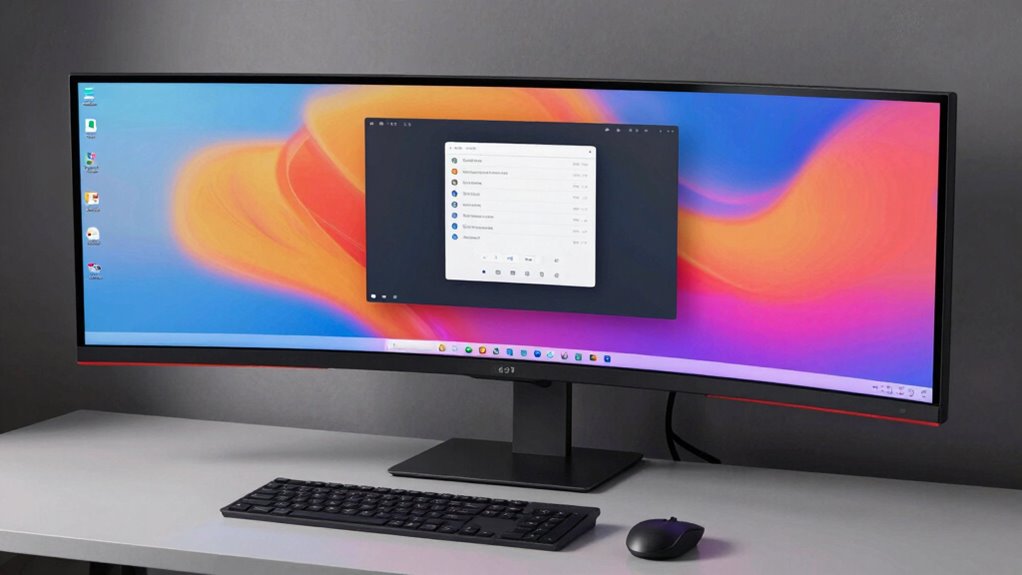

If you’re searching for an ultrawide monitor 49 inch, you’re looking at the widest mainstream format that replaces dual monitors with a single curved panel. The best overall pick is the Samsung 49″ Odyssey G9 (G91F) for its balanced mix of DQHD resolution, 144Hz refresh, and ergonomic stand. For pure image quality, the Samsung Odyssey G93SC QD-OLED leads with perfect blacks and a 240Hz refresh, while the CRUA 49-Inch DQHD 165Hz delivers the best value for budget gamers. The real tradeoffs come down to resolution (3840×1080 vs 5120×1440 vs 5K2K), panel type (VA vs OLED), and connectivity like USB-C with power delivery. Read on for the full breakdown of all 15 monitors and how to choose the right one for your desk.

Get furniture and decor delivered free with Prime
- Fast, free delivery on millions of items
- Prime Video, Amazon Music and more included
- Member-only deals all year
Complete the kit


Key Takeaways
- Samsung dominates the premium tier with three distinct models: the G91F for balanced performance, the G93SC QD-OLED for image quality, and the G9 240Hz for high-refresh gaming.
- Budget brands like CRUA and ZZA now offer DQHD 5120×1440 at 165Hz for roughly half the price of Samsung, making value a real option without sacrificing resolution.
- 3840×1080 panels (like the INNOCN 144Hz) are significantly cheaper but have lower pixel density, making them better for gaming than text-heavy productivity work.
- 5K2K (5120×2160) models from INNOCN and Deco Gear are the productivity winners, offering sharper text and extra vertical space, but they top out at 120Hz and need a powerful GPU.
- Connectivity separates office-focused monitors: USB-C with 65W power delivery and KVM switching (found on Deco Gear and Samsung Business) justify a higher price for multi-device setups.
- OLED panels like the G93SC and G91SD deliver unmatched contrast and response times, but they cost more and require burn-in precautions, making VA panels the safer mainstream choice.


| ultrawide monitor 49 inch | Screen size | Refresh rate | Resolution | Aspect ratio |
|---|---|---|---|---|
| INNOCN 49-Inch Curved Ultrawid | 49 inches | 144Hz | 3840 × 1080 | 32:9 |
| Samsung 49" Odyssey G93SC Seri | 49 inches | 240Hz | 5120 × 1440 | — |
| CRUA 49-Inch DQHD Ultrawide Cu | 49 inches | 165Hz | 5120 × 1440 | — |
| Deco Gear 49" Curved Super Ult | 49 inches | 165Hz | 5120 × 1440 | 32:9 |
| SAMSUNG 49-inch Odyssey G9 | 49 inches | 144Hz | 5120 × 1440 | 32:9 |
| Samsung 49” Odyssey G9 Series | 49 inches | 240Hz | — | 32:9 |
| Samsung 49-Inch Odyssey OLED G | 49 inches | 144Hz | 5120 × 1440 (Dual QHD) | 32:9 |
| ZZA Ultrawide 49-Inch Curved M | 49 inches | 165Hz | 5120 × 1440 | — |
| CRUA 49-Inch DQHD Ultrawide Cu | 49 inches | 120Hz | 5120 × 1440 (DQHD) | — |
| Samsung 49” Business Curved Ul | 49 inches | 120Hz | 5120 × 1440 | 32:9 |
| INNOCN 49-Inch Curved Ultrawid | 49 inches | 120Hz | 5120×1440 | 32:9 |
| Deco Gear 49 Inch Curved Ultra | 49 inches | 120Hz | 5120×1440 | 32:9 |
| Deco Gear 49" Curved Super Ult | 49 inches | 120Hz | 5120×1440 | 32:9 |
| Acer Nitro 49in DQHD 5120×1440 | 49 inches | 120Hz | 5120×1440 | 32:9 |
| Deco Gear 49" Super Ultrawide | 49 inches | 120Hz | 5120×1440 | 32:9 |
More Details on Our Top Picks
INNOCN 49-Inch Curved Ultrawide Gaming Monitor 144Hz 32:9 WDFHD 3840 x 1080P HDR400 USB-C DisplayPort HDMI
The INNOCN earns a place for buyers who want the 49-inch, 32:9 format and a responsive gaming experience without needing the sharper Dual QHD panels found in the CRUA 49-inch DQHD or Samsung Odyssey G9 G91F. Its 3840 × 1080 resolution gives games and desktop windows plenty of horizontal room, but spreads fewer pixels across the same width, so text and fine detail look less crisp. The 144Hz refresh rate, adaptive sync, and 1ms response time suit fast play, while USB-C with 65W power delivery can simplify a compatible laptop setup. I’d choose it for gaming and broad multitasking, not detail-critical creative work. The large footprint still calls for a deep, wide desk, and the supplied information offers little detail on color accuracy.
Pros:- 49-inch 32:9 curved screen provides room for immersive games and side-by-side windows.
- 144Hz refresh rate and adaptive sync support smooth gaming.
- USB-C supplies up to 65W power delivery for a compatible laptop.
- Height, tilt, and swivel adjustments give more positioning flexibility.
Cons:- 3840 × 1080 has substantially fewer pixels than the DQHD alternatives, reducing fine-detail sharpness.
- The wide display needs substantial desk space.
- Color accuracy and build-quality details are not specified.
Best for: Gamers who want a 49-inch panoramic screen, 144Hz motion, and USB-C laptop charging, and who are comfortable with 3840 × 1080 resolution.
Not ideal for: People who need sharp text or precise visual detail across a 49-inch workspace; the CRUA DQHD and Samsung G91F offer 5120 × 1440 instead.
- Screen size:49 inches
- Resolution:3840 × 1080
- Aspect ratio:32:9
- Panel:VA LCD
- Refresh rate:144Hz
- Response time:1ms
- HDR:HDR400
- Connectivity:HDMI 2.1, DisplayPort 1.4, USB-C with 65W power delivery, USB 3.0, USB-B, RJ45, 3.5mm audio
Our verdict“Choose the INNOCN if you prioritize a huge 144Hz gaming canvas and laptop-friendly USB-C over DQHD sharpness.”
Samsung 49″ Odyssey G93SC Series QD-OLED Curved Gaming Monitor
The Odyssey G93SC is the standout pick here for players who want QD-OLED contrast and the quickest listed refresh rate. Its 5120 × 1440 resolution matches the DQHD detail of the Samsung Odyssey G9 G91F, while its 240Hz refresh rate and 0.03ms response-time claim target competitive play more directly than that model’s 144Hz. OLED’s very high stated contrast and DisplayHDR True Black 400 are aimed at vivid highlights and deep-looking dark scenes, not merely a broad desktop. The tradeoff is that the source lists fewer useful connectivity details than the INNOCN or Deco Gear, including no USB-C power delivery information. Its 49-inch span also demands a suitable desk, and buyers who mainly need office multitasking may get more practical device-switching features from the Deco Gear instead.
Pros:- QD-OLED panel combines DQHD resolution with the high contrast associated with OLED.
- 240Hz refresh rate is the fastest among the five reviewed options.
- Listed 0.03ms GTG response time targets responsive gameplay.
- DisplayHDR True Black 400 is specified for HDR viewing.
Cons:- The supplied port list is incomplete or unusual, making device compatibility harder to judge.
- No USB-C power delivery or KVM feature is specified, unlike the Deco Gear.
- The 49-inch curved format requires ample desk space.
Best for: PC gamers with a system capable of driving high frame rates who want a 49-inch DQHD OLED display and prioritize motion speed and contrast.
Not ideal for: Laptop-first workers who need clearly specified USB-C charging or KVM switching; the Deco Gear lists both, while this product’s provided port details are limited.
- Screen size:49 inches
- Resolution:5120 × 1440
- Panel:OLED
- Refresh rate:240Hz
- Response time:0.03ms GTG
- Contrast ratio:1,000,000:1
- HDR:DisplayHDR True Black 400
- Ports listed:2 HDMI, 3 USB 3.0, 3 USB 2.0
Our verdict“Pick the G93SC for premium OLED contrast and 240Hz gaming, but choose a more clearly equipped productivity model if laptop connectivity is the priority.”
CRUA 49-Inch DQHD Ultrawide Curved Gaming Monitor, 165Hz, FreeSync, Black
The CRUA gives buyers the resolution that makes a 49-inch ultrawide more usable for both games and work: 5120 × 1440 DQHD. Compared with the INNOCN’s 3840 × 1080 panel, it provides more vertical detail and a sharper desktop, while its 165Hz refresh rate sits between the INNOCN’s 144Hz and Samsung G93SC’s 240Hz. FreeSync and a 1ms response-time specification support its gaming focus; the 1500R curve and height adjustment help the broad screen fit a seated setup. Its appeal is relatively direct rather than feature-packed: there’s no built-in audio, and the listed ports are limited to HDMI 2.1 and DisplayPort 1.4. I’d shortlist it for a DQHD gaming setup, but the Deco Gear is a better match for buyers who need USB-C, KVM, or speakers.
Pros:- 5120 × 1440 resolution provides more detail than the INNOCN’s 3840 × 1080 panel.
- 165Hz refresh rate with FreeSync supports responsive, smoother gameplay.
- 1500R curvature and height adjustment help accommodate the wide screen.
- 120% sRGB color-gamut figure is specified.
Cons:- No built-in speakers, unlike the Deco Gear and INNOCN.
- The listed connections are limited to HDMI 2.1 and DisplayPort 1.4.
- A 49-inch screen needs a large desk and careful placement.
Best for: PC gamers and multitaskers who want DQHD sharpness, a 165Hz panel, and a height-adjustable stand without needing built-in speakers or laptop docking.
Not ideal for: Hybrid workers switching between a laptop and desktop who want USB-C power delivery and KVM; the Deco Gear includes those features.
- Screen size:49 inches
- Resolution:5120 × 1440
- Panel:VA LCD
- Curvature:1500R
- Refresh rate:165Hz
- Response time:1ms
- Brightness:330 cd/m²
- Ports:HDMI 2.1, DisplayPort 1.4
Our verdict“Choose the CRUA for DQHD resolution and 165Hz gaming in a relatively straightforward setup, and skip it if you need docking or integrated audio.”
Deco Gear 49″ Curved Super Ultrawide Monitor, 165Hz, QHD (DGEVOLUTION495K)
The Deco Gear stands apart from the CRUA by pairing DQHD resolution and 165Hz with tools for a mixed work-and-gaming desk. Its USB-C with 65W power delivery can connect and charge a compatible laptop, while KVM lets one keyboard and mouse control multiple systems. That makes the expansive 32:9 screen more useful for switching between a work laptop and a gaming PC than the CRUA, whose listed connections are HDMI and DisplayPort only. The 1500R curve, PIP/PBP, and 1ms MPRT add flexibility, and built-in speakers avoid requiring separate audio for basic listening. Tradeoffs include a stated 250-nit brightness and a VA panel; buyers seeking the G93SC’s OLED contrast or 240Hz speed should look elsewhere. The product information also lists both 93% DCI-P3 and 100% sRGB, so color figures merit checking against the seller’s current documentation.
Pros:- USB-C with 65W power delivery supports a simpler compatible-laptop connection.
- KVM can share a keyboard and mouse between connected systems.
- 5120 × 1440 resolution and 165Hz combine detailed desktop space with fast gaming.
- PIP/PBP and built-in speakers add useful everyday flexibility.
Cons:- 250 cd/m² listed brightness may limit impact in bright rooms or HDR scenes.
- VA display does not match the OLED contrast approach of the Samsung G93SC.
- The supplied color-gamut figures are inconsistent across the product information.
Best for: Hybrid workers and creators who connect a USB-C laptop and another computer, want KVM switching, and also play games on the same 49-inch display.
Not ideal for: Competitive gamers who prioritize 240Hz motion or buyers seeking OLED contrast; the Samsung G93SC is the stronger gaming-focused choice.
- Screen size:49 inches
- Resolution:5120 × 1440
- Aspect ratio:32:9
- Panel:VA LED
- Refresh rate:165Hz
- Response time:1ms MPRT
- Brightness:250 cd/m²
- Connectivity and features:USB-C with 65W power delivery, KVM, HDMI 2.1, DisplayPort 1.4, PIP/PBP
Our verdict“Choose the Deco Gear if USB-C charging and KVM matter as much as DQHD gaming; choose the G93SC if OLED contrast and maximum refresh rate matter more.”
The G91F is a more balanced Samsung alternative to the OLED G93SC: it keeps the 5120 × 1440 DQHD canvas but pairs a VA panel with DisplayHDR 600 and a 144Hz refresh rate. That makes it a fit for buyers who want a broad, detailed gaming screen and HDR capability without choosing the G93SC’s 240Hz OLED-first profile. AMD FreeSync Premium Pro, VRR, and picture-in-picture help with smooth play and keeping chat or reference material visible. Its 1000R curve wraps the screen more tightly than the CRUA and Deco Gear’s 1500R curves, which may feel immersive but asks for a centered seating position. The main compromise is speed: the CRUA and Deco Gear both list 165Hz, and the G93SC reaches 240Hz. The provided connectivity details are also less useful for docking than the Deco Gear’s USB-C and KVM setup.
Pros:- 5120 × 1440 resolution preserves fine detail across the 49-inch workspace.
- DisplayHDR 600 is a higher HDR tier than the HDR400 specified for the INNOCN.
- FreeSync Premium Pro and VRR support smoother, synchronized gaming.
- Picture-in-picture can keep secondary content visible alongside the main display.
Cons:- 144Hz is below the CRUA and Deco Gear’s 165Hz and the G93SC’s 240Hz.
- The 1000R curve may be less comfortable for viewers who sit off-center.
- USB-C power delivery and KVM are not listed, limiting its workstation-docking appeal.
Best for: Gamers who want a 49-inch DQHD screen with a tighter 1000R curve, HDR600, and FreeSync Premium Pro, without needing a 240Hz OLED panel.
Not ideal for: Players chasing the highest refresh rate or hybrid workers who need USB-C laptop charging and KVM; the G93SC is faster, while the Deco Gear is better equipped for device switching.
- Screen size:49 inches
- Resolution:5120 × 1440
- Aspect ratio:32:9
- Panel:VA LCD
- Curvature:1000R
- Refresh rate:144Hz
- HDR:VESA DisplayHDR 600
- Adaptive sync:AMD FreeSync Premium Pro
Our verdict“Pick the G91F for DQHD gaming with HDR600 and a pronounced curve, but choose the G93SC for speed or the Deco Gear for laptop-focused connectivity.”
For players who want a 49-inch screen built around speed, the Odyssey G9’s 240Hz refresh rate is its main advantage: fast motion can appear smoother than on the 144Hz OLED G9 or the 165Hz ZZA. Its 1000R curve also wraps tightly around the field of view, which suits a monitor this wide. The VA panel, 1ms response time, and FreeSync Premium Pro round out a gaming-focused package, while DisplayHDR 1000 offers a higher stated HDR tier than the Samsung business monitor’s HDR 400. The tradeoff is that this is a large, heavy display with substantial desk demands, and its VA technology is a different proposition from the OLED G9’s deep blacks and vivid color. I’d choose it for refresh rate, not for an OLED-style image.
Pros:- 240Hz refresh rate and 1ms GtG response time target fast, responsive gameplay.
- 1000R curve creates a close, immersive viewing arc across the 32:9 screen.
- DisplayHDR 1000 and 1000 cd/m² stated brightness support high-impact highlights.
- Height, tilt, and swivel adjustments provide more positioning flexibility.
Cons:- Its 45.2-inch width and 34.4-pound weight call for a sturdy, spacious desk.
- VA panel does not offer the OLED G9’s self-lit pixels and true-black rendering.
- The demanding feature set may require a capable gaming PC to make full use of 240Hz.
Best for: PC gamers with a graphics setup capable of benefiting from very high refresh rates who have room for a large, deeply curved 49-inch display.
Not ideal for: Buyers prioritizing OLED contrast, a work-focused USB-C setup, or a monitor that fits a modest desk; the OLED G9 or Samsung business model may suit those needs better.
- Screen size:49 inches
- Aspect ratio:32:9
- Display technology:VA
- Refresh rate:240Hz
- Response time:1ms GtG
- Curvature:1000R
- HDR:VESA DisplayHDR 1000
- Brightness:1000 cd/m²
Our verdict“Choose the Odyssey G9 if high-refresh-rate gaming matters more to you than OLED contrast or a work-oriented connection setup.”
Samsung 49-Inch Odyssey OLED G9 (G91SD) Dual QHD Curved Gaming Monitor
The QD-OLED panel makes this Odyssey the picture-quality pick among these five: its self-lit pixels produce true blacks and vivid color, giving games and dark scenes a different look from the VA Odyssey G9 and the LCD ZZA. It keeps the same 49-inch, Dual QHD, 32:9 format, but its 144Hz ceiling is lower than the VA G9’s 240Hz and the ZZA’s 165Hz. The exceptionally quick 0.03ms response time still favors crisp motion, while DisplayHDR True Black 400 is aimed at OLED contrast rather than the Samsung G9’s higher stated HDR brightness tier. HDMI 2.1, DisplayPort, and USB-C broaden device options, and the three-year warranty is a useful distinction. I’d favor it for image quality, not maximum refresh rate.
Pros:- QD-OLED produces true blacks and vivid color for high-contrast scenes.
- 0.03ms response time and 144Hz support responsive gameplay.
- HDMI 2.1, DisplayPort, and USB-C offer varied connection options.
- Three-year warranty is specified.
Cons:- 144Hz is below the VA Odyssey G9’s 240Hz and the ZZA’s 165Hz.
- A 49-inch curved display requires considerable desk space.
- DisplayHDR True Black 400 prioritizes OLED contrast rather than the Odyssey G9’s DisplayHDR 1000 tier.
Best for: Gamers and media viewers who value OLED blacks, saturated color, and a fast response more than reaching 240Hz.
Not ideal for: Competitive players seeking the highest refresh rate in this group or buyers who need a compact screen; the VA Odyssey G9 is faster, and neither model is small.
- Screen size:49 inches
- Resolution:5120 × 1440 (Dual QHD)
- Aspect ratio:32:9
- Panel technology:QD-OLED
- Refresh rate:144Hz
- Response time:0.03ms
- HDR:VESA DisplayHDR True Black 400
- Connectivity:HDMI 2.1, Micro HDMI, DisplayPort, USB-C
Our verdict“Pick the OLED G9 for its deep blacks and vivid QD-OLED image if 144Hz is enough for your gaming setup.”
ZZA Ultrawide 49-Inch Curved Monitor 5120×1440P 165Hz, Height Adjustable, HDMI 2.1 & VESA Mount, Black
The ZZA gives buyers a 165Hz refresh rate and 5120 × 1440 resolution without steering the choice toward OLED or Samsung’s 240Hz flagship. That balance makes it a useful middle ground: it refreshes faster than the CRUA’s 120Hz, while its 1500R curve is less tight than the 1000R Odyssey G9. The stated 120% sRGB gamut and 300 cd/m² brightness suit general gaming and everyday viewing, but they do not match the OLED G9’s self-lit contrast or the Odyssey G9’s listed DisplayHDR 1000 capability. Height, tilt, and swivel adjustment plus HDMI 2.1 and DisplayPort 1.4 make placement and device hookup flexible. I’d shortlist it for a spec-conscious gamer, while checking that its one-year warranty and lack of built-in speakers fit your plans.
Pros:- 5120 × 1440 resolution gives the wide 32:9 screen detailed workspace and game imagery.
- 165Hz refresh rate exceeds the CRUA’s 120Hz specification.
- Height, tilt, and swivel adjustments support flexible positioning.
- HDMI 2.1 and DisplayPort 1.4 provide useful connection choices.
Cons:- 300 cd/m² brightness is modest beside the Samsung Odyssey G9’s listed 1000 cd/m².
- No built-in speakers are specified, so audio may require separate equipment.
- One-year warranty is shorter than the OLED G9’s stated three years.
Best for: Gamers seeking a 49-inch Dual QHD screen with a refresh rate above 144Hz, adjustable positioning, and HDMI 2.1 connectivity.
Not ideal for: Buyers who want built-in audio, OLED contrast, or a longer stated warranty; the Samsung OLED G9 offers QD-OLED, while this ZZA lists a one-year warranty and no speakers.
- Screen size:49 inches
- Resolution:5120 × 1440
- Refresh rate:165Hz
- Curvature:1500R
- Brightness:300 cd/m²
- Contrast ratio:3000:1
- Color gamut:120% sRGB
- Connectivity:HDMI 2.1, DisplayPort 1.4
Our verdict“Choose the ZZA for a feature-rich 165Hz Dual QHD setup if you can supply your own audio and do not need OLED.”
CRUA 49-Inch DQHD Ultrawide Curved Gaming Monitor, 120Hz, FreeSync, White
The CRUA keeps the headline format intact—49 inches, 32:9, and 5120 × 1440—but its 120Hz refresh rate puts it below the ZZA’s 165Hz and well behind Samsung’s 240Hz Odyssey G9. That makes it a better fit for broad-screen gaming and multitasking than for buyers chasing the fastest motion in this group. Its 1500R curve and 120% sRGB coverage support an immersive, colorful presentation, while FreeSync is listed for smoother gameplay. Two HDMI 2.1 and two DisplayPort 1.4 ports provide a practical range of connections. The LCD panel does not offer the OLED G9’s true blacks, and the CRUA has no built-in speakers, so it calls for separate audio. I’d compare it with the ZZA if refresh rate is a priority.
Pros:- 5120 × 1440 resolution spreads detailed content across the 32:9 display.
- FreeSync and a 120Hz refresh rate support smoother gameplay than a standard 60Hz display.
- Two HDMI 2.1 and two DisplayPort 1.4 ports allow several device connections.
- Height and tilt adjustments, plus wall-mount compatibility, help with placement.
Cons:- 120Hz is slower than the ZZA’s 165Hz and Samsung Odyssey G9’s 240Hz.
- No built-in speakers are specified, so separate audio equipment may be needed.
- LCD technology does not provide the OLED G9’s self-lit pixels and true blacks.
Best for: Gamers and multitaskers who want a 49-inch Dual QHD screen with FreeSync and multiple video inputs but do not need a refresh rate above 120Hz.
Not ideal for: Competitive gamers prioritizing high refresh rates or buyers seeking OLED image contrast; the ZZA runs at 165Hz, while Samsung’s OLED G9 uses QD-OLED.
- Screen size:49 inches
- Resolution:5120 × 1440 (DQHD)
- Refresh rate:120Hz
- Response time:1ms
- Display technology:LCD
- Curvature:1500R
- Brightness:330 cd/m²
- Ports:2 × HDMI 2.1, 2 × DisplayPort 1.4
Our verdict“The CRUA suits buyers who want a spacious Dual QHD gaming and work display at 120Hz, rather than the faster refresh rates offered by the ZZA or Samsung G9.”
Samsung 49” Business Curved Ultrawide Dual QHD Computer Monitor, USB-C, DisplayPort, HDMI, 120Hz, VESA DisplayHDR 400, Built-in Speakers, Height Adjustable Stand, Eye Care, LS49C954UANXZA, 2024
Unlike the Odyssey G9 and OLED G9, this Samsung is built around a work-friendly connection set: USB-C with 90W charging is listed, alongside DisplayPort, HDMI, and Ethernet. That can simplify a desk for laptop users, while built-in speakers and TÜV-certified Intelligent Eye Care add practical touches absent from the gaming-focused CRUA and ZZA descriptions. Its 5120 × 1440 resolution and 120Hz refresh rate still support fluid scrolling and occasional gaming, but the CRUA offers FreeSync and a stated 1ms response time, while the Odyssey G9 reaches 240Hz. DisplayHDR 400 is also a lower stated HDR tier than the gaming G9’s DisplayHDR 1000. I’d favor this model for a laptop-centered workspace, not for competitive gaming or a small desk.
Pros:- USB-C with 90W charging can reduce cable clutter for compatible laptops.
- Built-in speakers and Ethernet add useful desk-work features.
- 5120 × 1440 resolution provides a broad workspace for side-by-side applications.
- Height adjustment and TÜV-certified Intelligent Eye Care support longer desk sessions.
Cons:- 120Hz is below the 144Hz OLED G9, 165Hz ZZA, and 240Hz Odyssey G9.
- DisplayHDR 400 is a lower listed HDR tier than the Odyssey G9’s DisplayHDR 1000.
- Its 45.18-inch width can rule it out for smaller desks.
Best for: Laptop users and office professionals who want a single 49-inch workspace with USB-C charging, Ethernet, speakers, and height adjustment.
Not ideal for: Competitive gamers seeking the highest refresh rate or shoppers with limited desk space; the Odyssey G9 reaches 240Hz, and this Samsung is over 45 inches wide.
- Screen size:49 inches
- Aspect ratio:32:9
- Resolution:5120 × 1440
- Refresh rate:120Hz
- Brightness:400 cd/m²
- HDR:VESA DisplayHDR 400
- Connectivity:USB-C, DisplayPort, HDMI, Ethernet
- Built-in speakers:Yes
Our verdict“Choose this Samsung for a laptop-focused workstation with USB-C charging and built-in speakers, not for maximum gaming speed.”
INNOCN 49-Inch Curved Ultrawide Gaming Monitor 5K2K 120Hz 32:9 QHD, HDR400, USB-C, DisplayPort, HDMI, Built-in Speakers, Height/Tilt Adjustable
The INNOCN 49-inch is a well-rounded choice if you want one 32:9 screen for both productivity and gaming without prioritizing extreme refresh rates. Its 5120×1440 resolution gives you the vertical detail of two QHD displays side by side, while 120Hz keeps motion smoother than office-focused ultrawides. USB-C, HDMI, and DisplayPort make it easier to connect a laptop and desktop, and the included speakers cover basic audio without extra hardware. Compared with the Acer Nitro EI491CUR, this model offers USB-C and built-in speakers, while Acer emphasizes its tighter 1000R curve and gaming sync features. The tradeoff is that this INNOCN’s 120Hz ceiling and HDR400 are modest beside faster or higher-HDR 49-inch alternatives. Its footprint also calls for a wide, deep desk.
Pros:- 5120×1440 resolution provides room for several full-size windows.
- 120Hz refresh rate is a useful step up from standard office displays.
- USB-C, HDMI, and DisplayPort support a mix of computer connections.
- Height and tilt adjustment help tailor the viewing position.
Cons:- 120Hz is less suited to high-refresh competitive play than faster 49-inch options.
- The 49-inch width and curved panel require substantial desk space.
Best for: Hybrid workers who want a single 49-inch display for multiple windows, laptop connectivity, and occasional gaming.
Not ideal for: Competitive gamers seeking refresh rates beyond 120Hz or buyers with limited desk space.
- Screen size:49 inches
- Resolution:5120×1440
- Aspect ratio:32:9
- Refresh rate:120Hz
- Panel:VA
- Brightness:400 nits
- HDR:HDR400
- Connectivity:HDMI, DisplayPort, USB-C
- Adjustments:Height and tilt
Our verdict“Choose this INNOCN if you want a capable work-and-play 49-inch screen with broad connectivity, rather than a specialist gaming display.”
Deco Gear 49 Inch Curved Ultrawide Monitor, 5K2K Resolution, HDR400, 120Hz, USB-C 65W, KVM Switch, Built-in Speakers, Ergonomic Stand
The Deco Gear B09VWHWYPJ earns its place through desk-management features, not a higher refresh rate: its KVM switch and 65W USB-C power delivery let compatible laptop and desktop users share peripherals and reduce cable clutter. The 5120×1440 panel also provides the same broad workspace as the INNOCN, and 120Hz supports smoother motion than a conventional office monitor. Its 3000:1 contrast ratio suits users who prefer stronger dark-scene contrast, while the ergonomic stand and built-in speakers add convenience. Compared with the later Deco Gear DGEDGE495K, it shares the KVM and USB-C charging focus but lists lower brightness at 250 cd/m². That can limit comfort in bright rooms, and 120Hz will not match the faster gaming models elsewhere in this roundup.
Pros:- KVM switch makes it easier to share a keyboard and mouse across computers.
- USB-C provides up to 65W power delivery for compatible laptops.
- 5120×1440 resolution gives a dual-monitor-width workspace without a center bezel.
- Height-adjustable stand and built-in speakers reduce setup requirements.
Cons:- 250 cd/m² brightness may be limiting in a bright workspace.
- 120Hz is below the refresh rates offered by some gaming-focused 49-inch choices.
- Its 46.7-inch width and 24.2-pound weight call for a sturdy, spacious desk.
Best for: People who switch between a USB-C laptop and a desktop and want one 49-inch monitor to share their keyboard and mouse.
Not ideal for: Users in brightly lit rooms or competitive gamers who want a refresh rate above 120Hz.
- Screen size:49 inches
- Resolution:5120×1440
- Aspect ratio:32:9
- Refresh rate:120Hz
- Panel:VA
- Brightness:250 cd/m²
- Contrast ratio:3000:1
- USB-C power delivery:65W
- Weight:24.2 pounds
Our verdict“Pick this Deco Gear when sharing peripherals between two computers matters more than high brightness or a faster gaming refresh rate.”
Deco Gear 49″ Curved Super Ultrawide Monitor, 120Hz, Dual QHD (DGEDGE495K)
The DGEDGE495K stands apart from the other Deco Gear option by adding Picture-in-Picture and Picture-by-Picture, useful when you need to keep two video sources visible at once rather than simply switch between them. Its 5120×1440 canvas, 1500R curve, and height, tilt, and swivel adjustments make it a flexible fit for both work and gaming. USB-C with up to 65W power delivery and a KVM switch also support a laptop-and-desktop desk. Compared with the INNOCN 49-inch, the DGEDGE495K offers more explicit multisource viewing and peripheral-control features, but it does not have built-in speakers. The 120Hz ceiling is also less compelling for competitive play than faster 49-inch choices, and its 46.7-inch width needs room to spare.
Pros:- PIP and PBP modes can show multiple connected sources at the same time.
- KVM and 65W USB-C power delivery support a shared laptop-and-desktop workspace.
- Height, tilt, and swivel adjustments offer more positioning flexibility.
- 5120×1440 resolution and 100% sRGB coverage suit broad productivity and general creative work.
Cons:- No built-in speakers, unlike the INNOCN and Deco Gear B09VWHWYPJ.
- 120Hz is slower than the higher-refresh models in the wider roundup.
- The large, heavy chassis needs substantial desk space.
Best for: Multitaskers who monitor two computers or video sources simultaneously and want adjustable positioning plus USB-C laptop support.
Not ideal for: Buyers who need built-in audio, a compact monitor, or a refresh rate suited to high-speed competitive gaming.
- Screen size:49 inches
- Resolution:5120×1440
- Aspect ratio:32:9
- Refresh rate:120Hz
- Panel:VA
- Curve:1500R
- Brightness:400 cd/m²
- Connectivity:HDMI, DisplayPort, USB-C, USB-A, USB-B, audio out
- USB-C power delivery:65W
Our verdict“Choose the DGEDGE495K if seeing and controlling multiple sources on one 49-inch screen is more useful to you than built-in speakers or a higher refresh rate.”
Acer Nitro 49in DQHD 5120×1440 Curved 120Hz Office Monitor EI491CUR J0
The Acer Nitro EI491CUR is the pick for buyers who want a more enveloping 49-inch curve: its 1000R radius bends more tightly than the 1500R Deco Gear DGEDGE495K. That can make the far edges feel closer across a 32:9 screen, especially when you sit centered. The 5120×1440 resolution keeps text and detail crisp across the wide workspace, while 120Hz and AMD FreeSync are useful for smoother gaming. Acer lists a 3ms response time, and its height- and tilt-adjustable stand helps with positioning. Unlike the USB-C-equipped INNOCN 49-inch, the supplied data does not list USB-C, so laptop-first users may prefer that alternative. The 120Hz refresh rate also trails the faster gaming monitors in the larger roundup.
Pros:- 1000R curvature wraps more tightly than the 1500R Deco Gear DGEDGE495K.
- 5120×1440 resolution combines a very wide workspace with QHD-level vertical resolution.
- AMD FreeSync is designed to reduce tearing when frame rates vary.
- Height and tilt adjustments support a more tailored position.
Cons:- USB-C is not listed among the provided connectivity details.
- 120Hz is below the refresh rates of several gaming-focused alternatives.
- The wide panel and tight curve suit a centered viewing position better than shared viewing.
Best for: Centered sitters who want a tightly curved 49-inch screen for a mix of office work, media, and moderate gaming.
Not ideal for: Laptop users who need USB-C connectivity or gamers prioritizing refresh rates above 120Hz.
- Screen size:49 inches
- Resolution:5120×1440
- Aspect ratio:32:9
- Refresh rate:120Hz
- Panel:VA
- Curve:1000R
- Response time:3ms
- Sync technology:AMD FreeSync
- Adjustments:Height and tilt
Our verdict“Choose the Acer Nitro if the tighter 1000R curve is your priority and USB-C or refresh rates beyond 120Hz are not requirements.”
Deco Gear 49″ Super Ultrawide Curved Monitor, 5120×1440, 120Hz, 32:9
This Deco Gear 49-inch is the most positioning-focused choice here, with 130mm height adjustment, swivel, tilt, and VESA mounting listed in its specifications. That flexibility can help buyers fit a screen this wide to an existing desk or monitor arm. Like the INNOCN 49-inch, it pairs 5120×1440 resolution with a 120Hz refresh rate and built-in speakers, but its stated 300 cd/m² brightness is lower than the INNOCN’s 400 nits. USB-C joins HDMI and DisplayPort for a mixed-device setup, while 100% sRGB coverage is suited to general creative tasks. The tradeoffs are the same large footprint common to 49-inch monitors and a 120Hz limit that falls short of faster gaming alternatives.
Pros:- 130mm height adjustment plus tilt and swivel allows flexible positioning.
- VESA 100×100mm support gives an alternative to the included stand.
- USB-C, HDMI, and DisplayPort accommodate multiple device types.
- 5120×1440 resolution and 100% sRGB coverage support productivity and general creative work.
Cons:- 300 cd/m² brightness is lower than the listed 400 nits on the INNOCN option.
- 120Hz is less suited to competitive gaming than faster 49-inch displays.
- A 49-inch curved monitor still needs a wide desk and careful placement.
Best for: Desk-setup planners who need a 49-inch screen with substantial height and swivel adjustment or want to use a VESA mount.
Not ideal for: People working in bright rooms or competitive players seeking refresh rates above 120Hz.
- Screen size:49 inches
- Resolution:5120×1440
- Aspect ratio:32:9
- Refresh rate:120Hz
- Brightness:300 cd/m²
- Contrast ratio:3000:1
- Connectivity:DisplayPort, HDMI, USB-C
- VESA mount:100×100mm
- Adjustments:130mm height, tilt, and ±30° swivel
Our verdict“Pick this Deco Gear if adjustability and VESA mounting matter more than higher brightness or a faster refresh rate.”

How We Picked
To rank these 15 monitors, I evaluated them across five buyer-critical dimensions: resolution and pixel density, refresh rate and adaptive sync, panel technology (VA vs OLED), connectivity and ergonomics, and target use case fit. A 49-inch screen is a huge investment, so I weighed whether each model justifies its price for gaming, productivity, or hybrid work. I gave extra credit to models with USB-C power delivery, KVM switches, and height-adjustable stands because those features transform daily usability. I also considered the GPU burden: 5120×1440 requires a high-end graphics card, while 3840×1080 is far more accessible. The ranking reflects a balance of performance, features, and value for the intended buyer, not just raw specs.
Factors to Consider When Choosing Ultrawide Monitor 49 Inch
Choosing a 49-inch ultrawide goes beyond picking a big curved screen. The following factors will shape your experience more than the brand name, and understanding them helps you avoid paying for features you don’t need or missing the ones you do.
Resolution: 3840×1080 vs 5120×1440 vs 5K2K
The resolution determines both sharpness and GPU load. 3840×1080 is the entry-level option, effectively two 1080p monitors side by side; it’s easy to drive and cheap, but text looks soft and pixelated on a 49-inch panel. 5120×1440 (DQHD) is the sweet spot for gaming and productivity, offering the equivalent of dual 1440p displays with much better clarity. 5K2K (5120×2160) adds vertical resolution, giving you a 32:9 aspect ratio with the height of a 4K monitor — ideal for spreadsheet work and video editing, but it demands a top-tier GPU and rarely exceeds 120Hz. Match the resolution to your primary use case and hardware.
Panel Type: VA vs OLED
Most 49-inch monitors use VA panels because they offer good contrast and are inexpensive to produce at this size. VA has its quirks: dark scenes can show smearing, and viewing angles are narrow, but modern VA panels like those in the CRUA and ZZA models have improved response times. OLED panels (Samsung G93SC, G91SD) deliver perfect blacks, instant response, and vibrant colors, but they cost twice as much and carry a burn-in risk if you leave static elements on screen for hours. For mixed use with lots of text, VA is the safer choice; for immersive gaming and HDR movies, OLED is transformative.
Refresh Rate and Adaptive Sync
Refresh rate matters more than most buyers expect. 120Hz is the baseline for smooth desktop motion and casual gaming, while 144Hz and 165Hz give competitive players a real edge in fast-paced titles. The 240Hz panels on Samsung’s Odyssey G9 and OLED models are overkill for most users but feel incredibly fluid if you have a GPU that can hit those frames at 5120×1440. Adaptive sync (FreeSync or G-Sync Compatible) prevents tearing, but check that your graphics card supports the specific version — AMD FreeSync Premium Pro works with NVIDIA cards too, but not all features are enabled. Don’t pay extra for 240Hz if you’re using a mid-range GPU that can’t push past 100 fps at DQHD.
Connectivity: USB-C, KVM, and Power Delivery
A 49-inch monitor often becomes the center of a multi-device desk. USB-C with 65W power delivery (found on the Deco Gear 5K2K and Samsung Business) lets you connect a laptop with a single cable, charging it while transmitting video and data. KVM switching is a game-changer if you use two computers — it lets you control both with one keyboard and mouse, eliminating the need for a separate KVM box. HDMI 2.1 is essential for running 5120×1440 at high refresh rates; older HDMI 2.0 ports cap out at 60Hz. Before buying, check your devices: if you’re all-in on a desktop PC with DisplayPort, you may not need USB-C, but for laptop users it’s a must-have.
Curvature and Ergonomics
Curvature is measured in R-value (1000R, 1800R, etc.), with 1000R being the most aggressive and wrapping around your field of view. For a 49-inch screen, 1000R is the sweet spot because it brings the edges closer to your eyes, reducing neck strain and distortion. The stand matters just as much: a height-adjustable stand with tilt and swivel lets you position the top edge at eye level, which is critical for long sessions. Some budget models (like the ZZA) offer height adjustment, while others only tilt. If you plan to use a monitor arm, check the VESA pattern (100x100mm is standard) and weight capacity.
HDR Performance: What to Expect
HDR is the most overhyped spec on 49-inch monitors. DisplayHDR 400 is basically a marketing badge — it adds little real benefit because the peak brightness is too low for true HDR. DisplayHDR 600 (on the Samsung G91F) is the entry point for noticeable highlights, while DisplayHDR 1000 (on the G9 240Hz) and OLED panels deliver genuinely impressive HDR with deep blacks and bright speculars. If HDR is a priority, avoid anything below 600 and be ready to pay a premium. For office work, HDR is irrelevant — focus on color accuracy and brightness instead.
Frequently Asked Questions
Can my GPU handle a 5120×1440 ultrawide monitor?
Running a DQHD (5120×1440) monitor requires roughly the same GPU power as a 4K display, since the pixel count is similar. A mid-range card like an RTX 3060 or RX 6600 can handle office work and older games, but for modern AAA titles at 60+ fps, you’ll need an RTX 3080 or better. If you’re on a budget GPU, consider a 3840×1080 model like the INNOCN 144Hz — it’s far easier to drive and still gives you the ultrawide experience. For 5K2K (5120×2160), even the RTX 4080 struggles to hit 120Hz in demanding games, so that resolution is best for productivity, not gaming.
Is a 49-inch ultrawide better than two separate monitors?
For most people, a 49-inch ultrawide is better than dual monitors because it eliminates the bezel gap, creates a seamless curved field of view, and requires only one cable. The downside is that window management on a single ultrawide can be trickier — you’ll need software like PowerToys FancyZones or the monitor’s built-in picture-by-picture mode to split the screen into virtual zones. If you prefer separate displays for different tasks (like one portrait and one landscape), dual monitors offer more flexibility. But for immersive gaming and a clean desk setup, the 49-inch is the winner.
What’s the difference between the Samsung Odyssey G9 models?
Samsung has several G9 variants that confuse buyers. The G91F (2025) is the entry-level DQHD with 144Hz and DisplayHDR 600, aimed at mainstream gamers. The G9 240Hz (1000R) is an older but still excellent model with a faster refresh and DisplayHDR 1000, but it uses a VA panel. The G93SC and G91SD are OLED versions, with the G93SC offering a 240Hz refresh and the G91SD a 180Hz refresh — both have perfect blacks and faster response times. The OLED models cost significantly more but deliver the best image quality. Choose based on your budget and whether you prioritize refresh rate or contrast.
Will a 49-inch monitor fit on my desk?
A 49-inch ultrawide is about 45 inches wide and 15-17 inches tall with the stand, so measure your desk depth and width first. You’ll need at least 32 inches of depth to avoid sitting too close to the screen, and the stand footprint can be large — check the dimensions of the specific model. If your desk is shallow, consider a monitor arm to free up space and improve ergonomics. Also, the curvature means the edges curve toward you, so the effective width feels less than a flat 49-inch, but it still requires a sturdy desk rated for 30+ pounds of monitor weight.
Is a 3840×1080 ultrawide worth it for productivity?
A 3840×1080 monitor (like the INNOCN 144Hz) is a poor choice for productivity because the low pixel density makes text look fuzzy, and you get the same vertical space as a 1080p monitor — only 1080 pixels tall. For spreadsheets, code, or writing, you’ll constantly scroll, and the lack of sharpness causes eye strain. If you’re on a tight budget and mainly game, it’s acceptable, but for office work, spend a bit more for a 5120×1440 model like the CRUA or ZZA. The extra vertical resolution is worth the cost for any text-heavy tasks.
Conclusion
After comparing all 15 monitors, the best overall pick is the Samsung 49″ Odyssey G9 (G91F) — it offers the right balance of DQHD resolution, 144Hz refresh, HDR600, and an ergonomic stand for both gaming and productivity. For the best value, the CRUA 49-Inch DQHD 165Hz delivers nearly the same specs at a fraction of the price, making it the smart choice for budget-conscious gamers. If money is no object, the Samsung Odyssey G93SC QD-OLED is the best premium pick, with unmatched contrast and a 240Hz refresh. Beginners should start with the INNOCN 49-Inch 144Hz — its lower 3840×1080 resolution is easier on GPUs and wallets. For productivity-focused buyers, the Deco Gear 5K2K with KVM and USB-C 65W is the best for specific needs, offering sharp text and seamless multi-device switching. Whatever your use case, there’s a 49-inch ultrawide here that fits — just match the resolution and panel to your hardware and daily tasks.