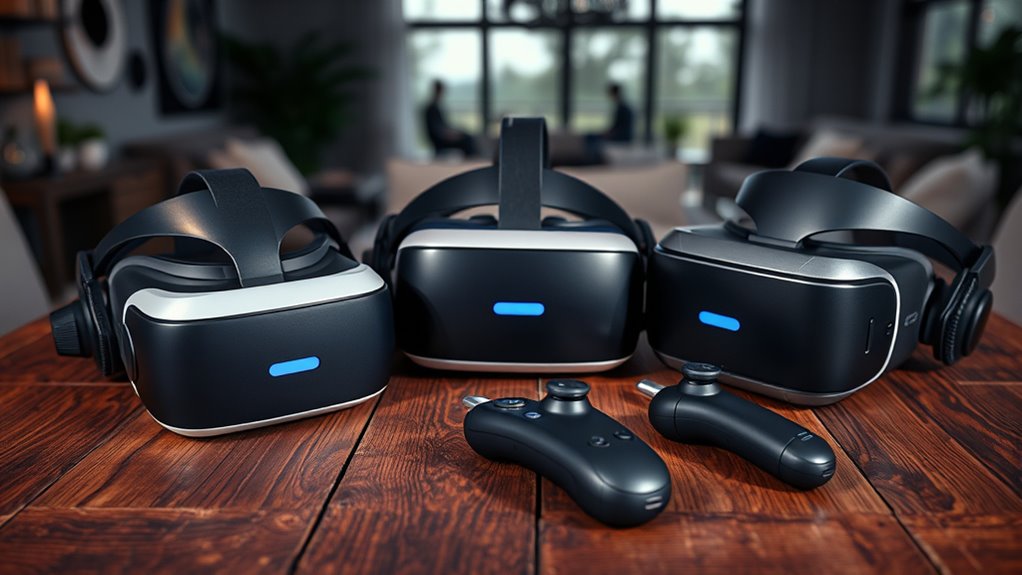

Among these virtual reality headsets on Amazon, I’d put the Meta Quest 3 512GB first for its standalone use, mixed-reality features, and room for a large game library. The Meta Quest 3S is a more accessible route into current Quest games, while the HP Reverb G2 suits buyers who specifically want a PC-connected headset. The biggest tradeoffs are whether you need a headset that runs games on its own, whether you already own a compatible phone or gaming PC, and how much storage your library needs. Phone and Switch viewers can cost less to set up, but they don’t offer the same experience or game selection as standalone VR. Read on for a breakdown of all 14 options and the buyer each one suits best.

Get furniture and decor delivered free with Prime
- Fast, free delivery on millions of items
- Prime Video, Amazon Music and more included
- Member-only deals all year
Complete the kit

Key Takeaways
- The Meta Quest 3 512GB is the most versatile pick. Its standalone design and mixed-reality features give it an advantage over the older Quest 2 listings and phone-based viewers.
- Quest 3S models target buyers who want newer standalone VR without choosing the Quest 3. The renewed 256GB listing and the 128GB Gorilla Tag bundle differ in condition, storage, and bundle contents, so check the specific listing.
- The Quest 2 appears in several overlapping listings. Storage, condition, seller details, and included accessories matter more here than the repeated product name; compare the exact listing before choosing.
- Phone and Switch viewers are narrower-purpose options. TECKNET models use a compatible phone, and the Orzly is designed for Switch use; neither is a direct substitute for a standalone Quest headset.
- The HP Reverb listings make sense only for a compatible PC-focused setup. They differ from Quest models in how they connect and what equipment buyers need, so confirm PC and software compatibility first.


| virtual reality headsets on amazon | Field of view |
|---|---|
| Meta Quest 3 512GB VR Headset | — |
| Oculus Quest 2 Advanced All-in | — |
| Meta Quest 3S 256GB Virtual Re | — |
| TECKNET VR Headset for Phone | 110° |
| HP Reverb G2 Virtual Reality H | 110° |
| Meta Quest 3S 128GB Virtual Re | 110 degrees |
| Meta Quest 2 | — |
| Orzly VR Headset for Nintendo | 100 degrees |
| TECKNET VR Headset for Phone | 110 degrees |
| TECKNET VR Headset for Phone w | 110 degrees |
| Oculus Quest 2 128GB VR Headse | — |
| Oculus Quest 2 VR Headset 256G | — |
| Oculus Quest 2 256GB Advanced | — |
| HP Reverb Virtual Reality Head | 114° |
More Details on Our Top Picks
Meta Quest 3 512GB VR Headset with Gorilla Tag Bundle and 3-Month Horizon+ Trial
Quest 3 is my strongest all-around pick for buyers who want a standalone headset without a PC or phone. Its Snapdragon XR2 Gen 2 processor and 4128 x 2208 display give it a clearer, more capable foundation than the phone-powered TECKNET headset, while wireless play avoids the cable required by the HP Reverb G2. The 512GB capacity leaves more room for games and media than the 128GB Oculus Quest 2. Dual RGB cameras support mixed-reality experiences, and the included Gorilla Tag bundle and Horizon+ trial give new owners content to start with. The tradeoff is a battery life of about 2.2 hours, so longer sessions may need a charging break. I’d skip it if a wired PC setup or extended play without recharging matters more than flexibility.
Pros:- 512GB storage provides more room for games and media than the 128GB Oculus Quest 2.
- 4128 x 2208 display and Snapdragon XR2 Gen 2 support detailed visuals and responsive standalone play.
- Wireless design avoids the PC connection required by the HP Reverb G2.
- Gorilla Tag bundle and three-month Horizon+ trial provide included content.
Cons:- Battery life is listed at about 2.2 hours, limiting uninterrupted sessions.
- Standalone VR still requires a safe play area and initial setup.
- The product data does not specify headset weight, making fit comparisons harder.
Best for: Buyers who want a high-capacity standalone headset for VR games, mixed reality, and media without relying on a PC or phone.
Not ideal for: People who need long sessions without charging or want PC-tethered VR with a cable-based setup.
- Storage:512 GB
- Display resolution:4128 x 2208 pixels
- Display type:LCD
- Refresh rate:120 Hz
- Processor:Snapdragon XR2 Gen 2
- Memory:8 GB RAM
- Battery life:2.2 hours
- Cameras:Dual RGB color cameras
- Included content:Gorilla Tag bundle and 3-month Horizon+ trial
Our verdict“Choose Quest 3 if you want the most versatile standalone option here and can work around its short battery life.”
Oculus Quest 2 Advanced All-in-One Virtual Reality Gaming VR Headset, 128GB, White
Quest 2 keeps standalone VR straightforward: it includes the headset, two Touch controllers, batteries, a silicone cover, and a glasses spacer, so buyers have the main setup pieces in the box. Its 1832 x 1920 pixels per eye give it a dedicated headset display, unlike the TECKNET model, which depends on a compatible phone for content. Compared with the Meta Quest 3, though, this Quest 2 has less storage and lacks the listed newer processor and mixed-reality camera features. The 128GB capacity suits a focused library better than someone who wants to keep many large games installed. The included AA batteries make initial setup convenient, but replacing them adds an ongoing hassle. I’d choose it over the Reverb G2 for a simpler all-in-one arrangement, not for a PC-based setup.
Pros:- Standalone all-in-one design does not require a PC or phone for its core VR setup.
- 1832 x 1920 pixels per eye provide a dedicated display for headset content.
- Includes two Touch controllers, batteries, silicone cover, glasses spacer, cable, and power adapter.
- Adjustable straps and silicone grips add fit and handling options.
Cons:- 128GB storage is less than the 256GB Meta Quest 3S and 512GB Quest 3 options in this group.
- Controllers use AA batteries, which need replacement or separate rechargeable cells.
- Product details do not specify built-in audio features.
Best for: New VR players who want a self-contained gaming headset with controllers and basic setup accessories included.
Not ideal for: Buyers who want a large installed game library, newer mixed-reality features, or detailed audio specifications before choosing.
- Storage:128 GB
- Resolution:1832 x 1920 pixels per eye
- Color:White
- Controllers:Two Touch controllers
- Controller batteries:Two AA batteries included
- Included accessories:Silicone cover, glasses spacer, charging cable, and power adapter
Our verdict“Pick Quest 2 for a self-contained entry into gaming VR if 128GB storage and replaceable controller batteries suit your needs.”
Meta Quest 3S 256GB Virtual Reality Headset (Renewed Premium)
Quest 3S brings mixed reality into a standalone headset, making it a more flexible choice than the phone-dependent TECKNET for buyers who want VR alongside digital elements in their room. Its 256GB storage is a useful middle ground between the 128GB Oculus Quest 2 and 512GB Quest 3, while the listed 120Hz refresh rate supports smooth motion. Integrated speakers also mean the product data confirms built-in audio, unlike the HP Reverb G2 listing, which calls for external audio solutions. The key compromise is its Renewed Premium condition: buyers may encounter cosmetic marks or warranty limits, and the supplied details do not spell out the warranty terms. The listed HDMI connectivity also merits a compatibility check before purchase. I’d choose it for mixed-reality features and capacity, but not if new condition is a priority.
Pros:- Mixed-reality capability lets digital content sit alongside the user’s environment.
- 256GB storage exceeds the Oculus Quest 2’s listed 128GB capacity.
- 120Hz refresh rate is specified for smooth visual motion.
- Integrated speakers are listed, unlike the HP Reverb G2’s external-audio requirement.
Cons:- Renewed condition may involve cosmetic imperfections or limited warranty coverage.
- The listed HDMI connectivity should be checked against the buyer’s intended setup.
- Battery life is not specified in the supplied product data.
Best for: Buyers seeking a standalone 256GB headset with mixed-reality features and integrated speakers who are comfortable considering a renewed unit.
Not ideal for: Shoppers who require a new headset, clearly stated warranty coverage, or confirmed compatibility details before buying.
- Storage:256 GB
- Resolution:2880 x 1600
- Refresh rate:120 Hz
- Features:Mixed reality
- Audio:Integrated speakers
- Connectivity:HDMI
- Platform:Meta Quest
- Condition:Renewed Premium
Our verdict“Choose the renewed Quest 3S if mixed reality and 256GB storage matter more to you than new condition and clearly stated warranty terms.”
TECKNET VR Headset for Phone, 110°FOV, Anti-Blue Light Lenses, Adjustable Gears, Compatible with iPhone, Samsung, Android 4.7-7.2″ – Black
TECKNET is the simplest low-commitment route to phone-based VR in this group: it holds a compatible 4.7- to 7.2-inch smartphone rather than operating as a standalone computer like the Meta Quest 3. The 110-degree field of view and adjustable gears offer ways to tune the viewing position, while support for myopia up to 600° may help some users view without glasses. Its 268g listed weight is also a clear specification where the Quest 3’s product data gives no weight. The tradeoff is fundamental: the phone supplies the content and processing, and the headset does not convert ordinary images into 3D. Unlike the HP Reverb G2, it does not provide a dedicated PC VR setup or motion-tracking specifications. I’d pick it for compatible phone apps and simple viewing, not demanding interactive VR.
Pros:- Works with listed Android phones and iPhones measuring 4.7 to 7.2 inches.
- 110-degree field of view and adjustable gears offer viewing-position adjustments.
- 268g listed weight makes it lighter on paper than the bulk of a PC headset setup.
- Supports naked-eye viewing for myopia up to 600°.
Cons:- Requires a compatible smartphone and apps; it is not a standalone headset like Quest 3.
- Does not automatically convert standard images into 3D content.
- Phone size limits compatibility, and the product data does not list motion-tracking controllers.
Best for: Phone owners who want to try compatible VR videos, games, or virtual tours without buying a standalone headset or connecting a PC.
Not ideal for: Buyers seeking a self-contained VR library, dedicated motion tracking, or content that works without compatible phone apps.
- Field of view:110°
- Compatible phone size:4.7–7.2 inches
- Weight:268 g
- Lens adjustment:Adjustable gears
- Blue-light protection:Yes
- Myopia support:Up to 600°
- Materials:Plastic and foam
- Warranty:36 months
Our verdict“Choose TECKNET for casual phone-powered VR viewing, but choose Quest 3 or Quest 2 for a dedicated standalone gaming system.”
HP Reverb G2 Virtual Reality Headset V2
HP Reverb G2 is the PC-first choice for buyers who value detailed visuals over the freedom of a standalone headset. Its 2160 x 2160 LCD resolution per eye is substantially different from the phone-based TECKNET: the Reverb is built around Windows PC VR and supports SteamVR and Windows Mixed Reality. Four built-in cameras and 6 DoF tracking help translate head and controller movement into virtual space, while the 6m cable allows room to move without going wireless. That cable and PC requirement are also its defining drawbacks. Quest 3 and Quest 3S work as standalone headsets, while the Reverb depends on a compatible high-performance Windows computer and DisplayPort connection. The included controllers and adapters help with setup, but the product data says audio requires an external solution. I’d pass if you want a compact, untethered system.
Pros:- 2160 x 2160 resolution per eye provides detailed PC VR visuals.
- Compatible with SteamVR and Windows Mixed Reality.
- Four-camera tracking and 6 DoF motion tracking support movement in virtual space.
- Includes two motion controllers, a 6m cable, adapters, and a power adapter.
Cons:- Requires a compatible high-performance Windows PC and DisplayPort connection.
- Wired operation is less flexible than the standalone Meta Quest 3 and Quest 3S.
- Product details specify no built-in speakers and call for external audio.
Best for: Windows PC VR users who prioritize high per-eye resolution, SteamVR compatibility, and included motion controllers.
Not ideal for: Buyers without a compatible high-performance Windows PC, or anyone who wants wireless standalone play or listed built-in audio.
- Resolution:2160 x 2160 per eye
- Display:LCD panels
- Field of view:110°
- Connectivity:DisplayPort
- Platform:Windows
- Tracking:6 DoF motion tracking, gyroscope, accelerometer, and magnetometer
- Included controllers:Two motion controllers
- Cable:6 m
- Compatibility:SteamVR and Windows Mixed Reality
Our verdict“Choose the Reverb G2 if you already have a suitable Windows PC and want high-resolution wired VR rather than standalone convenience.”
Meta Quest 3S 128GB Virtual Reality Headset with Gorilla Tag Bundle
The Meta Quest 3S is the strongest fit here for someone who wants a self-contained VR system rather than a phone holder. Its 128GB storage, Meta Horizon OS, and Snapdragon XR2 Gen 2 platform support gaming and social experiences without a console or PC, while the included Gorilla Tag bundle gives new owners a specific place to start. Compared with the Meta Quest 2 128GB, this listing highlights newer processing hardware, but the supplied specs show a 60Hz maximum refresh rate, so I would not choose it based on an assumed high-refresh experience. Its roughly 2.5-hour battery life also limits long sessions, and Wi-Fi is needed for full functionality. Choose this over the phone-based TECKNET models for standalone VR; skip it if you only want inexpensive phone-powered viewing.
Pros:- Runs as a standalone headset, so it does not need a phone or external sensors for core VR use.
- Snapdragon XR2 Gen 2 platform is listed as providing enhanced graphics and performance.
- 128GB storage supports a selection of games and apps.
- Gorilla Tag bundle gives new owners a ready-made starting point.
Cons:- Around 2.5 hours of battery life can require a recharge during extended play.
- The listed maximum refresh rate is 60Hz, below what buyers seeking smoother motion may expect.
- Full functionality depends on Wi-Fi.
Best for: First-time VR buyers who want a wireless, standalone headset with a bundled game and room to explore gaming and social apps.
Not ideal for: People seeking long uninterrupted sessions, a high-refresh display, or a simple phone accessory rather than a full standalone system.
- Storage:128 GB
- Display:LCD
- Resolution:1832 x 1920 pixels per eye
- Field of view:110 degrees
- Maximum refresh rate:60Hz
- Battery life:Approximately 2.5 hours
- Operating system:Meta Horizon OS
- Connectivity:Wi-Fi, USB, auxiliary
- Included accessory:Adjustable headband
Our verdict“Choose the Quest 3S if you want a standalone headset with a bundled game; pick a phone-based TECKNET instead if you want a simpler, phone-powered viewer.”
Meta Quest 2 — Advanced All-In-One Virtual Reality Headset — 128 GB
The Meta Quest 2 128GB earns its place for buyers who value a broad selection of standalone VR content. Its listed library spans more than 250 titles across gaming, fitness, social, and entertainment, with Beat Saber included, while hand tracking and 3D positional audio add interaction beyond basic phone-based viewers such as the TECKNET VR Headset for Phone. It is an all-in-one design, so external sensors are not required. The tradeoff is that its listing does not provide display resolution, refresh rate, or battery-life figures, making direct spec comparisons with the Meta Quest 3S harder. Storage may also feel tight for buyers who keep many large games installed, and safe play still requires clear room around the user. This makes more sense for library access than for buyers prioritizing the newer Quest 3S hardware.
Pros:- Access to a library of more than 250 titles across several categories.
- All-in-one operation does not require external tracking sensors.
- Hand tracking, haptic feedback, and 3D positional audio support more involved play.
- Beat Saber is listed as an included game.
Cons:- 128GB may limit how many large games can stay installed at once.
- The product data does not specify resolution, refresh rate, or battery life.
- Room is needed to move safely during active experiences.
Best for: Players who want a standalone headset with a wide range of gaming, fitness, and social titles, including Beat Saber.
Not ideal for: Buyers who need detailed display and battery specifications, more than 128GB of storage, or a headset designed for use in a cramped area.
- Storage:128 GB
- Included game:Beat Saber
- Content library:More than 250 titles listed
- Audio:3D positional audio
- Tracking and interaction:Hand tracking and haptic feedback
- System type:All-in-one headset
Our verdict“Pick the Quest 2 if access to a varied standalone game library matters more than newer listed hardware or detailed display specifications.”
Orzly VR Headset for Nintendo Switch & Switch OLED – White – Gift Boxed Edition
The Orzly VR Headset is the platform-specific choice in this group: it uses a Nintendo Switch or Switch OLED rather than acting as a standalone headset. That makes it a more relevant add-on for Switch owners than either Meta Quest model, which brings its own operating system and VR library. The adjustable lenses and head strap let users tune fit, while the 6-inch display specification and 1280 x 720 resolution describe a more limited visual setup than the Quest 3S’s listed per-eye resolution. Its 100-degree field of view is also narrower than the 110-degree figure provided for the Quest 3S and TECKNET phone headsets. The main compromise is compatibility: this is not a general VR option for phones, PCs, or consoles beyond the Switch family. I would choose it for Switch-oriented experimentation, not as a replacement for a dedicated standalone headset.
Pros:- Designed to work with Nintendo Switch and Switch OLED consoles.
- Adjustable lenses and head strap allow some fit customization.
- Lightweight design is intended for comfortable use.
- Can be used for compatible gaming and multimedia viewing.
Cons:- Limited to the Nintendo Switch platform rather than operating as a standalone VR headset.
- 1280 x 720 resolution is lower than the listed per-eye resolution of the Meta Quest 3S.
- The 100-degree field of view is narrower than the 110-degree figures on several alternatives here.
Best for: Nintendo Switch and Switch OLED owners who want a headset accessory for compatible VR gameplay or multimedia viewing.
Not ideal for: Buyers without a Switch, or anyone seeking a standalone headset, broad VR app library, or higher-resolution display.
- Platform:Nintendo Switch
- Compatibility:Nintendo Switch and Switch OLED
- Display size:6 inches
- Resolution:1280 x 720 pixels
- Field of view:100 degrees
- Sensors:Accelerometer, gyroscope, proximity
- Color:White
- Age range:8 years and above, including adults
- Warranty:Limited
Our verdict“Choose Orzly only if you already own a Switch and want a compatible headset accessory; for standalone VR, the Meta Quest 3S is the more fitting option.”
TECKNET VR Headset for Phone, Virtual Reality Headsets with HD 110°FOV, Anti-Blue Light Lenses & Adjustable Gears, 3D VR Headset for Kids, Compatible with iPhone and Android (4.7-7.2 inch screens)
The TECKNET VR Headset for Phone is the straightforward option for buyers who already own a compatible smartphone and want to try app-based 3D viewing without moving to a dedicated system. Its 110-degree field of view matches the listed figure for the Meta Quest 3S, and it accepts phones with screens from 4.7 to 7.2 inches. Adjustable headbands and lenses offer fit and viewing adjustments, while the 268g weight keeps the headset itself relatively light. But it remains a phone holder, not a standalone VR device: users must find compatible apps, and ordinary images do not become 3D automatically. Unlike the TECKNET model with Bluetooth controller, this listing does not include a controller, so interaction options are more limited. I would choose it for occasional viewing, not gaming that depends on dedicated controls or built-in audio.
Pros:- Fits smartphones with screen sizes from 4.7 to 7.2 inches.
- 110-degree field of view is wide for a phone-based viewer.
- Adjustable headband and lenses allow fit and focus changes.
- 268g headset weight keeps the device relatively light.
Cons:- Requires compatible apps and does not automatically turn standard images into 3D.
- No built-in audio or included controller is listed.
- Limited to compatible smartphones rather than standalone use.
Best for: Smartphone owners who want an uncomplicated, lightweight viewer for compatible 3D apps and occasional virtual tours.
Not ideal for: People who want standalone games, built-in audio, a controller, or 3D conversion from ordinary phone content.
- Field of view:110 degrees
- Phone compatibility:Smartphones with 4.7–7.2-inch screens
- Weight:268 g
- Lens feature:Anti-blue-light lenses
- Adjustments:Adjustable headband and lenses
- Color:Black
- Warranty:36 months
Our verdict“Choose this TECKNET if you want a light phone-powered viewer for compatible apps, but select its controller-equipped sibling for easier interaction.”
TECKNET VR Headset for Phone with Bluetooth Controller, 4.7-7.2 inch Screen, 110° FOV, Anti-Blue Light Lenses, Adjustable Gears, Compatible with iPhone, Samsung, Android
This controller-equipped TECKNET is the more interactive of the two phone-based viewers here. Like the other TECKNET, it supports phones from 4.7 to 7.2 inches, weighs 268g, and lists a 110-degree field of view; its added Bluetooth controller gives users a way to interact with compatible apps without relying only on touch controls. Adjustable pupil distance and focal length also help tailor the view. These additions make it a better pick than the controller-free TECKNET VR Headset for Phone for simple games and app navigation, but they do not turn it into a standalone system like the Meta Quest 3S. It still depends on a compatible smartphone and apps, and standard images are not automatically converted to 3D. Consider it for casual phone-based use, not as a substitute for a full VR library.
Pros:- Includes a Bluetooth controller for interaction with compatible apps.
- Supports smartphones with screens from 4.7 to 7.2 inches.
- 110-degree field of view is shared with the more basic TECKNET model.
- Adjustable pupil distance and focal length allow viewing adjustments.
Cons:- Requires a compatible smartphone and apps; it is not a standalone headset.
- Does not automatically convert ordinary images into 3D content.
- The listing notes some users may find the fit uncomfortable during long sessions.
Best for: Smartphone owners who want a phone-based VR viewer with a controller for simple compatible games, tours, and app navigation.
Not ideal for: Buyers seeking standalone VR, reliably immersive game controls, built-in audio, or a headset that supplies its own 3D content.
- Field of view:110 degrees
- Phone compatibility:Smartphones with 4.7–7.2-inch screens
- Weight:268 g
- Controller:Bluetooth controller included
- Pupil distance:Adjustable
- Focal length:Adjustable
- Lens feature:Anti-blue-light lenses
- Color:Black
Our verdict“Pick this model over the controller-free TECKNET if you want basic app interaction, while choosing the Quest 3S for a dedicated standalone VR experience.”
Oculus Quest 2 128GB VR Headset – All-in-One Virtual Reality Gaming Set
I’d pick this 128GB Quest 2 for someone who wants a ready-to-use standalone headset and a clearly listed set of essentials. Its 1832 x 1920 pixels per eye display supports detailed VR visuals, while the included Touch controllers, batteries, glasses spacer, silicone cover, and charging gear reduce the need to source basic accessories separately. Compared with the Oculus Quest 2 256GB, this version leaves less room for a large installed library, so it suits selective players better than people who keep many games on the headset. Its advantage over the HP Reverb Professional Edition is all-in-one use without the wired PC setup described for that model. The tradeoffs are limited storage and AA-powered controllers; the supplied information also does not specify built-in audio details.
Pros:- 1832 x 1920 pixels per eye provides detailed visuals for an all-in-one headset.
- Includes two Touch controllers, two AA batteries, a silicone cover, and a glasses spacer.
- Standalone design does not require a PC or console for basic VR use.
Cons:- 128GB storage gives less room for installed content than either 256GB Quest 2 option.
- Controllers rely on AA batteries rather than a listed rechargeable power system.
- The supplied product details do not specify built-in speakers or audio quality.
Best for: First-time VR buyers who want a standalone gaming headset with core setup accessories included and expect to keep a modest library installed.
Not ideal for: Players who want a large collection of games installed at once or prefer rechargeable controllers; the 128GB capacity and included AA batteries may be limiting.
- Storage capacity:128GB
- Display resolution:1832 x 1920 pixels per eye
- Included headset:VR headset
- Controllers:Two Touch controllers
- Controller batteries:Two AA batteries
- Included fit accessories:Silicone cover and glasses spacer
- Charging accessories:Charging cable and power adapter
Our verdict“Choose this Quest 2 if you want a self-contained VR starter set and do not need the extra storage of the 256GB models.”
Oculus Quest 2 VR Headset 256GB, White
For buyers who would rather keep more VR content installed than routinely manage storage, I’d favor this 256GB Quest 2 over the 128GB Oculus Quest 2 set. It retains the same listed 1832 x 1920 pixels per eye resolution while doubling the storage capacity, making it the more accommodating pick for varied games and entertainment. The standalone design also lets you use it without a PC or console, while PC VR compatibility is available through an Oculus Link cable sold separately. That gives it more flexibility than the HP Reverb Professional Edition, which is described as wired and Windows-based, but the Quest’s PC link adds a separate purchase and cable. The listing also calls for a Facebook account and does not specify battery life, so I’d skip it if account requirements or session planning are concerns.
Pros:- 256GB capacity offers more installed-content room than the 128GB Quest 2 set.
- Standalone operation does not require a PC or console.
- PC VR compatibility is listed through an Oculus Link cable.
- Includes adjustable straps, Touch controllers, silicone cover, and glasses spacer.
Cons:- Oculus Link cable is sold separately for PC VR use.
- The listing states that a Facebook account is required.
- Battery life is not specified in the supplied product details.
Best for: Standalone VR users who keep several games or entertainment apps installed, with the option to connect to a PC using a separately purchased Link cable.
Not ideal for: Buyers who avoid Facebook account requirements, need stated battery-life figures, or want PC VR without buying a separate cable.
- Storage capacity:256GB
- Display resolution:1832 x 1920 pixels per eye
- Processor:Fast processor; specific model not provided
- Controller type:Touch controllers with improved ergonomics
- Wireless internet:Required
- PC VR compatibility:Yes; Oculus Link cable sold separately
- Included accessories:Silicone cover, glasses spacer, charging cable, power adapter, and two AA batteries
Our verdict“Pick this 256GB Quest 2 over the 128GB version if a larger installed library matters more than avoiding account or cable requirements.”
Oculus Quest 2 256GB Advanced All-in-One Virtual Reality VR Headset Set
This package makes the most sense for buyers who want 256GB of Quest 2 storage plus a listed set of controller and fit accessories. The display matches the other Quest 2 listings at 1832 x 1920 pixels per eye, so the reason to choose it is the included two Touch controllers, AA batteries, silicone cover, glasses spacer, and charging accessories—not a different resolution. Compared with the Oculus Quest 2 VR Headset 256GB, White, this listing emphasizes adjustable knuckle straps and anti-slip grips, which may appeal to buyers focused on controller handling. It remains a standalone option, unlike the HP Reverb Professional Edition and its wired Windows setup. The tradeoffs are that controllers still need AA batteries and the headset may feel heavy during extended sessions; the supplied details do not establish a difference in core headset performance from the other Quest 2 models.
Pros:- 256GB storage provides more room than the 128GB Quest 2 set.
- Includes two Touch controllers, two AA batteries, and charging accessories.
- Silicone cover and glasses spacer are included.
- Adjustable knuckle straps and anti-slip grips are listed for controller handling.
Cons:- Controllers require AA batteries.
- The headset may feel heavy during extended use.
- The supplied details do not identify a performance advantage over the other 256GB Quest 2 listing.
Best for: Quest 2 buyers who want 256GB of storage and value included controller grips, knuckle straps, and basic setup accessories.
Not ideal for: People seeking a clearly differentiated display or processor, rechargeable controllers, or a lighter headset for long sessions.
- Storage capacity:256GB
- Display resolution:1832 x 1920 pixels per eye
- Included headset:VR headset
- Controllers:Two Touch controllers
- Controller batteries:Two AA batteries
- Controller accessories:Adjustable knuckle straps and anti-slip grips
- Other included accessories:Silicone cover, glasses spacer, charging cable, and power adapter
Our verdict“Choose this bundle if you want a 256GB Quest 2 with listed controller grips and setup accessories, but not for a distinct hardware upgrade.”
HP Reverb Virtual Reality Headset – Professional Edition
I’d choose the HP Reverb Professional Edition for a Windows PC setup where fine visual detail matters more than wireless freedom. Its 2160 x 2160 pixels per eye exceeds the 1832 x 1920-per-eye resolution listed for each Oculus Quest 2 here, and its 114° field of view adds a wider viewing area. At 1.1 pounds, it is described as lightweight, with integrated spatial audio and inside-out tracking. The tradeoff is a wired connection and Windows platform requirement, so it is less convenient for room-to-room standalone play than either Quest 2. Its button-control description also differs from the Quest 2 Touch controllers, which may matter to buyers choosing around controller style. I’d pass if you want a headset that works independently of a PC or need wireless movement.
Pros:- 2160 x 2160 pixels per eye is higher than the listed Quest 2 resolution.
- 114° field of view provides a wider viewing area than the Quest 2 specs supplied here.
- Inside-out tracking avoids reliance on separately placed external sensors.
- Integrated spatial audio and a listed weight of 1.1 pounds support a self-contained, lighter PC headset setup.
Cons:- Wired connectivity limits movement compared with standalone Quest 2 headsets.
- Requires the Windows platform, unlike Quest 2 standalone use.
- Button control may not suit buyers who prefer the Quest 2 Touch controller setup.
Best for: Windows PC VR users who prioritize high per-eye resolution and a wide field of view for professional applications or detailed visual work.
Not ideal for: Buyers who want standalone play, wireless movement, or a headset that works without a Windows PC.
- Platform:Windows
- Connectivity:Wired
- Resolution per eye:2160 x 2160 pixels
- Combined resolution:4320 x 2160 pixels
- Field of view:114°
- Display type:LCD
- Tracking:Inside-out
- Weight:1.1 pounds
- Controller type:Button control
Our verdict“Choose the HP Reverb if your Windows PC setup can accommodate a cable and you value its higher listed resolution over Quest 2 portability.”

How We Picked
I compared the 14 listings by the kind of VR experience they can provide, the equipment needed to use them, and how clearly their listing details identify storage, condition, and included extras. Standalone operation, compatibility with the buyer’s existing devices, fit for gaming versus phone-based viewing, and practical storage needs carried the most weight. I also treated renewed products and bundles as distinct offers: their condition and extras can change the value, but buyers should verify those details on the current Amazon listing.
The ranking favors options that suit more buyers without requiring a separate phone or PC, which puts the Meta Quest 3 512GB first. Quest 3S follows as a current standalone alternative, while Quest 2 listings remain relevant for buyers who prioritize an older model or a particular storage configuration. Phone viewers, the Switch-focused Orzly, and PC-connected HP headsets rank for narrower setups rather than broad appeal. Similar or duplicate Quest 2 listings are separated by their stated storage and listing format, not treated as distinct generations.
Factors to Consider When Choosing Virtual Reality Headsets On Amazon
Before choosing among these listings, I’d start with the device you already own and the kind of VR content you want to use. The product names can make phone viewers, standalone headsets, and PC headsets seem interchangeable, but they require different hardware and serve different needs.
Choose the headset type before comparing models
A standalone headset runs supported apps without a phone or gaming PC, making it the simplest path for room-scale games and general VR use. A phone viewer depends on a compatible smartphone and is better treated as an entry-level way to view phone-based VR content, not as a replacement for a Quest library. PC-connected headsets call for a compatible computer and can involve extra setup, so the headset alone may not be the whole purchase. The common mistake is comparing these types by the word “VR” while overlooking what powers the experience. I’d decide first whether convenience, phone viewing, or PC use matters most, then compare models within that group.
Check compatibility and the full setup
Amazon listing titles do not always spell out every requirement, so check the current listing details and manufacturer guidance before ordering. For a phone viewer, confirm your phone’s screen size and fit, along with whether the content you want works with that viewer. For a PC headset, check the computer’s graphics capability, connection ports, and software support rather than assuming any gaming PC will work. A Switch-focused viewer also needs to match the console setup and content you intend to use. Allow for accessories or adapters only when the listing and device documentation show they are needed; guessed compatibility can turn a seemingly simple purchase into an unusable one.
Match storage to the way you use VR
Storage matters most when you install several standalone games and keep them on the headset rather than removing titles between sessions. A larger capacity can reduce library housekeeping, but it does not improve comfort, image quality, or game performance by itself. Buyers who play a small number of titles at a time may be better served by a lower-storage configuration, provided the listing is for the intended model and condition. Bundles add another variable: a game or trial can be useful, but it should not distract from the headset’s storage or the bundle’s stated terms. Compare the exact 128GB and 256GB listings instead of assuming that similarly named Quest products include the same capacity or extras.
Treat renewed and older listings as a separate decision
A renewed headset can appeal to buyers who want a particular model or storage size, but its condition and included parts deserve a closer check than a new listing. Read the seller’s condition description, return terms, warranty information, and accessory list before deciding. Older Quest 2 listings may still fit a buyer’s needs, yet their age makes software support, replacement parts, and listing accuracy worth verifying. Similar product names can refer to different storage sizes or bundles, so use the model and item details rather than the title alone. If those details are unclear, a clearly identified current model may be the safer choice.
Prioritize fit and comfort for longer sessions
A headset that feels uncomfortable can limit use even if its features look appealing on paper. Weight distribution, facial interface, strap adjustment, and whether the device accommodates glasses can all affect fit; product-page photos rarely answer every question. Phone viewers add another fit variable because the phone must sit securely and align with the lenses. If more than one person will use the headset, quick adjustment and easy cleaning become more relevant than a bundle aimed at one player. Check whether replacement facial interfaces or straps are available for the model, especially if you expect frequent or shared use.
Pay for the capability you will actually use
A higher-spec or larger-storage headset is worthwhile when its features match your habits, not simply because it sits higher in a product family. Mixed-reality functions and standalone convenience make the Quest 3 a broader choice than a phone viewer, while a PC-connected headset is a better fit only when the buyer has the computer and content to use it. Bundles can simplify a first purchase, but included trials and games may have activation conditions or limited usefulness for a particular buyer. Avoid paying for unused storage or PC features when your main aim is occasional phone-based viewing. I’d compare the complete setup and the listing’s included items, not just the headset name.
Frequently Asked Questions
Should I choose the Meta Quest 3 or a Quest 3S listing?
Choose based on the features and fit you want, not only the model name or bundle. The Quest 3 512GB is the broadest pick in this roundup, with standalone use, mixed-reality features, and more room for installed content. Quest 3S listings offer a different route into current Quest use, but the two listed here vary in storage, condition, and bundle details. The renewed 256GB version calls for a close check of condition and return terms, while the 128GB bundle’s extras may matter if you want the included content. Compare the exact listing specifications before deciding.
Are the several Oculus Quest 2 listings different headsets?
They are all presented as Quest 2 products, but the listings differ in stated storage and packaging, and one may be a separate seller offer for a similar device. This roundup includes 128GB and 256GB versions, so confirm capacity rather than relying on the product title alone. Check whether the headset is new or renewed, what accessories are included, and who handles returns and warranty support. An older model can still suit a buyer seeking its particular setup, but buyers should verify current software and app compatibility for the content they plan to use. If two listings appear identical, compare their item details and condition before selecting one.
Can a TECKNET phone VR headset replace a Meta Quest?
No: a phone viewer and a standalone Quest serve different purposes. The TECKNET models hold a compatible smartphone and rely on phone-based content, while a Quest runs supported apps on the headset itself. That makes the TECKNET a more limited choice for buyers who want to try basic phone VR or already have suitable content, but it does not provide the same standalone game library. Check phone size, fit, and the content’s compatibility before ordering. If you want room-scale gaming without a phone inside the headset, choose a standalone model instead.
What should I check before buying an HP Reverb headset?
Start by confirming that your PC meets the headset’s hardware requirements and has the needed ports. Then check software and platform support, since a PC-connected headset is only useful if it works with the applications you plan to run. Review the exact Reverb model and listing condition: this roundup includes both a Reverb G2 V2 listing and a Professional Edition listing, and they should not be assumed to include identical parts or support. Also account for setup space and any required cables or accessories. If you do not already have a compatible PC, a standalone Quest may be a simpler overall purchase.
Is the Orzly Switch headset suitable for general VR gaming?
The Orzly listing is aimed at Nintendo Switch and Switch OLED owners, so I’d treat it as a console-specific accessory rather than an all-purpose VR headset. Its usefulness depends on the Switch content and viewing experience you want, not on access to the Quest or PC VR libraries. Check the current listing for supported console models, included parts, and any software or content requirements. If you want a headset for standalone VR games across a broader library, a Quest model is a better match. For a Switch owner seeking a dedicated accessory, the Orzly may be worth comparing on its own terms.
Conclusion
For the best overall choice, I’d start with the Meta Quest 3 512GB because it combines standalone use, mixed-reality features, and ample listed storage. The best alternative for newer standalone VR is a Quest 3S listing, with the renewed 256GB and bundled 128GB versions suited to different storage and condition preferences. For buyers focused on an older Quest setup, compare the Quest 2 listings carefully and choose by capacity, condition, and included accessories rather than title alone. The best beginner option depends on the beginner: a Quest is the more capable all-in-one route, while a TECKNET phone viewer is narrower and relies on a compatible phone. For specific needs, consider the Orzly for Switch use or an HP Reverb only when you have a compatible PC and want a PC-connected headset. Match the headset to your devices first; that choice will narrow this lineup faster than comparing names alone.
Halloween Picks
halloween
As an affiliate, we earn on qualifying purchases.