
TL;DR

Get furniture and decor delivered free with Prime
- Fast, free delivery on millions of items
- Prime Video, Amazon Music and more included
- Member-only deals all year
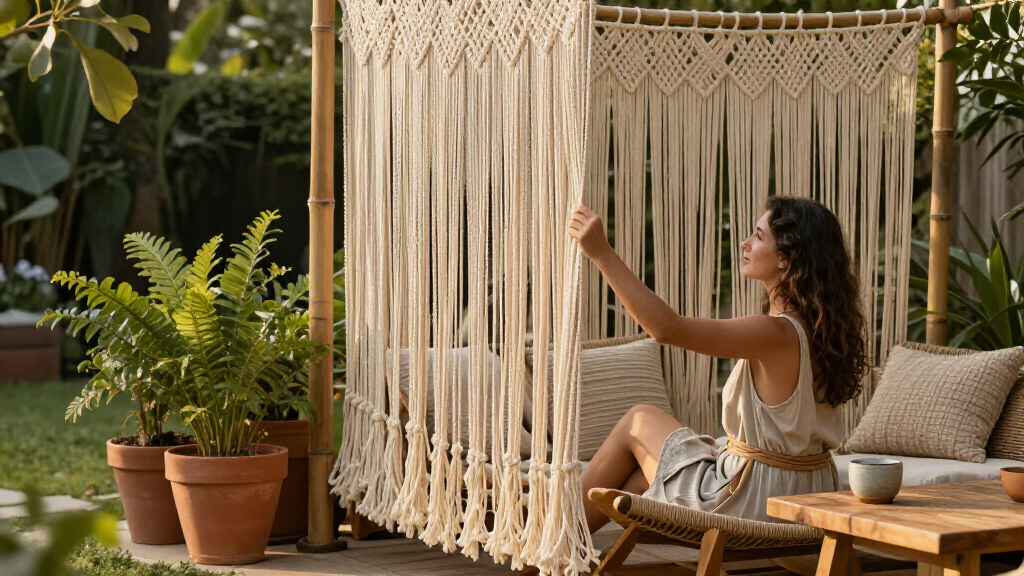
A Hunker report outlines a DIY macrame screen as a decorative alternative to a traditional fence or hedge for patios and yards. The project uses cord woven onto a supported rod or frame; its privacy, durability and suitability depend on the design, materials and installation.
Hunker has published instructions for making a macrame privacy screen as an alternative to a conventional fence or hedge, describing a DIY divider for a patio or yard. The guide gives a materials estimate and basic construction steps, but the screen offers a customizable barrier rather than a guaranteed substitute for a solid fence.
The report estimates that a 2-by-5-foot panel takes about 200 yards of synthetic or weather-treated cord, along with a wooden or metal support such as a curtain rod or pergola. Heavy-duty hooks, eye screws or zip ties may be used to secure the support, depending on the design. Hunker advises planning for extra cord because the amount needed can vary with the pattern and setup.
For the basic method, attach a sturdy rod or frame above the area to be screened. Cut cords to twice the intended panel length, fold each in half, and attach them to the support with lark’s head knots. The strands can then be knotted into rows to form a chosen pattern. The guide also suggests adding beads, incorporating plant hangers or putting planters near the screen.
Design options include a free-hanging curtain, a screen fixed to a pergola or a movable divider made with a folding frame. The source says a folding frame may be bought or built, with weatherproofing for outdoor use. These are project suggestions, not tested specifications: the report does not provide structural ratings or a standard for how much visibility a finished screen blocks.
A Screen That Leaves Design Choices Open
A macrame divider can give residents a way to mark off a seating area or limit sightlines without committing to a conventional fence. Because the maker chooses the cord, pattern, size and support, the project can be adapted to an existing patio or pergola. It may also be easier to move or alter than a permanent boundary, particularly if built on a folding frame.
That flexibility comes with trade-offs. Knotted cord is not the same as a solid fence: gaps in the pattern may leave views open, and the screen may not provide the same separation or boundary function. The source does not establish how well any particular pattern performs for privacy or how it holds up under local weather. Homeowners should treat the idea as a decorative screen and assess support strength and outdoor exposure before building.
As an affiliate, we earn on qualifying purchases.
From Decorative Knots to Yard Divider
Hunker presents macrame as both a decorative craft and a functional way to create a divider, referencing its history as far back as the 13th century. The report focuses on applying the craft outdoors, where a woven panel can serve as a visual screen while adding a handmade element to a yard or patio.
The article points readers toward patterns, including work by blogger Rachel of A Beautiful Mess and tutorials by Deepa Rai on YouTube. It does not identify one required pattern, specify a single construction plan for every support type, or report a completed installation. The concept is therefore a customizable DIY proposal rather than a documented product test.
Durability and Coverage Depend on Design
The source does not say how much privacy a finished panel provides, how long it lasts outdoors or whether a specific cord or knot pattern has been tested against wind, rain or sun. Its estimate of about 200 yards per 2-by-5-foot panel is presented as a planning figure, not a guaranteed quantity; materials and cord use can change with the frame and design.
It also gives no installation load ratings for hooks, brackets, rods or pergolas. A support must be suitable for the screen’s weight and placement, and outdoor materials need to match local conditions. The report does not address local rules for fences or outdoor structures, which may vary by location.
Plan the Frame Before Knotting
Anyone following the idea would first need to measure the area, choose between a fixed and movable screen, and select outdoor-suitable cord and a support that can carry the finished panel. Hunker recommends attaching the rod or frame with strong supports, then making the knotted panel to the desired length. Since the source offers no universal installation plan, the details must be adjusted to the site and materials.
After assembling the screen, the maker can adjust the knots and add decorative elements or plants. The report does not announce a product launch, formal testing or follow-up results. Whether a particular installation provides enough privacy and remains secure will depend on its construction and conditions where it is used.
Key Questions
How much cord does the guide estimate for one panel?
Hunker estimates about 200 yards of synthetic or weather-treated cord for a 2-by-5-foot panel. The amount can vary with the pattern and support, so the figure is a planning estimate.
Can a macrame screen replace a traditional fence?
It can serve as a decorative screen or partial visual barrier, but the source does not say it provides the coverage, boundary function or durability of a conventional fence. The open knots may leave sightlines through the panel.
What support can hold the screen?
The report suggests a wooden or metal support, such as a curtain rod, pergola or frame, secured with appropriate hooks, brackets or other strong fasteners. It does not provide load ratings, so the support must be suitable for the installation.
Can the divider be moved?
Yes. Hunker describes using a folding room-divider frame to make a movable screen and says a frame could be built or purchased. Outdoor use calls for weatherproofing, though the source does not specify a particular treatment.
Source: rss
Fall Picks
fall essentials
As an affiliate, we earn on qualifying purchases.