A bariatric sliding transfer board can bridge the gap between a wheelchair and a bed, toilet, or vehicle, but capacity alone does not determine whether a board fits. My best overall pick is the Sammons Preston 35-inch board, whose stated 600-pound capacity and handles make it a strong option for buyers needing a longer, higher-capacity surface. The DMI 32-inch board rated to 735 pounds stands out for its stated load limit, while the 36-inch wood board with handles offers extra length without a listed capacity in its product name. The main tradeoffs are load rating, usable width, board length, surface and handle design, and whether the board suits the transfer route and user’s abilities. Read on for the full comparison, practical selection guidance, and the limits to verify before buying.

Get furniture and decor delivered free with Prime
- Fast, free delivery on millions of items
- Prime Video, Amazon Music and more included
- Member-only deals all year
Complete the kit


Key Takeaways
The Sammons Preston 35-inch board is the clearest high-capacity choice with a stated 600-pound limit; the DMI 32-inch model lists a higher 735-pound limit but has a different 32-by-10-inch footprint.
Longer boards are not interchangeable with wider boards: the 36-inch model is longest, while the 30-by-12-inch model gives more listed width for buyers comparing lateral room.
Several DMI models list 440-pound capacities but vary in length and thickness, so the specific model—not the brand name—should guide fit and capacity checks.
Many products are described as wood or heavy-duty wood, but product titles do not provide matching details on finish, cleaning, or edge treatment; verify these before choosing for frequent care use.
Two Vive listings appear in the roundup with nearly identical stated use cases, while some other listings omit a capacity in the title; confirm exact specifications to avoid assuming the entries are distinct or similarly rated.


| transfer board sliding bariatric | Material | Weight capacity | Dimensions | Handles |
|---|---|---|---|---|
| Wood Slide Transfer Board with | Wood | — | 24 x 8 x 0.75 in | 2 cutout handles |
| Vive Transfer Board | Wood | — | 24 x 8 x 0.75 in | 2 cutout handholds |
| Pinewood Transfer Board | Pinewood | 300 lb | Exact measurements not provided | Ergonomic handholds |
| Transfer Board and Slide Sheet | — | Not specified | — | 3 |
| DMI Heavy-Duty Transfer and Sl | Scotch pine | Up to 735 lb | 32 x 10 x 1 in | 2 cutout handles |
| Transfer Board and Slide Board | High-density ABS polymer | 440 lb | 29.5 x 8 x 0.5 inches | 3 built-in handles |
| Rubberwood Transfer Board for | Rubberwood | 400 lb | — | Ergonomic cutout handles |
| DMI Heavy-Duty Transfer and Sl | Scotch Pine | 440 lb | 30 x 8 x 0.75 inches | — |
| DMI Transfer Board and Slide B | Scotch pine | 440 lb | 30 x 8 x 1 inch | 2 cutout handles |
| Vive Transfer Board | Wood | 800 lb | 36 x 12 x 1 inches | 2 cutout handles |
| Transfer Board Patient Slide A | Plywood | — | 30 x 12 x 0.7 inches | Ergonomic handles |
| DMI Heavy-Duty Wooden Transfer | Scotch pine | 440 pounds | 24 x 8 x 1 inches | — |
| Wood Slide Transfer Board with | Wood | 500 pounds | 36 x 12.8 x 0.75 inches | — |
| Heavy-Duty Wooden Transfer & S | Heavy-duty wood | Up to 500 pounds | — | Ergonomic cutout handles |
| Sammons Preston Bariatric Tran | Birch plywood | Up to 600 pounds | — | — |
More Details on Our Top Picks
Wood Slide Transfer Board with 2 Cutout Handles, 24 x 8 x 0.75 in
This 24-inch board stands out for pairing a 500 lb stated capacity with a straightforward, two-handle design. Its polished wood surface is intended to help clothing and skin slide across the board, while the cutouts give a caregiver places to grip and reposition it. Compared with the Vive Transfer Board, it lists a higher capacity at the same dimensions; compared with the much longer DMI Heavy-Duty 32 x 10 board, it is easier to fit into tighter storage spaces but offers less reach. That compact size can limit transfers across wider gaps, so I would match it carefully to the distance between surfaces. Wood also needs more care during cleaning than a nonporous surface, and a high capacity alone does not replace sound transfer technique.
Pros:- Stated 500 lb bearing capacity
- Two cutout handles provide grip for positioning
- Polished surface is designed to reduce sliding friction
- Compact 24-inch length is easier to store than longer boards
Cons:- At 24 inches long, it may not bridge larger gaps
- Wood can be harder to clean and sanitize than nonporous alternatives
Best for: Caregivers seeking a compact 24-inch wood board with a stated 500 lb capacity for transfers across short gaps.
Not ideal for: People transferring across wider distances, or care settings that need a surface that is easy to sanitize frequently.
- Material:Wood
- Dimensions:24 x 8 x 0.75 in
- Bearing capacity:Up to 500 lb
- Handles:2 cutout handles
- Surface:Smooth, polished
- Intended settings:Home or clinical use
Our verdict“Choose this board for short-gap transfers when you want a compact wood option with a higher stated capacity than the similarly sized Vive board.”
Vive Transfer Board – Patient Slide Assist Device for Wheelchair, Bed, Toilet, Car, Bathtub (24″ x 8″ x 0.75″)
The Vive board is a practical pick for buyers who want a sealed wood finish and a listed weight of just 2 lb. At 24 x 8 inches, it shares the compact footprint of the Wood Slide Transfer Board with 2 Cutout Handles, but its 440 lb maximum load is lower than that board’s stated 500 lb capacity. Rounded corners and tapered ends are intended to make positioning gentler on furniture and the person being moved. The tradeoff is reach: this short board may not span the gap between some surfaces, while the DMI Heavy-Duty 32 x 10 board offers more length and width for broader transfers. I would favor the Vive when storage and a sealed finish matter more than added capacity or reach; its wooden construction still calls for care during cleaning.
Pros:- Listed weight of 2 lb makes it easier to position and store
- Sealed wood finish provides a smooth sliding surface
- Dual cutout handholds give caregivers grip when positioning the board
- Rounded corners and tapered ends are designed to protect furniture
Cons:- Short 24-inch length may not suit wider transfer gaps
- 440 lb maximum load is lower than the 500 lb compact wood alternative
- Wood requires more cleaning care than nonporous board materials
Best for: Caregivers who need a compact, light board for short transfers and prefer sealed wood with rounded edges.
Not ideal for: Buyers who need a capacity above 440 lb or a longer board for wider gaps between transfer surfaces.
- Brand:Vive
- Model number:RHB1037WOOD
- Material:Wood
- Dimensions:24 x 8 x 0.75 in
- Weight:2 lb
- Maximum load:440 lb
- Handles:2 cutout handholds
- Item count:1
Our verdict“Pick the Vive for short-gap transfers where a light, sealed-wood board matters more than the higher capacity of its similarly sized competitor.”
Pinewood Transfer Board, XXL Size, Sliding Board for Transfers
This XXL pinewood board is the lineup’s choice for buyers who prioritize extra width and length over a clearly specified compact format. A broader, thicker board can offer more room to place and support the transfer path than the 24-inch Wood Slide Transfer Board or Vive board, both of which are only 8 inches wide. Ergonomic handholds and rounded corners add practical grip and smoother edges, while the 300 lb stated capacity is a major limitation for a bariatric-focused purchase. The description does not provide exact dimensions, so I would confirm that it fits the user’s transfer surfaces and storage space before choosing it. Its added thickness may also make it heavier to handle than smaller boards, and the listed one-year warranty does not resolve the capacity concern.
Pros:- XXL format is described as wider and longer than standard boards
- Thicker construction is intended to improve stability and durability
- Ergonomic handholds provide grip for positioning
- Rounded corners help reduce sharp-edge contact
Cons:- 300 lb stated capacity is low for many bariatric transfer needs
- Exact length and width are not provided
- Extra thickness may make the board heavier to handle
Best for: Users whose transfer setup needs a wider, longer board and whose needs fall within the stated 300 lb capacity.
Not ideal for: Bariatric users who require a capacity above 300 lb, or buyers who need exact dimensions before checking fit.
- Material:Pinewood
- Size:XXL / plus size
- Dimensions:Exact measurements not provided
- Weight capacity:300 lb
- Thickness:Described as thicker than a quarter dollar coin
- Handles:Ergonomic handholds
- Edges:Rounded corners
- Warranty:1 year
Our verdict“Consider this board for extra-wide coverage only when its 300 lb capacity and unspecified dimensions fit the user and transfer setup.”
Transfer Board and Slide Sheet for Patient Transfers to Wheelchair, Car, Toilet, and Tub
This set differs from the all-in-one wood boards by pairing a 31.5-inch transfer board with a separate slide sheet. That combination may suit caregivers who want both a board for bridging a gap and a sheet for other assisted repositioning tasks. Its anti-slip back and three handles offer more handling points than the two-handle Wood Slide Transfer Board, while curved edges are intended to make placement less abrupt. The main drawback is a missing weight-capacity rating, a serious gap for anyone shopping specifically for bariatric use. The included sheet also adds another item to manage and clean. Compared with the DMI 32 x 10 board, this set provides more components but less certainty about load limits and no listed board width beyond 8 inches.
Pros:- Includes both a 31.5-inch transfer board and a 28 x 28-inch slide sheet
- Anti-slip backing is designed to help keep the board stable
- Three handles offer multiple grip points
- Curved edges are intended to ease placement
Cons:- No weight-capacity information is provided
- The extra slide sheet adds storage and cleaning needs
- Board width is only listed as 8 inches, limiting lateral space
Best for: Caregivers who want a longer board plus a slide sheet for varied assisted transfers and can verify suitability with the supplier.
Not ideal for: Bariatric users who need a confirmed load rating, or buyers seeking a simple single-board setup with clear capacity data.
- Transfer board size:31.5 x 8 in
- Slide sheet size:28 x 28 in
- Material / surface:Smooth, non-scratch surface
- Backing:Anti-slip
- Handles:3
- Edges:Curved
- Weight capacity:Not specified
Our verdict“Choose this set for its added slide sheet and handling features only after confirming that its unspecified capacity suits the user.”
DMI Heavy-Duty Transfer and Slide Board for Patient and Senior Transfers, Holds up to 735 lbs, 32 x 10 x 1, with 2 Handles
The DMI board leads this group for bariatric-focused shopping because it combines the lineup’s highest stated capacity, 735 lb, with a longer and wider 32 x 10-inch surface. That extra area can help bridge a broader gap and give caregivers more room to position the board than the 24 x 8-inch Vive or Wood Slide boards. Its tapered ends and two cutout handles support placement and grip, while the sealed, coated surface is designed for smoother sliding. The tradeoff is that this is still a wooden board, and its size may be less convenient to store or position than a compact option. The product description also stresses proper training; this is not a substitute for assistance or safe transfer technique. For buyers who need a confirmed high capacity, it is more compelling than the XXL pinewood board, rated at 300 lb.
Pros:- 735 lb stated capacity is the highest among these five products
- 32 x 10-inch dimensions provide more reach and width than 24 x 8-inch boards
- Two cutout handles support grip and positioning
- Sealed, coated surface is designed to reduce friction
Cons:- Larger size can be harder to store and maneuver than compact boards
- Wood requires more cleaning care than nonporous alternatives
- Safe use requires proper transfer technique and may require assistance
Best for: Bariatric users and caregivers who need a high stated load capacity, a wider transfer surface, and a long board for varied transfers.
Not ideal for: People who need a lightweight, compact board or expect to perform transfers without suitable training and assistance.
- Material:Scotch pine
- Dimensions:32 x 10 x 1 in
- Weight capacity:Up to 735 lb
- Handles:2 cutout handles
- Surface:Sealed and coated
- Ends:Tapered
- FSA eligible:Yes
Our verdict“Choose the DMI when high stated capacity and a larger transfer surface outweigh compact storage and the need for trained assistance.”
Transfer Board and Slide Board for Wheelchair Transfers – Patent Pending
For buyers who want a firmer grip on slick transfer surfaces, this ABS board stands apart from the wood options here by including a 10-inch non-slip pad. Its three built-in handles give a caregiver or user several places to hold while positioning the board, while tapered ends and side notches are designed to reduce catching at transfer edges. At 440 lb capacity, it offers a substantial stated limit, though it does not match the 800 lb capacity listed for the Vive Transfer Board. The 29.5-by-8-inch profile is closer to a standard narrow board than an extra-wide bariatric surface, so fit should be checked against the user, chair, and destination before use. It is a board rather than a slide sheet, and some users may need added padding.
Pros:- 440 lb stated weight capacity
- Included 10-inch non-slip pad adds traction on smooth surfaces
- Three built-in handles offer multiple grip points
- Tapered ends and side notches are designed to reduce catching
Cons:- Requires careful fit testing between the specific transfer surfaces
- Narrow board may provide less coverage than wider options such as the Vive Transfer Board
- Does not include a full slide sheet or additional padding
Best for: Wheelchair users and caregivers who want a narrow ABS board with an included traction pad for transfers across smooth surfaces.
Not ideal for: Buyers needing an extra-wide landing area or a higher stated capacity; its 8-inch width and 440 lb limit may not suit their setup.
- Material:High-density ABS polymer
- Dimensions:29.5 x 8 x 0.5 inches
- Weight capacity:440 lb
- Handles:3 built-in handles
- Included accessory:10-inch non-slip round pad
- Design features:Tapered ends and side notches
Our verdict“Choose this board if the included traction pad and multiple grip points matter more than extra width or a higher capacity rating.”
Rubberwood Transfer Board for Patient Transfers, XXL Size
This XXL Rubberwood board is the lineup’s choice for buyers who want a larger wooden platform rather than a compact transfer surface. Its wider and longer format is intended to add stability during wheelchair, bed, or car transfers, while ergonomic cutout handles help with lifting and positioning. Compared with the 30-by-8-inch DMI Heavy-Duty Transfer and Slide Board, this model puts more emphasis on its plus-size footprint than on a specified length and width. The tradeoff is fit: a larger board can be awkward in tight spaces or for short gaps, and the supplied data does not give exact dimensions to check against a particular chair or vehicle. Its 400 lb stated capacity is also lower than the 440 lb DMI options, so buyers should verify that it suits the intended user and transfer plan.
Pros:- Wider and longer XXL format is designed to provide a more stable platform
- Rubberwood construction
- Ergonomic cutout handles support positioning and leverage
- Rounded corners and smooth surface
Cons:- Large footprint may be difficult to place in confined transfer areas
- 400 lb stated capacity is below the 440 lb DMI boards in this lineup
- Exact dimensions are not provided, making fit checks harder
Best for: Caregivers and wheelchair users seeking an XXL wooden board with a wider, longer platform for transfers where the surrounding space can accommodate it.
Not ideal for: People working with compact car seats, narrow bathroom layouts, or users whose needs exceed the stated 400 lb capacity.
- Material:Rubberwood
- Size:Plus Size / XXL
- Weight capacity:400 lb
- Handles:Ergonomic cutout handles
- Surface:Smooth
- Corners:Rounded
Our verdict“Pick this XXL board when a broad wooden platform is the priority and you have enough room to position it safely.”
DMI Heavy-Duty Transfer and Slide Board for Patient and Senior Transfers, 30 x 8 x 0.75 inches, Holds up to 440 lbs
The DMI 30-by-8-inch board is a practical fit for buyers who want a familiar, narrow wooden design with a clearly stated size and capacity. Its sealed Scotch Pine surface and tapered ends are intended to help users slide between level surfaces without an abrupt edge catching the board. Compared with the ABS Transfer Board and Slide Board in this roundup, it has no included traction pad or three-handle arrangement; in return, its wood construction and cutout handle keep the setup simple. The 440 lb stated capacity matches that ABS model, but the DMI description warns that the board is intended for flat, level surfaces and can become slippery when wet. It also calls for proper transfer technique, so this is not a substitute for training or a suitable transfer plan.
Pros:- 440 lb stated weight capacity
- 30-by-8-inch dimensions make fit checks straightforward
- Sealed Scotch Pine surface is designed for smooth sliding
- Tapered ends and a cutout handle aid placement
Cons:- Use is limited to flat, level surfaces
- Surface may be slippery if wet
- Requires appropriate technique and training for safe use
Best for: Caregivers who need a specified 30-by-8-inch wooden board for transfers between flat, level surfaces.
Not ideal for: Users transferring across uneven or soft surfaces, or caregivers who want an included non-slip pad like the ABS board’s.
- Material:Scotch Pine
- Dimensions:30 x 8 x 0.75 inches
- Weight capacity:440 lb
- Surface:Sealed, glossy finish
- End design:Tapered ends
- Handle:Cutout handle
Our verdict“Choose this DMI when a standard-width wooden board with stated dimensions suits your flat, level transfer setup.”
DMI Transfer Board and Slide Board, Heavy-Duty Wood, 30 x 8 x 1, Holds up to 440 lbs
Unlike the 30-by-8-inch DMI board with one described cutout handle, this version lists two cutout handles, giving caregivers more options for gripping and positioning the board. Its 1-inch thickness is also greater than the other DMI model’s 0.75-inch profile, a difference buyers should account for when checking clearance at the wheelchair and destination edges. Both DMI boards list a 440 lb capacity and smooth wood construction, so this model’s distinction is not a higher stated limit but its handle layout and thicker build. The tradeoffs remain familiar: the board needs a suitable, level transfer surface and proper technique, and it is an assistive transfer tool rather than a mobility device. FSA eligibility is listed in the supplied product data.
Pros:- Two cutout handles provide multiple grip points
- 440 lb stated weight capacity
- 30-by-8-inch size is specified for fit planning
- Smooth Scotch pine surface supports sliding transfers
Cons:- One-inch thickness may not fit every transfer gap as easily as the thinner DMI board
- Not suited to uneven or soft transfer surfaces
- Requires proper technique and does not provide mobility support
Best for: Caregivers who value two cutout grip points for positioning a 30-inch wooden board and can accommodate its 1-inch thickness.
Not ideal for: Buyers needing a thinner board for tight clearances or a higher stated capacity than 440 lb.
- Material:Scotch pine
- Dimensions:30 x 8 x 1 inch
- Weight capacity:440 lb
- Handles:2 cutout handles
- Surface:Smooth, sealed
- FSA eligible:Yes
Our verdict“Select this DMI if two handles are useful for your positioning routine and the thicker board fits your transfer gaps.”
Vive Transfer Board – Patient Slide Assist Device for Bed, Wheelchair, Toilet, Car, Bathtub
Among these five products, the Vive stands out on stated capacity: its listed 800 lb limit is higher than the 440 lb limits on both DMI boards and the ABS model, and the 400 lb Rubberwood board. Its 36-by-12-inch surface is also substantially wider and longer than those 30-by-8-inch boards, offering more coverage for buyers whose transfer setup calls for a larger platform. That size can be a drawback in tight bathrooms, vehicles, or wheelchair arrangements, so measuring the available space matters. The wooden build, sealed finish, dual cutout handles, and rounded corners support positioning and reduce sharp edges, but the product data does not list an included traction pad like the ABS option. Buyers should follow appropriate transfer guidance and confirm that the board and setup suit the intended user.
Pros:- 800 lb stated weight capacity, highest among these five products
- 36-by-12-inch surface is larger than the DMI and ABS boards reviewed here
- Dual cutout handles provide grip and leverage
- Rounded corners and a smooth, sealed finish
Cons:- Larger footprint may be difficult to position in confined spaces
- Wood construction calls for careful handling and hand washing
- No non-slip pad is listed among the included features
Best for: Users and caregivers seeking a larger wooden board with the highest stated capacity among these five products.
Not ideal for: People who need a compact board for tight spaces or specifically want an included non-slip pad.
- Material:Wood
- Dimensions:36 x 12 x 1 inches
- Weight:2 lb
- Weight capacity:800 lb
- Handles:2 cutout handles
- Color:Light brown
- Shape:Rectangular
Our verdict“Choose the Vive when its larger footprint and 800 lb stated capacity fit your needs better than a narrower board.”
Transfer Board Patient Slide Assist Device for Elderly and Disabled, 30″ x 12″
This 30-by-12-inch board stands apart from the plain sliding surfaces in the lineup: its 360-degree rotating seat is intended to help reposition a user during a transfer, while tire notches help locate the board against a wheelchair. That combination may suit caregivers handling transfers where alignment is awkward. Its 440-pound capacity is solid, but below the 500-pound rating of the Wood Slide Transfer Board with Handles and the 600-pound limit of the Sammons Preston Bariatric Transfer Board. The plywood body is described as lightweight, and its handles aid carrying and placement. The tradeoff is that the product data does not identify a non-slip surface, so careful setup and supervision matter. I would choose it for its rotating feature, not as a substitute for checking fit and transfer technique.
Pros:- Rotating seat can help with positioning during transfers
- Notches are designed to fit around wheelchair tires
- 440-pound stated load capacity
- Ergonomic handles support lifting and placement
Cons:- No non-slip surface is specified, so secure placement needs attention
- 440-pound capacity is lower than the 500-pound and 600-pound options in this batch
- The rotating seat and sliding slot may require more careful setup than a plain board
Best for: Caregivers who want a wheelchair-oriented board with a rotating seat and tire notches for alignment.
Not ideal for: Buyers needing a clearly stated non-slip surface or a capacity above 440 pounds; the product details do not provide either.
- Material:Plywood
- Dimensions:30 x 12 x 0.7 inches
- Load capacity:440 pounds
- Seat feature:360-degree rotating seat
- Sliding feature:Sliding slot
- Wheelchair fit:Notches for wheelchair tires
- Handles:Ergonomic handles
Our verdict“Choose this board if rotating positioning and wheelchair-tire notches matter more than the higher capacity offered by the Sammons Preston.”
DMI Heavy-Duty Wooden Transfer & Slide Board – Holds up to 440 lbs, 24″ x 8″ x 1″
The DMI is the straightforward choice here: a 24-by-8-inch Scotch pine board with a smooth, sealed surface and a 440-pound capacity. Its shorter format is easier to place in tighter transfer setups than the 35- or 36-inch boards, though it gives less bridging length. Compared with the Transfer Board Patient Slide Assist Device, it has no rotating seat or tire notches; in return, its simpler surface and rounded, sanded edges make the design easier to understand and position. The sealed finish is intended to reduce friction and clothing snags, while FSA/HSA eligibility may help some buyers with reimbursement. Its main compromise is weight: solid wood may be less convenient to handle than lighter construction, and the listed capacity is below the 500- and 600-pound options.
Pros:- Smooth sealed surface is designed to reduce clothing snags
- Rounded, sanded edges support more comfortable handling
- Compact 24-by-8-inch footprint can suit tighter setups
- FSA/HSA eligible, according to the product details
Cons:- 440-pound capacity is below several alternatives in this batch
- Solid wood may be heavier to handle than lightweight materials
- Shorter length offers less bridging reach than the 35- and 36-inch boards
Best for: Buyers who need a compact, conventional wooden board for wheelchair, bed, or chair transfers and value a sealed surface.
Not ideal for: Users needing a longer bridge, rotating positioning features, or a stated capacity above 440 pounds.
- Material:Scotch pine
- Dimensions:24 x 8 x 1 inches
- Weight capacity:440 pounds
- Surface:Smooth, sealed
- Edges:Rounded and sanded
- FSA/HSA eligibility:Yes
Our verdict“Pick the DMI for a compact, sealed wooden board when a 440-pound rating and simple design meet your needs.”
Wood Slide Transfer Board with Handles, 36 x 12.8 x 0.75 inches
At 36 inches long and 12.8 inches wide, this board offers the broadest listed surface in this batch, making it a candidate when a transfer needs more bridging area than the compact DMI board provides. Two handles help with carrying and placement, while the 500-pound capacity exceeds the 440-pound DMI and the rotating-seat board. It is not the highest-capacity pick: the Sammons Preston supports a stated 600 pounds, though it is narrower at 8 inches. The smooth wood surface is described as protective for skin and clothing, but the product data also flags substantial weight and wood-care needs. Although the description mentions home and outdoor use, the listed drawback limits it to indoor use; I would not select it for exposed or uneven outdoor transfers.
Pros:- 36-inch length provides more bridging reach than the 24-inch DMI board
- 12.8-inch width offers a broad transfer surface
- Two ergonomic handles aid grip and placement
- 500-pound stated capacity
Cons:- Heavy construction may be difficult for some caregivers to maneuver
- Wood requires careful maintenance
- Product details conflict on outdoor suitability, so it is a poor choice for outdoor use
Best for: Caregivers seeking a long, wide wooden board with two handles for indoor transfers where a larger bridging surface is useful.
Not ideal for: People who need a lightweight board, outdoor use, or a capacity above 500 pounds.
- Material:Wood
- Dimensions:36 x 12.8 x 0.75 inches
- Weight capacity:500 pounds
- Handle count:2
- Surface:Smooth, sealed
- Intended setting:Home and outdoor use stated; product drawback notes indoor use
Our verdict“Choose this board for indoor transfers that benefit from extra length and width, but choose the Sammons Preston for a higher stated capacity.”
Heavy-Duty Wooden Transfer & Slide Board with Handles – Holds Up to 500 lbs
This board’s main advantage is choice: its four size options range from 24-by-8 inches to 35-by-12 inches, letting buyers match the board to the gap and available space rather than accept a single footprint. Each option is rated up to 500 pounds, above the 440-pound DMI board but below the 600-pound Sammons Preston. The polished, sealed surface is designed to reduce friction against skin and clothing, and cutout handles offer a grip for placement. Compared with the 36-by-12.8-inch Wood Slide Transfer Board with Handles, this model’s largest size is slightly shorter and narrower, but the selection of smaller sizes may fit more setups. Its wooden build can be heavy, and the product information cautions that uneven or outdoor surfaces may limit performance.
Pros:- Four size choices provide flexibility for different transfer setups
- 500-pound stated capacity across the listed options
- Sealed, polished surface is designed to protect skin and clothing
- Cutout handles provide grip for positioning
Cons:- Wood construction may be heavy and less portable
- Largest listed size is shorter and narrower than the 36-by-12.8-inch wood board
- Uneven or outdoor surfaces may reduce suitability
Best for: Caregivers who want to select a board size for a particular wheelchair, bed, or seating gap and need a 500-pound rating.
Not ideal for: Buyers who need a lightweight board, a capacity above 500 pounds, or reliable use on uneven outdoor surfaces.
- Material:Heavy-duty wood
- Weight capacity:Up to 500 pounds
- Small size:24 x 8 x 0.75 inches
- Medium size:29 x 8 x 0.75 inches
- Large size:31 x 10 x 0.75 inches
- Extra-large size:35 x 12 x 0.75 inches
- Handles:Ergonomic cutout handles
- Surface:Polished and sealed
Our verdict“Select this model when matching board dimensions to your setup matters more than choosing the longest board or the highest capacity.”
Sammons Preston Bariatric Transfer Board for Wheelchair Users, 35″ Medical Transfer Board with Handles, Supports up to 600 lbs
The Sammons Preston is the clearest choice for buyers prioritizing the highest stated capacity in this group: 600 pounds, compared with 500 pounds for the two larger wooden alternatives and 440 pounds for the DMI. Its 35-inch length gives it more reach than the compact DMI, while the 8-inch width is narrower than the 12-inch boards from the 30-inch rotating-seat option and the 36-inch wood board. Birch plywood, a 5/8-inch thickness, and handles plus hand slots provide several ways to grip or position the board. That bariatric focus comes with a practical compromise: the board may be heavy to handle without assistance, and the product details describe specific transfer scenarios rather than broad positioning features such as a rotating seat. I would prioritize this pick when capacity is the deciding factor.
Pros:- Highest stated capacity in this batch at 600 pounds
- 35-inch length offers more reach than the 24-inch DMI
- Handles and hand slots provide grip options
- Birch plywood construction with a sealed wooden surface
Cons:- Heavy for some users to handle without assistance
- 8-inch width is narrower than the wider boards in this batch
- Product details focus on specific transfer scenarios and do not list a rotating seat
Best for: Wheelchair users and caregivers who need a 35-inch wooden transfer board with a stated capacity of up to 600 pounds.
Not ideal for: Buyers who need a wider surface, a lightweight board, or rotating positioning features.
- Length:35 inches
- Width:8 inches
- Material:Birch plywood
- Thickness:5/8 inch
- Weight capacity:Up to 600 pounds
- Grip features:Handles and hand slots
- Intended use:Transfers between beds, wheelchairs, or toilets
Our verdict“Choose the Sammons Preston when its 600-pound capacity is your priority, and accept the narrower surface and potential handling weight.”
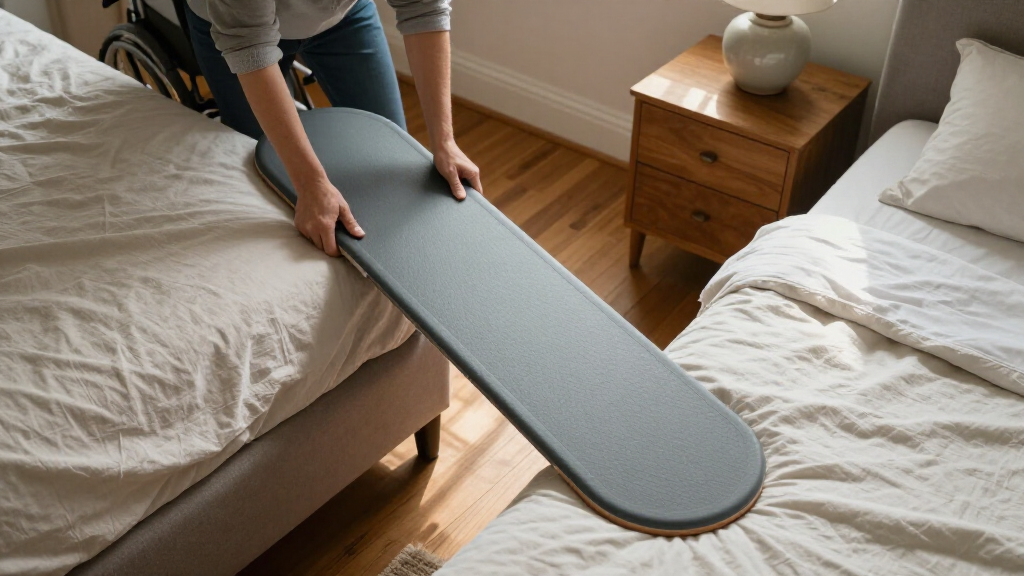
How We Picked
I ranked these boards by how clearly their listed specifications address bariatric transfer needs: stated weight capacity, usable dimensions, handles, and suitability for common transfer routes. A high load rating matters, but it does not replace checking that the full setup—user, clothing, and any carried items—stays within the manufacturer’s limit. I also gave weight to information that helps a buyer judge fit, such as board length and width, while treating missing capacity or construction details as uncertainty rather than an implied advantage.
The order favors options with a useful combination of a stated capacity and transfer-oriented dimensions, then separates boards that appear better for particular fit or use needs. The Sammons Preston board ranks first for its 35-inch length, handles, and stated 600-pound capacity; the DMI 32-inch board is a strong alternative for buyers prioritizing its listed 735-pound limit. Products with narrower footprints, lower stated limits, fewer listed details, or overlapping listings rank lower—not because they cannot work, but because buyers have less information or a more specific fit to verify.
| transfer board sliding bariatric | Surface |
|---|---|
| Wood Slide Transfer Board with | Smooth, polished |
| Vive Transfer Board | — |
| Pinewood Transfer Board | — |
| Transfer Board and Slide Sheet | — |
| DMI Heavy-Duty Transfer and Sl | Sealed and coated |
| Transfer Board and Slide Board | — |
| Rubberwood Transfer Board for | Smooth |
| DMI Heavy-Duty Transfer and Sl | Sealed, glossy finish |
| DMI Transfer Board and Slide B | Smooth, sealed |
| Vive Transfer Board | — |
| Transfer Board Patient Slide A | — |
| DMI Heavy-Duty Wooden Transfer | Smooth, sealed |
| Wood Slide Transfer Board with | Smooth, sealed |
| Heavy-Duty Wooden Transfer & S | Polished and sealed |
| Sammons Preston Bariatric Tran | — |
Factors to Consider When Choosing Transfer Board Sliding Bariatric
My comparison points to a common mistake: choosing by the word “bariatric” or by load rating alone. A board has to match the person, the transfer surfaces, the caregiver plan, and the available space. Use these checks to narrow the field before treating a listed capacity or dimension as a complete answer.
Match the Capacity to the Whole Setup
Start with the manufacturer’s stated capacity and compare it with the user’s weight, following the product’s instructions rather than relying on a general safety margin. A higher listed limit, such as the DMI 32-inch model’s 735 pounds, does not automatically make a board the right fit if its dimensions or transfer method do not suit the user. Check whether the stated rating applies to the board as sold and whether accessories or a particular setup change its use. Do not infer an unlisted capacity from material, thickness, or another model from the same brand. If the capacity is absent or unclear, ask the seller or manufacturer before purchase. When a clinician or therapist has set transfer requirements, use those requirements to rule options in or out.
Choose Length and Width for the Transfer Route
Length and width solve different problems: length affects how far the board must span, while width affects the available support surface. Measure the gap between the two surfaces and account for their height and position; a board that is too short may not provide the needed overlap. Then check the space around the wheelchair, bed, toilet, or vehicle, since added board length can make positioning harder in tight rooms. Wider models, including the listed 30-by-12-inch board, may offer more lateral room, but can be harder to position beside some seats. Do not assume the largest dimensions are automatically safest or easiest. Compare the actual measurements with the transfer plan and the person’s ability to reposition.
Treat Handles as a Positioning Feature, Not a Capacity Cue
Handles can make carrying, retrieving, and repositioning a board easier, but their presence does not establish how the user should hold or load the board during a transfer. Check where the cutouts sit and whether they leave enough uninterrupted surface for the planned placement. A handle can also become an edge or pressure point if the board is positioned poorly, so follow the manufacturer’s directions. Boards without a clearly listed handle design may still suit a setup, but provide less information for caregivers who need to move the board between locations. Before ordering, consider who will carry it, where it will be stored, and whether the grip openings are practical for that caregiver. Keep the transfer technique within the guidance of a qualified clinician.
Check Surface, Finish, and Cleaning Instructions
Wood boards can differ in finish, edge smoothness, and resistance to moisture, yet those details are not consistently stated in the product titles here. Ask how the surface should be cleaned and dried, especially if the board will be used near a bathroom or shared by multiple people. A smooth surface may help sliding, but it can also affect control; the user’s clothing, transfer technique, and placement all matter. Do not apply coatings or cleaners unless the manufacturer permits them, since changes may affect the surface or care instructions. Inspect the board regularly for splinters, cracks, damage around handle cutouts, or other defects. When routine sanitation is a priority, prefer a product with clear care directions over one whose finish is unspecified.
Match the Board to the Person’s Transfer Ability
A transfer board is not a substitute for a transfer plan, and the same board may suit one wheelchair user but not another. Consider sitting balance, upper-body strength, ability to follow instructions, pain, and whether a caregiver will assist. The board’s length, grip points, and placement should work with the person’s mobility equipment and the destination surface. A slide sheet bundled with a board, as in one listing, represents a different set of tools than a rigid board alone; verify when and how each component is intended to be used. Do not assume that a longer board or a higher capacity makes a transfer appropriate without guidance. If the person’s abilities or support needs have changed, ask a therapist or other qualified professional to review the setup.
Verify the Exact Model Before Ordering
This roundup includes similar-looking entries, including two Vive listings and several DMI boards with different dimensions and stated capacities. Compare the exact model name, length, width, thickness, handle configuration, and included accessories rather than relying on a shared brand label. Product titles may omit a capacity or other details, so check the manufacturer’s specification sheet and packaging information where available. Confirm that the board can be positioned around the chair arms, wheels, bed frame, or toilet seat in the intended location. Also check the return process in case measured fit differs from the listing. These steps reduce the risk of treating two distinct models—or duplicate-looking listings—as identical.
Frequently Asked Questions
Which board in this roundup has the highest stated weight capacity?
The DMI 32-by-10-inch heavy-duty board lists a capacity of 735 pounds, the highest stated figure among the products named here. The Sammons Preston 35-inch board lists 600 pounds and adds handles, making it a different choice for buyers who need a longer board with a clearly stated rating. A capacity figure alone does not confirm that a board will fit the user or transfer route. Check the exact model’s instructions and rating, then compare its dimensions with the planned setup. If the listing does not clearly confirm the capacity, contact the manufacturer before purchase.
Is a longer transfer board always better for a bariatric user?
No. Extra length can help span a larger gap, but it can also make positioning and storage more difficult, particularly in a crowded room or beside a vehicle. The 36-inch model is the longest listed here, while the Sammons Preston board combines 35 inches of length with a stated 600-pound capacity. Those measurements do not establish which board fits a specific transfer: overlap, surface height, chair position, and user ability all matter. Measure the route and check the equipment layout before choosing. A therapist can help confirm whether the board length supports the intended transfer method.
How should I compare two boards with the same stated capacity?
Compare more than the load limit: check length, width, thickness, handles, included accessories, care directions, and the transfer locations the manufacturer names. The DMI models rated to 440 pounds vary in size, so the same rating does not make them interchangeable. A narrower board may fit a tight space more readily, while a wider one may offer more surface but require more clearance. Verify the exact model because similar brand names can cover different specifications. Choose the one that matches the measured route and care plan, not simply the one with the most familiar listing.
Can I use one board for wheelchair-to-bed, toilet, and car transfers?
Some listings name several destinations, including beds, toilets, and cars, but that does not mean every setup is suitable for one board or one technique. Surface heights, gaps, seat shape, wheel and armrest clearance, and available caregiver space change from one route to another. Measure each intended transfer and check that the board can be placed securely without interfering with the equipment. Follow the manufacturer’s directions for each use and get professional guidance if the person needs assistance or has limited balance. If one route does not fit the board’s specifications, a separate transfer method or device may be needed.
What should I do if a product listing does not state its capacity or care instructions?
Do not assume the rating or cleaning method from a similar-looking board, another listing, or the material description. Ask the manufacturer or seller for the exact model’s load limit, approved cleaning instructions, and any restrictions on use. This is especially relevant here because some product titles omit a capacity, and several entries have similar names or overlapping features. If you cannot confirm the information, choosing a listing with clearly stated specifications is the more informed route. Keep the product documentation so caregivers can follow the same instructions.
Conclusion
For a strong all-around starting point, I’d choose the Sammons Preston 35-inch board when its stated 600-pound capacity and handle design match the user and transfer route. Buyers prioritizing the highest listed capacity should compare the DMI 32-inch, 735-pound model against its narrower 10-inch width and their available space. For a value-focused choice, I’d look at the DMI 440-pound models only after selecting the exact dimensions that fit; the product titles alone do not establish which offers the best value. Beginners should first seek a board with clearly stated specifications and ask a clinician to review fit and technique rather than choosing by size alone. For specific needs, compare the 36-inch board for added span, the 30-by-12-inch option for listed width, or a board paired with a slide sheet when the full transfer plan calls for both. Confirm capacity, dimensions, care instructions, and suitability before deciding.
Halloween Picks
halloween
As an affiliate, we earn on qualifying purchases.