
TL;DR

Get furniture and decor delivered free with Prime
- Fast, free delivery on millions of items
- Prime Video, Amazon Music and more included
- Member-only deals all year
House Beautiful’s report gathers seven paint approaches interior designers say can make a small room appear more spacious, from painting the ceiling to choosing colors with the room’s natural light in mind. These are design recommendations, not guarantees: how a paint color looks depends on the room, its lighting and the application.
House Beautiful has outlined seven paint techniques that interior designers say can make small rooms appear larger, including extending wall color onto the ceiling, using a single shade across multiple surfaces and testing paint under a room’s changing light. The recommendations focus on visual perception; they do not change a room’s actual dimensions, and results can vary by space.
The report quotes designers Joe Waroquier, founder and principal designer of Joe Waroquier Home, and Amber Guyton, founder of Blessed Little Bungalow, on how paint can affect the way people read a room. Guyton describes paint as a way to give the eye an impression of greater space. The article also quotes Jewel Marlowe, who recommends color-drenching: painting walls, trim, doors and ceiling in one color to soften the boundaries between surfaces.
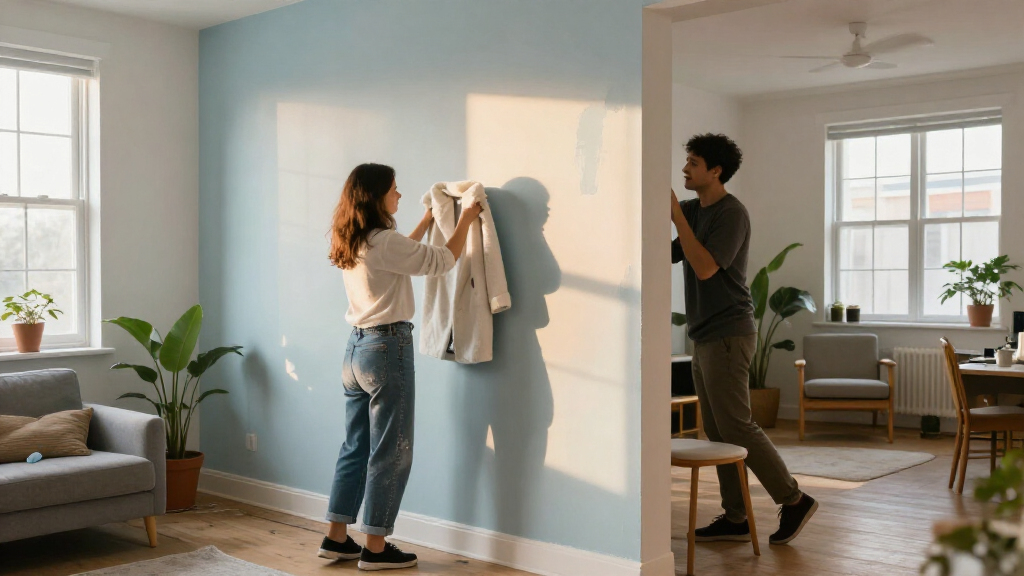
The seven approaches are to paint an accent wall; color-drench the room; consider a color’s undertones; paint the ceiling; divide the wall horizontally with paint or wainscoting; consider dark, saturated hues; and choose a color with the room’s natural light in mind. The article presents these as options rather than a formula that works in every room.
For people unsure about a full-room color change, Guyton recommends painting only part of a wall, roughly four to six feet high, or using wainscoting. Marlowe suggests adding contrast in finishes—for example, a wipeable matte finish on walls and a high-gloss finish on trim or cabinetry—while keeping the color consistent. Waroquier advises testing several large samples in the room at different times of day before choosing a shade.
How Paint Changes Room Perception
Paint is a relatively direct way to alter how a room’s boundaries and surfaces are perceived without changing its footprint. That can matter in powder rooms, bedrooms and other compact spaces, where a strong division between walls and ceiling, or a color that reads differently in dim light, may affect the overall impression.
The designers’ suggestions also offer different levels of commitment. An accent wall or a painted lower section can introduce color without covering every surface, while color-drenching makes a more unified visual statement. Dark hues are included as an option, challenging the familiar assumption that only pale paint can make a room feel larger. The report does not establish that one approach is universally more effective than another.
Products Worth Considering

Blueair Blue Pure 211i Max Smart Air Purifier for Large Rooms

Samsung 48-Inch S90H OLED 4K Smart TV (2026)

Ring Floodlight Cam 2K Wired Security Camera, 3-Pack, Black
As an affiliate, we earn on qualifying purchases.
The Seven Techniques in Practice
The report contrasts paint with familiar small-room strategies such as mirrors, reduced clutter and carefully selected decor, then focuses on how paint may affect visual perception. Waroquier says paint changes how people perceive a space, while Guyton describes the effect as an illusion that can make a room feel less bounded. These are designers’ explanations of the techniques, not measured findings in the supplied source.
Several recommendations concern the way surfaces meet. Color-drenching can make the borders between walls and ceiling less distinct, according to Marlowe. Continuing wall color onto the ceiling is another option; Guyton also suggests choosing a ceiling shade slightly lighter or darker than the walls for a monochromatic scheme. A half-painted wall, meanwhile, can add a band of color without carrying it to the ceiling.
Other recommendations focus on choosing and testing a shade. Waroquier cautions against judging paint only by whether it is light or dark, since undertones and changing natural light affect how a color reads. He says stark white can look flat or gray in a room with little daylight and recommends considering softer neutrals or more saturated colors. Testing large samples in the actual room gives homeowners a chance to see those changes before painting.
““Paint is a great way to make a small room feel larger because it changes the visual perception of the space.””
— Joe Waroquier, founder and principal designer of Joe Waroquier Home
Results Depend on the Room
The report does not provide measurements, controlled comparisons or evidence that any of the seven approaches reliably increases perceived room size for all viewers. The recommendations are designers’ professional opinions, and the source does not rank the techniques against one another. It is also unclear how particular paint colors will look in a specific home without seeing the room’s orientation, windows, existing finishes and lighting.
The article gives no universal paint brands, color codes or application specifications. Its advice to test samples reflects that uncertainty: undertones and daylight can change a shade’s appearance. Homeowners may also need to account for existing trim, cabinetry and surface condition when deciding whether a technique is practical.
Test Colors Before Painting
The next step for readers considering one of the techniques is to try large paint samples on the surfaces they plan to change and observe them at different times of day, following Waroquier’s advice. They can then decide whether to begin with a partial treatment, such as an accent wall or a painted lower section, or apply one color across the room.
The source material does not identify a follow-up study, product launch or other scheduled development. The outcome for any particular room remains dependent on its light, layout and chosen finishes.
Key Questions
What are the seven paint tricks in the report?
The report lists an accent wall, color-drenching, checking undertones, painting the ceiling, painting only part of a wall, considering dark hues and choosing colors based on natural light.
Does dark paint always make a small room feel smaller?
No. The designers quoted say saturated dark colors can blur a room’s edges and create a cocooning sense of depth. That is a design judgment, not a result guaranteed for every room.
What does color-drenching mean?
It means using one color on multiple surfaces—such as the walls, trim, doors and ceiling—to make the boundaries between them less distinct, according to designer Jewel Marlowe.
How should I test paint before choosing a color?
Joe Waroquier recommends testing several large samples in the room and checking them at different times of day, because natural light and undertones affect how paint appears.
Source: housebeautiful.com